Time flies with great content! Renew in to keep enjoying all our premium content.
Prime
Diageo, Vodafone exit and waning UK empire in Kenya
Atsushi Katsuki (left), President and CEO of Asahi Group Holdings, and Jane Karuku, EABL Group CEO and Managing Director, meet with EABL staff following the announcement of Asahi’s acquisition of Diageo PLC’s shares in EABL.
For decades, British companies sat in the front row in Kenya’s economy, straddling key sectors such as manufacturing, energy, agriculture, banking and finance.
Recent years have not been kind to the UK firms, with their grip on the Kenyan economy being loosened by new players from China, Japan, India, South Africa and Nigeria.

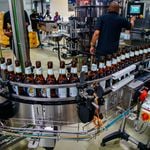
The latest example is last week’s announcement of a proposed sale by London-listed multinational Diageo Plc of its 65 percent majority ownership of East African Breweries (EABL) and a 53.68 percent holding in spirits producer and importer UDV Kenya to Japanese beverage maker Asahi Holdings for $3 billion (Sh386.8 billion).
This deal is only the latest in a series of exits from the Kenyan market by British companies, mirroring London’s reduced economic and diplomatic influence in Nairobi amid the steady fall in trade between the two countries.
Keen followers of Kenya’s economy say the UK’s softening dominance of profit repatriation from local public companies is in line with the former colonial master’s loss of government contracts in the past 20 years.
Britain has been one of the major casualties of Kenya’s dalliance with the Chinese that started under the administration of then President Mwai Kibaki in 2003.
This policy was continued during the Uhuru Kenyatta presidency, with China and Japan securing key contracts for the construction of the standard gauge railway and expansion of the port of Mombasa, for example.
The UK also saw Japanese and Chinese automakers take up key public sector contracts that were once the preserve of British firms, such as the supply of vehicles to security agencies.
“Made in England was replaced by Made in China. That was the natural decline of the Empire where the sun never set,” said Prof X.N Iraki, a University of Nairobi economics lecturer.
“These changes were best illustrated by the change from the Land Rover ceremonial presidential car that took the Head of State around the stadium during national celebrations— it is now a Toyota.”
Trade patterns also illustrate the falling clout of the British in the Kenyan economy.
In 2015, Britain enjoyed a trade surplus over Kenya, where it exported Sh42.97 billion worth of goods to Nairobi, while importing Sh40.7 billion.
A decade down the road, Kenya was the one enjoying a surplus, having exported goods worth Sh60.96 billion to the UK, while importing goods worth Sh44.76 billion.
In 1999, the UK was the largest exporter of goods to Kenya at Sh23.1 billion, with China shipping in a paltry Sh4.82 billion.
The tables have turned and China is the leader with shipments worth Sh576 billion last year, with the UK coming in at number 16 with Sh44.7 billion.
Britain now accounts for 1.65 percent of Kenya’s imports compared to 11.8 percent in 1999.
“With colonies gone and at liberty to trade and engage with anyone, the economic and soft power of Britain has declined. In Kenya, competitors have come in droves—Chinese, South Africans, Turkish and lately Nigerian,” added Prof Iraki.
For the British companies, the list of former household names whose presence in Kenya is now diminished cuts across key sectors, where they once enjoyed dominance and shipped billions in annual dividends out of the country.
Aside from Diageo, UK firms that have left the Kenyan market, reduced their footprint or been subject to takeovers include Barclays, Vodafone, security printer De La Rue, pharmaceutical firm GlaxoSmithKline (GSK), Tullow Oil, independent power producer Aggreko, Lipton Tea and fellow tea firm James Finlay.
After 104 years under the Barclays Bank of Kenya brand, the UK lender rebranded to Absa Kenya in 2020 after the South African subsidiary took over the African operations of its parent following a continent-wide restructuring.
Banknote printer De la Rue exited the Kenyan market in 2023 after suffering a decline in its currency and cheque printing business. The company was printing notes for Kenya at its Ruaraka plant through a local joint venture that was 40 percent owned by the Kenyan government, but it was discontinued after losing the cash printing contract.
The company, operating as De La Rue Kenya EPZ Limited, had about 300 employees. The government has since tapped German firm Giesecke+Devrient Currency Technology GmbH (G+D) to print a new series of banknotes on a five-year contract, which started last year.
GSK, on its part, restructured its Kenyan operation in 2022, moving from drug manufacturing in Nairobi to a distributor-led model where it supplies its products in the country through a third party.
It, however, kept the Nairobi plant open under its standalone affiliate Haleon, a consumer healthcare business.
Tullow Oil, which discovered Kenya’s oil deposits in Turkana in 2012, this year completed the sale of its Kenyan operation to Auron Energy, an affiliate of Kenyan firm Gulf Energy in a deal worth Sh15 billion.
Meanwhile, Sri Lanka-based Browns Investments Plc acquired the Kenyan tea estates business James Finlay Kenya from UK multinational Finlays in November 2023 for an estimated Sh3 billion.
The Asian tea company, through an affiliate known as B Commodities, followed up with an acquisition of Lipton Tea’s Kenyan assets, which include a 54.9 percent stake in the Nairobi Securities Exchange (NSE)-listed Limuru Tea.
Before the Diageo deal was announced, the largest British-linked transaction at the NSE was Vodafone Plc’s sale of a 35 percent stake in Safaricom to its South African subsidiary Vodacom Group for €2.4 billion (Sh360 billion at today’s rate) in 2017.
Vodafone is now selling the five percent stake, which it had retained in the Kenyan telecoms operator to Vodacom for $500 million (Sh64.5 billion).
A decade ago, the NSE had about a dozen companies with majority British ownership, allowing these firms to claim the lion’s share of the dividends paid out by these firms.
They also happened to be some of the largest and most profitable companies at the Nairobi bourse—the likes of Safaricom, EABL, Barclays Bank (now Absa Bank Kenya), BAT Kenya, Equity Group and Standard Chartered Bank Kenya.
Others were plantation firms Kakuzi, Limuru Tea, Williamson Tea and its associate Kapchorua Tea, and Rea Vipingo, which delisted from the bourse in September 2018.
The majority of British owners of these companies claimed dividends worth Sh24.5 billion in 2015, which was more than half of the total payout of Sh45 billion the companies distributed at the time.
Today, there are seven listed firms in Kenya with a directly held British majority ownership, comprising the agriculture firms, BAT, WPP Scangroup, Stanchart and EABL, soon to drop to six once Diageo completes its exit.
Last year, the seven companies paid out Sh29.2 billion in cumulative dividends, out of which Sh20.1 billion was taken up by the UK-based owners.
Standard Chartered Plc took the bulk of the dividends at Sh12.56 billion from its 73.9 percent holding in the Kenyan bank, which paid out a total dividend of Sh17 billion or Sh45 per share last year.
Diageo earned Sh4.1 billion for the year ending June 2025, being 65 percent of EABL’s total distribution of Sh6.33 billion at a rate of Sh8 per share for the period. BAT was the other large earner from its 60 percent holding in BAT Kenya, grossing Sh3 billion out of the Sh5 billion the firm paid out in 2024 at a rate of Sh50 per share.