On this day, he was not the man who had served as MP, Cabinet minister and Prime Minister. He was not the man who had run for President five times.
He was just the East African Spectre director, who happened to love the factory more than the boardroom.
Raila Odinga, who in 1971 sold his Opel to get capital to found East African Spectre, sat down with the firm’s general manager, Hudson Chitala, last month to discuss how to further improve operations.
Mr Odinga chaired a meeting with guests and his senior managers and, as had become the norm, pulled Mr Chitala aside for a chat on the company, the Nairobi-based LPG cylinder manufacturer.
On Wednesday, Mr Chitala and the more than other 150 staffers strolled into work with rumours of their boss’s health hanging in the air. The senior managers opted to dash to the Odinga home in Karen, Nairobi where the sad news was confirmed.
By the time they returned to the office, staff were seemingly already aware and overburdened by the news.
“We found the staff were unable to work, so we just told them to go home,” Mr Chitala told the Business Daily in an interview in the East African Spectre boardroom on Thursday.
In Mr Odinga’s office on the first floor of the building lies a pink candle, lit by the managers in honour of the man who often spoke of using manufacturing to resolve Kenya’s problems.
Former Prime Minister Raila Odinga's office at East Africa Spectre Limited in Industrial Area, Nairobi, on October 16, 2025.
Photo credit: Bonface Bogita | Nation Media Group
Mr Chitala hopes that when staff return to the plant on Tuesday, two days after Mr Odinga’s burial, they will be emotionally and psychologically stable enough to resume operations.
For now, the silence, which is usually overpowered by the chugging and buzzing of heavy machinery and staff chatter, is palpable.
Mr Odinga’s passing throws fresh attention on a low-profile business empire.
Behind the rallies and reform drives was a set of commercial interests built systematically over decades and anchored around energy, manufacturing and family-run holding structures, which housed multi-million shilling real estate.
At the centre sits Be Energy, an oil-marketing company whose Kenyan unit counts the Odinga family as a significant shareholder.
East African Spectre is a second pillar, with vast real assets and land being the icing on the portfolio.
A look inside Raila Odinga’s office at East African Spectre
Odinga is best known as a political animal, but he first cut his teeth in business, helping his family run a bus company in Nyanza.
From early on, he built a clear moat between commerce and politics, a discipline that would later define his public life. Around the time he struck a truce with President William Ruto amid anti-tax protests, the Odinga family quietly opened a larger branch near the Industrial and Commercial Development Corporation (ICDC), underscoring the parallel track on which his businesses run.
He was among the first Kenyans to venture into gas-cylinder manufacturing, inspired by the extensive use of firewood and makaa (charcoal) in the country then. Yet there was a political angle to his business ambitions.
“Given his background in training, he has only looked at manufacturing as a way of solving Kenyans’ problems,” said Mr Chitala.
Together with his father, the late Jaramogi Oginga Odinga, he founded East African Spectre.
Ruth Okwiri, an accountant who has worked at East African Spectre for 36 years, said that the plant was initially based at the Kenya Industrial Estate and churned out about 30 cylinders a month.
The enterprise quickly hit a structural gap: Kenya had no local safety standards for pressure vessels. Early clients such as Shell and BP sent cylinders to London’s Atomic Energy establishment for testing because local certification did not exist.
Only after those tests did the oil marketing companies allow full production. Even inspection logistics were shaky; cylinders were sent to Lloyd’s for certification. Mr Odinga spotted an opportunity.
He pushed to establish Kenyan standards and monitoring for cylinders and played a role in setting up the Kenya Bureau of Standards to oversee them. He later served as a senior manager at the standards body.
Mr Odinga’s ability to juggle politics and business became a hallmark. Even while serving as Prime Minister, he came to the factory to discuss technical issues, said Mr Chitala.
He reckoned that, unlike many directors, he preferred the shopfloor to the boardroom, a hands-on habit that kept him close to manufacturing realities.
“When he comes here, the first thing he does is to go to the factory,” said Mr Chitala, noting that he would visit the Mombasa Road-based factory twice a month.
Alongside East African Spectre, the family’s business interests included Spectre International, which has since ceased operations, and several properties.
The former Prime Minister has never publicly declared a personal net worth, but in an earlier interview he suggested the Odinga family’s wealth is a conservative Sh2 billion amid estimations it could be larger.
Much like his political life, Odinga’s net worth remains an enigma in death, just as it was in life
His formative years in East Germany, then in the communist sphere, fuelled periodic claims that he harboured Marxist leanings.
Those fears peaked on the campaign trail in 2007 when he described the Nairobi Securities Exchange (NSE) as a den of insider trading and money laundering. The remark spooked investors and triggered a sell-off, with exchange officials warning that billions in paper wealth were evaporating daily. Mr Odinga moved quickly to visit the bourse and calm sentiment.
“Investors want to know: are you a communist, a socialist or a capitalist?” then NSE vice-chair James Wangunyu asked.
Mr Odinga’s answer was pragmatic: he had lived through the inefficiencies of communism in East Germany, which practised the ideology until the 1989 fall of the Berlin Wall. In later years, he has styled himself as a social democrat—market-friendly but keen to fight inequality and abuse of market power.
He said that devolution was about equitable use of resources through greater access, saying the laissez-faire economic model – which allows unmitigated operation of market forces – had led to a situation of “everyone for himself and God for us all.”
The arc back to business predates the politics. Returning to Kenya in 1970, Mr Odinga set up as an entrepreneur before following his father into opposition politics.
The firm was initially Standard Processing Equipment Construction and Erection, but later rebranded to East Africa Spectre Limited.
Mr Odinga took a loan from the Kenya Industrial Estates to expand his company’s operations.
Mourners escort the remains of former prime minister Raila Amolo Odinga along Mombasa Road on October 16, 2025.
Photo credit: Bonface Bogita | Nation Media Group
The estate of Jaramogi Oginga Odinga owns 262,500 shares in East Africa Spectre.
The former Prime Minister owns 90,000 shares. His brother, Oburu Oginga, owns 60,000 shares.
His spouse, Ida Odinga, owns 50,000 shares.
Israel Otieno Agina, the man who spent two years in detention for alleged sedition against former President Daniel Arap Moi, owns 30,000 shares.
The family of Argwings Kodhek, the first black lawyer in East Africa, owns 5,000 shares.
The family of former National Oil Corporation of Kenya director Ngesa Okolo holds 2,500 shares.
Mr Odinga, his wife Ida, and brother Oburu all have offices at the East African Spectre plant.
Just 5.2 kilometres from the Mombasa road plant lies the memories of another firm Mr Odinga set up, but for which fate had a different ending scripted.
Spectre International ceased operations in 2017, leaving behind a trail of debt to multiple creditors, including staff who negotiated a Sh44 million pay deal after suing in the same year.
Spectre International was incorporated in 1989, and six years later bid Sh570 million for the assets of the Kenya Chemical and Food Corporation (KCFC).
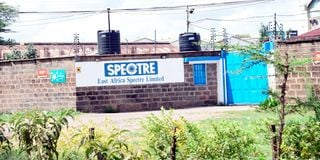
East Africa Spectre plant in Industrial Area in Nairobi.
Photo credit: Evans Habil | Nation Media Group
Former President Jomo Kenyatta had created the KCFC in 1977 to produce power alcohol.
In 2000, Mr Odinga and President Daniel Arap Moi formed a political pact, which saw the former appointed Energy minister a year later.
Around the same time, KCB’s receiver manager reached an agreement to sell the 240-acre land hosting the molasses plant to Spectre International for Sh3.6 million.
Be Energy, a petroleum dealer, has had better luck in business than could have wiped the tears brought by Spectre International’s loss-making end.
In 2020, Be Energy controlled 2.4 per cent of the market share. By 2022 the firm was controlling 3.1 percent of the oil market. In the 2024/25 financial year, that control grew to 3.52 per cent after selling 205,369 cubic metres of petroleum products.
Energy and Petroleum Regulatory Authority (Epra) disclosures indicate that it is currently the fifth biggest oil marketer in Kenya only behind the big four multinationals – Vivo Energy (Shell), Rubis Energy, TotalEnergies and Ola Energy.
Be Energy exports petrol, diesel, kerosene, jet fuel and oil lubricants to South Sudan, Uganda, Burundi, Rwanda and the Democratic Republic of Congo.
Mr Odinga and his family own 2,801 shares in Be Energy Limited through Pan African Petroleum Company Ltd.
The family of Saudi Arabian tycoon Sheikh Abdul Kader Al Bakri is the majority owner with 5,201 shares held through their International Energy World S.A.
Pan African Petroleum Company is owned by Raila Odinga Junior (25,000 shares), Rosemary Adhiambo Odinga (50,000 shares), Winnie Irmgard Odinga (25,000 shares), Elija Bonyo Oburu (125,000 shares), Wenwa Akinyi Oranga (25,000 shares) and Kango Enterprises (250,000 shares).
Kango Enterprises is wholly owned by Mr Odinga and his wife, Ida. They each have 100 shares in Kango Enterprises.
The former Prime Minister’s son, named after him, runs Be Energy’s Kenyan operations.