Factories run by the giant Kenya Tea Development Agency (KTDA) are soaked in Sh26 billion debt following a borrowing spree that flouted financial guidelines, an audit by the tea industry regulator has revealed.
The audit by the Tea Board of Kenya (TBK) flags several blunders, including KTDA sanctioning inter-factory loans at the headquarters and over-valuing assets to get bigger loans, while factory managers took loans not approved or beyond the limits approved by their respective boards of directors.
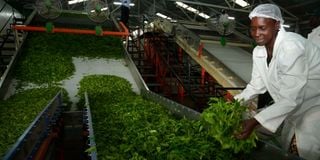
The blunders left KTDA-managed factories with a combined Sh26.06 billion debt by June 2025, with processors located in the Rift Valley and Western Kenya holding more than three-quarters of the loans, TBK says.
The regulator audited KTDA-managed factories to evaluate their financial sustainability and address challenges facing the sector, following a directive by the Ministry of Agriculture last month.
In a presentation to a committee of Parliament, TBK says it analysed amounts borrowed by factories, utilisation of the loan proceeds, and loan balances for factories.
The regulator found that of the Sh26.06 billion loans by the end of June, factories located West of the Rift (WoR) owed Sh21.61 billion while those in the East of the Rift (EoR) owed Sh4.45 billion.
“From the audit on loans, TBK established that there were no Board resolutions approving the lending/borrowing from/to factories, as these arrangements are done at the KTDA head office,” TBK says about inter-factory loans.
KTDA factories have loaned each other to the tune of Sh10.36 billion, but there lacks a policy guideline on inter-factory financing, which has led to arbitrariness in issuance and repayment of such loans, the Board observes.
“Several factories are experiencing cash flow constraints, which have hindered their ability to repay inter-factory loans within the stipulated one-year period,” it adds in its report to the Departmental Committee on Agriculture and Livestock.
Last month, KTDA phased out the decades-long inter-factory loan programme in favour of factories borrowing from commercial banks and revealed that WoR factories had borrowed more from EoR factories.
KTDA’s East Block factories are located in Kiambu, Murang’a, Nyeri, Kirinyaga, Embu, and Meru counties.
The West Block, on the other hand, includes factories in Kericho, Bomet, Nyamira, Kisii, Nandi, Vihiga, and Trans Nzoia counties.
KTDA manages 71 tea factories with an estimated 700,000 smallholder farmers across the country, and TBK regulates the tea industry on behalf of the government.
The Board also analysed Sh12.8 billion worth of commodity loans, finding that they were used to finance operations and not to pay bonuses released in October 2024, as earlier indicated.
It said KTDA lacks details on specific factories that benefited from the Sh12.8 billion ($99.7 million) commodity loans, which were procured against expected incomes for the period running from July 2024.
“Closing stocks as at 30th June 2024, which KTDA-MS used as a guarantee for the commodity loans to finance the second payment in October 2024, were overvalued, especially for the factories in the WoR,” TBK said.
The audit also found that some factories lacked board resolutions sanctioning the loans for use in paying bonuses, raising concerns about whether they had asked for the money or the decision was made in the boardroom in Nairobi.
Holes poked in the borrowing of some Sh2.59 billion through asset-based financing included cases where several factories borrowed amounts exceeding board-approved limits and over-quoting of equipment prices.
“Equipment supplied to factories like Kambaa and Sanganyi was significantly more expensive than similar units supplied in other factories,” the audit says.
The audit further faults some factories for stating that they were borrowing to finance projects, only to use the cash on unrelated issues.
Kebirigo, Ragati, and Chinga factories borrowed Sh300.17 million under project financing that would ideally go to capital-intensive uses, such as withering expansions, acquisition of automatic withering machines, and installation of orthodox lines, but they “spent the money on other items”.
On fertiliser financing, TBK established that the government owes KTDA Sh4.67 billion, being a subsidy refund for the importation of fertilizer between July 2021 and June 2023.
The Board now wants KTDA to provide details on the latest loan balances by its factories, and warns against borrowing to pay tea bonuses at the end of the year.
“Going forward, the second payment of green leaf should be based on actual performance and funds available rather than borrowings and overstated stock valuation to show higher performance,” it says.
TBK has also recommended that a forensic audit on loans borrowed by KTDA on behalf of its factories since July 2021 be undertaken, to give tea farmers confidence in the probity of the loans.
It also wants KTDA to implement a retention policy immediately to address cash flow challenges facing its factories and has further called for physical verification of assets acquired through the loans, to verify utilisation of the loan proceeds and value for money.
Tea farmers WoR have been hit by successive runs of lower earnings, with this year likely to be no exception amid subdued demand for their produce at the auction in Mombasa.
Data from the regional auction showed that tea grown in zones WoR fetched an average Sh226.17 a kilo over the nine months to September 2025, compared to Sh270.11 in a similar period of last year, translating to a Sh43.94 drop or 16.26 percent.
The main WoR tea-growing zones in Kenya include Kisii, Kericho, Nandi, and Nyamira counties.
Comparatively, tea grown in EoR fetched Sh379.96 a kilo at the auction in the nine months to September 2025, down from Sh387.72 realised in a similar period, marking a drop of Sh7.76 a kilo or two percent.
The EoR main tea growing zones include Kiambu, Murang’a, Nyeri, Kirinyaga, Meru, and Embu counties.