Time flies with great content! Renew in to keep enjoying all our premium content.
Prime
Mobile phone firms swap dealers in new market wars
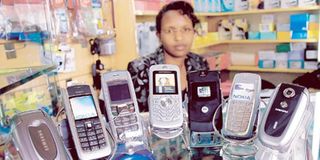
A mobile phone shop. Operators have been using different incentives to woo and keep dealers in their stable. Photo/FILE
Mobicom, one of Kenya’s largest and most seasoned telecom dealers, has ended its contract with market leader Safaricom as the battle for control of the mobile phone market takes a new shape with the expected entry of India’s Bharti Airtel.
The firm, estimated to control nearly 10 per cent of Safaricom’s dealership revenue, ended the nine-year contract last Tuesday and will instead market the services of rival Zain.
Key players
Safaricom’s 400 dealers handled more than Sh5 billion worth of business per month by September last year – excluding the M-Pesa business estimated to have been worth more than Sh10 billion per month.
Together with the sale of the wireless internet modems, laptops and phones, the monthly business turnover handled by the dealers stands at more than Sh20 billion a month, making them key players in the telecoms market.
At Zain, Mobicom becomes the 86th dealer for Kenya’s second largest telecoms operator by subscriber base.
Winning Mobicom – one of the few dealers with a national footprint — to its side offers Zain a much larger sales platform to spread its footprint and increase visibility in the marketplace.
Rene Meza, Zain Kenya’s managing director, said the company has been talking to Mobicom and other established dealers for partnerships to help strengthen its distribution network but had sealed no deal by last Friday.
“Our new strategy is to focus on rural areas and dealers are key pillars to the achievement of such a goal,” said Mr Meza, adding: “We have been talking to a number of established dealers including Mobicom as they have the experience and the financial capability to take our products down to the subscribers.”
Bharti, the new owners of Zain, have recently announced plans to spend part of the $150 million they intend to invest in Kenya on shoring up their distribution network and improving quality.
Safaricom chief executive Michael Joseph confirmed that Mobicom had terminated their contract with the firm but declined to comment further.
“I do not wish to comment on this until I understand the reasons behind the move,” said Mr Joseph, who will be retiring as Safaricom’s chief executive in November.
A wide dealership network that offers its subscribers access to the company’s products such as airtime and M-Pesa has been one of the key pillars of Safaricom’s market leadership with 78 per cent of the voice market.
Safaricom has 500 dealers compared to Zain’s 85 for 10.4 per cent of the voice market, Telkom Kenya’s 56 for 5.6 per cent and Essar’s Yu with 20 for 5.6 per cent.
The operators have been using different incentives to woo and keep the dealers in their stable.
Other than earning commissions for every SIM card sold, the dealers are also paid a residual percentage of the total spend by a subscriber on the line or number.
All the three operators apart from Essar’s Yu pay their dealers 10 per cent of the airtime spent by a subscriber during the lifetime of the SIM card in residual commissions.
Commissions paid for airtime sales vary among the operators and the information is public.
Telkom Kenya has recently announced a change in dealership plan, trimming the number from 300 to 56.
The telecom firm requires the dealers to have Sh5 million in working capital, open four branded shops and a network of eight direct agents who can transact business worth Sh20 million per month.
Mickael Ghossein, the company’s chief executive, says reorganisation of the dealers should enable Telkom to double its second quarter revenue.
Telkom earned Sh2.3 billion in revenues in the first quarter of the year, down from sh2.7 billion in the same period last year.
Mr Ghossein said the revenue growth projection is supported by the ongoing proactive enhancement of Telkom’s GSM and wireless coverage as well as diversification of product and service offerings to customers.
“I have signed a deal with Ericsson for enhancement of our GSM network. This should guarantee our customers’ unmatched quality of voice and data services as we mark our second year in Kenya,” he said.
“Customers will soon be able to sign up for post-paid and SIM swap services from our preferred partners countrywide,” Mr Ghossein said during a meeting with the 56 dealers.
Telkom has announced plans to launch its money transfer service Orange Money in Kenya as well as its 3G services in the fourth quarter of the year.
Mr Ghossein says the twin plans should help boost revenue growth for dealers while offering backward and forward linkages to individual and corporate customers.
Orange is also planning to boost its wireless services by introducing trendy and versatile CDMA handsets that will enable customers access the internet, email and other services that are currently only available to customers on the GSM platform.
Telkom Kenya plans to invest between Sh10 billion and Sh12 billion on its network, concentrating investments on building its mobile data network, CDMA and its fixed line segment.
Unlock a world of exclusive content today!Unlock a world of exclusive content today!