Time flies with great content! Renew in to keep enjoying all our premium content.
Prime
New crop is fodder for dairy sector’s growth
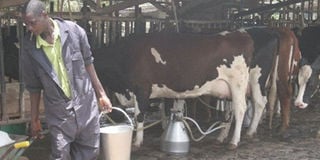
A dairy farmer milks on his farm in Central Kenya. Poor rains and rising food prices have pushed up cattle-feed costs. Photo/FILE
Mr Peter Kangaru, 46, runs a seven-acre farm in Naivasha where he grows a fodder crop—lucerne — for sale.
Kangaru started to grow the crop in January, this year.
He previously grew maize on a two-acre plot .
He switched from maize to lucerne farming to cash in on growing demand for fodder crops in his area. But the supply was minimal.
“There are many farmers in my area who keep dairy livestock and have been buying fodder crops from brokers who set up a small market twice a week to sell the crops and other animal feeds and supplements,” says Mr Kangaru.
The current drought and the increasing prices of processed animal feeds have seen the fodder crop sub-sector start to mushroom in the dairy industry belt.
Kangaru says middle-men started selling fodder crops early this year mainly as a result of drought. This was after prices of cattle feed increased.
“Initially, most brokers sold animal supplements and cattle feeds like Dairy Meal and napier grass. But prices for some cattle feeds gradually increased, pushing farmers to seek more affordable feeds,” he says.
A spot check by the Business Daily in wholesale stores that sell animal feeds indicated that prices had gone up by approximately 20 per cent since January, this year.
At Belfast Millers Limited in Industrial Area, a 70 kilogramme bag of Dairy Feeds that currently retails at Sh1, 350 sold at Sh1, 250 in January, this year.
A 70 kilogramme bag of Super Dairy Meal, which retails at Sh1, 500, retailed at Sh1, 400 and a 70 kilogramme bag of Ranch Cubes, which retails Sh1, 500, was selling at Sh1, 400 in January.
“Demand for cattle feed has gone up by approximately 70 per cent since the beginning of the year—but the biggest challenge lies in the supply which does not match demand,” said Mr Rajesh Shah, a director at Belfast Millers.
Mr Shah says most animal feed millers buy raw materials for cattle feed from maize and wheat dealers whose prices have also gone up due to the drought.
“We are currently getting less raw materials which has affected our production hence the failure to meet growing demand,” said Mr Shah, adding that their production has decreased by about 10 per cent.
Fodder farming does not require a lot of manpower and can boost dairy and beef production as some farmers have found out.
“Most fodder crops grow well in warm areas and the crops need watering three times a day. I have adopted sprinkle irrigation,” says Kangaru who pumps water from a borehole.
According to players in the industry, fodder farming should be the way to go because there always will be demand. by cattle farmers.
“For a long time, Kenya has relied on rain fed agriculture and that is why the current drought has greatly affected us. Farmers need to be trained on fodder farming and animal feed storage,” said Mr Machira Gichohi, the managing director at Kenya Dairy Board (KDB).
Fodder farming heavily relies on the dairy sector growth as Mr Gichohi explains.
For fodder farming to prosper, it means that the dairy sector should perform well.
Data provided by KDB indicates that by the end of this year, the dairy sector might report approximately 20 per cent because of the drought.
Mr Gichohi says the losses could have been avoided if farmers grew fodder crops and learned storage methods.
Product development
The data indicates that between 2003 and 2008, milk intake in Kenya has been rising at an estimated 80 per cent.
This growth was attributed to milk awareness campaigns and product development.
KDB has been training farmers on cattle -rearing which includes fodder farming to attract more growers.
Manera Farm in Naivasha which is owned by the Delamere Estates—has been practising fodder farming to feed its cattle but the farm recently started selling fodder.
“We noticed that there was a growing demand for animal feed and decided to sell some our crop,” said Mr William Rotich, the farm manager.
Manera Farm grows lucerne under irrigation on 313 acres of land. In a good harvest, the farm produces between 20, 000 and 25, 000 bales which they sell at Sh350 each.
Mr Kangaru started growing lucerne on two acres but after the first harvest, he increased the acreage to four as demand rose.
“I harvested 30 bales of lucerne in my first harvest in May and I sold each at Sh250. The returns were encouraging considering that the cost of production was manageable,” he says.
In September, Kangaru harvested his second batch of lucerne containing 65 bales . He sold each bale at Sh350. After deducting his expenses, he made a profit of Sh15, 000.
Affordable sources
The farmer said over the last three months, prices for fodder crops have escalated mainly because of increased cost of production , especially water costs.
But he maintains that fodder crops are still affordable sources of proteins compared to other source of proteins whose prices range between Sh1, 000 and Sh1, 300.
A bale of lucerne that weighs about 30 kilos can feed approximately five cows twice a day but it has to be mixed with either Dairy Meal or Super Dairy Meal to balance the nutrients level.
“Fodder can not be fed alone—it is very rich in proteins and it has to be mixed with grains to balance the nutrient level, he says.
These means that a farmer feeding his cows on fodder and grain would approximately spend Sh12, 100 a month.
This includes Sh9, 800 a month for 21 bales of lucerne and one bag of 70 Kg dairy meal retailing at Sh1, 500.
As of 2008 milk production in Kenya grew to four billion litres from 3.8 billion litres reported in 2007.
“Milk consumption has over the years been increasing- this means that there is a market for milk and indication that fodder farming is sustainable in the country,” said Mr Gichohi.
Unlock a world of exclusive content today!Unlock a world of exclusive content today!