Six men falsely charged in Equity Bank robbery walk away with Sh1.1m each

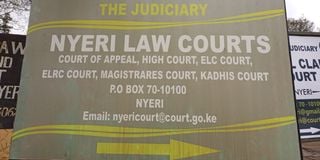
Nyeri Law Court signage

The signage of the Nyeri Law Courts in Nyeri town on September 8, 2022. High Court judge says the practice of arresting young men first and later deciding what charges to impose is not only barbaric but warrants judicial condemnation.

Photo credit: Mercy Mwende I Nation Media Group

The High Court has upheld a compensation award to six individuals wrongly accused of involvement in a Sh30 million robbery at Equity Bank, ruling that police and prosecutors acted without evidence and violated their constitutional rights.

The court dismissed an appeal by the Attorney General and the Inspector-General of Police, affirming an award of Sh1.1 million to each claimant for unlawful arrest, detention and malicious prosecution. The total payout amounts to Sh6.6 million.
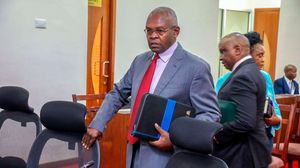
The beneficiaries include an IT expert, casual workers linked to his office, a businessman and university students.

The case arose from an early morning robbery in October 2015 at Equity Bank’s Othaya branch, where Sh30 million was reported stolen after robbers, posing as auditors from the lender’s head office, gained access to the bank and escaped with the cash.

Police detectives arrested several suspects, including the IT specialist and individuals associated with his workplace.

They were charged before the Othaya Magistrate’s Court and detained — some for several days — before being released on bond, which some were unable to raise immediately.

One university student testified that he was detained for days and admitted to a Sh3 million bond he could not afford, forcing him to remain in remand custody. He told the court that the detention cost him a scholarship and a job opportunity.

Another claimant was arrested while visiting a relative who was already in police custody.

The criminal case collapsed in August 2016 after the trial court acquitted the accused under Section 210 of the Criminal Procedure Code, citing insufficient evidence.

Prosecutors conceded that there was no evidence linking the men to the robbery and acknowledged that investigations had been flawed.

Following their acquittal, the six sued the State for damages, arguing that they had been arrested, detained and prosecuted without reasonable or probable cause.

They said they were subjected to psychological torture during their unlawful detention, suffered trauma and humiliation, and that their constitutional rights were violated.

In 2018, the Othaya Magistrate’s Court awarded each claimant Sh1.1 million in damages, prompting the State to appeal on grounds that the arrests were justified and the compensation excessive.

The High Court rejected those arguments, noting that the prosecution failed to call witnesses to rebut the respondents’ evidence.

“The State filed charges routinely, not to uphold justice,” the judge said, describing the arrests as baseless.

He criticised investigators for indiscriminately detaining individuals, including visitors checking on suspects, terming the conduct reckless and malicious.

“The practice of arresting young men first and later deciding what charges to impose is not only barbaric but warrants judicial condemnation,” the judge said.

The court found that all elements of malicious prosecution had been established, noting that the State initiated proceedings without justification, the case ended in the accused’s favour, and malice was evident in the investigators’ conduct.

The judge emphasised that probable cause “cannot exist where the State admits there was no evidence”.

While acknowledging that inflation and the seriousness of the robbery-with-violence charge could have justified higher damages, the court declined to vary the award due to the absence of a cross-appeal.

Follow ourWhatsApp channel for the latest business and markets updates.

PAYE Tax Calculator

Note: The results are not exact but very close to the actual.