Time flies with great content! Renew in to keep enjoying all our premium content.
Prime
Treasury says no immediate plan to sell 25.3pc stake in East African Portland Cement
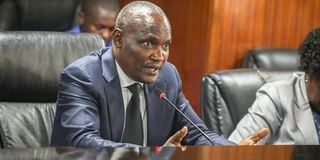
National Treasury and Economic Planning Cabinet Secretary John Mbadi when he appeared before the National Assembly Public debt and Privatization Committee at the Continental House in Nairobi on November 28, 2024.
Treasury Cabinet Secretary John Mbadi says the government is reviewing its shareholding in several State-owned enterprises but has yet to decide whether to follow the National Social Security Fund (NSSF) in offloading its stake in East African Portland Cement (EAPC).
Mr Mbadi said the Treasury is assessing its investments in commercial State corporations to determine which ones are “mature enough” for privatisation.
However, he said no conclusion has been reached on Portland Cement.
“No, we haven’t,” he told the Business Daily on Friday when asked whether the Treasury intends to sell its stake in EAPC.
“We are reviewing all our stakes in the state-owned enterprises that we feel are mature for offloading. If Portland is mature enough to warrant that, then we will, but I cannot comment on that yet.”
NSSF and Treasury own 27 percent and 25.3 percent of Portland Cement, respectively. EAPC’s biggest shareholder, Kalahari Cement, is buying the pension fund’s stake in the company for Sh1.6 billion.
The purchase will give Kalahari’s owner, the Tanzanian tycoon Edhah Munif, effective control of EAPC, with an eventual stake of 68.7 percent.
Mr Munif currently holds a 41.7 percent stake in EAPC through Kalahari Cement (29.2 percent) and his wholly owned Bamburi Cement (12.5 percent).
Already, President William Ruto has passed the Government Owned Enterprises (GOE) Act, which guides the privatisation of State corporations, including the Kenya Pipeline Company (KPC).
Under the plan, the State seeks to encourage private investment and lessen the fiscal pressure from loss-making and non-performing government entities. It is targeting billions of shillings to reduce reliance on debt and address budget deficits.
“We are reviewing a number of them, including KenGen,” Mr Mbadi said, referencing the electricity generator, whose 70 percent stake the government owns.
“Leave alone for revenue raising; we feel we want to reduce our stake in commercially viable enterprises because of the advantages that come with privatisation, like improved efficiency and better governance structure.”
So far, Mr Mbadi’s ministry has signed a deal to offload a 15 percent stake in Safaricom to South Africa’s Vodacom Group for Sh204.3 billion or Sh34 per share.
The sale is expected to be completed in the first quarter of 2026 and will see the government's stake in the telco drop from the current 35 percent to 20 percent.
Treasury is leveraging future dividend entitlement on the residual stake to get more cash in the transaction.
The exchequer sold the right to receive future dividends of Sh55.7 billion to Vodacom at a price of Sh40.2 billion, thus surrendering Sh15.5 billion in future dividends from Safaricom.
Concurrently, Vodacom is also buying a five percent stake in Safaricom that is held by its parent firm, UK-based Vodafone Group, at the same price of Sh34 per share.
Once the two transactions are concluded, Vodacom will raise its ownership in the telco to 55 percent, giving it control after spending a total of Sh272.4 billion on the share purchases.
Mbadi has said the proceeds of the share sale will provide the seed capital for the proposed Infrastructure and Sovereign Wealth Funds, which will support projects in energy, roads, water and irrigation, and airports.
This includes the construction of 50 dams and an upgrade of the Jomo Kenyatta International Airport (JKIA) in Nairobi after the government last year cancelled a deal with India's Adani Group over its founder’s indictment in the United States.
MPs have also approved KPC’s privatisation, which will see the government retain not less than 35 percent shares while releasing not more than 65 percent of its ownership.
Treasury expects to raise approximately Sh100 billion from the initial public offering at the Nairobi Securities Exchange (NSE). The listing’s deadline is March 31, 2026.