A London-based court has ordered Kenyan businessman Paul Ndung'u to reimburse his co-shareholders and rivals in SportPesa Global Holdings Limited (SGHL) Sh374 million before January 9 after losing a legal bid to reinstate his 17 per cent stake in the firm.
The judge on December 10 blocked Mr Ndung’u from appealing against reimbursing legal costs pending the conclusion of the London legal fight, involving former partners who helped build the SportPesa brand in Kenya.
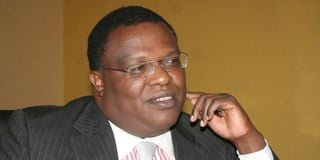
The London court has ordered Mr Ndung'u to pay SGHL £548,000 (Sh94.5 million) and his co-owners and directors of the firm £1.6 million (Sh275.9 million), totalling Sh374 million, before 4pm on January 9.
Mr Ndung'u had sued SGHL, which is affiliated to the Kenyan unit of SportPesa, and some of his co-directors after his shareholding was diluted to 0.85 percent between 2019 and 2022 in the wake of three rights issues totalling £1.9 million (Sh325.5 million).
The businessman, who is also fighting for control of the SportPesa brand in the Kenyan courts, claims that his fellow directors hatched a scheme through forgery and an equity fund-raising scheme to dilute his ownership.
He sought restoration of his original 17 percent stake, rectification of SGHL’s share register, damages for financial losses and wrongful dismissal as a director, as well as legal costs for the mega suit.
However, the London court on November 17 ruled against the restoration of his original 17 percent stake and offered the businessman damages for financial loss, citing a lack of evidence.
The court has also imposed interest on those legal costs of one percent per annum above the Bank of England base rate, which stands at four percent, between November 27 and January 9.
From January 9, the interest will increase to eight percent per annum above the Bank of England base rate, which could see the costs balloon to over half a billion shillings.
The SGHL in line for the multi-million shilling reimbursements include Bulgarians, Ivaylo Petev, Kalina Karadzhova and Guerassim Nikolov. American Gene Grand will also get millions of shillings if Mr Ndung'u fails to overturn the award.
“The consolidated claim be dismissed. The claimant to make an interim payment on account of the first defendant in respect of the costs in the amount of £548,000 by 4pm on 9 January 2026,” the judge ordered.
The claimant to make an interim payment on account of the second defendant to the sixth defendant in respect of the costs in the amount of £1,600,000 by 4pm on 9 January 2026," the judge added.
Mr Ndung’u’s opponents in the suit can seek enforcement of the awards in the UK and Kenyan courts amid the risks of property seizure and auction, escalating the fight for the SportPesa brand and firm between former partners and now turned rivals.
In the UK suit, Mr Ndungu sought restoration of his original 17 percent stake, rectification of SGHL's share register, damages for financial losses and wrongful dismissal as a director, as well as legal costs for the mega suit.
The London court ruled against offering the Kenyan businessman remedies, citing a lack of evidence that the SGHL directors and majority shareholders run the firm in a manner that harmed the interests of minority shareholders or Mr Ndung'u.
It also ruled that claims of forgery and falsification of board communications lacked evidence.
“More specifically, the claimant has failed to establish that there has been any conduct of the affairs of the Company, which has caused him to suffer prejudice, in his capacity as a member of the Company. The failure of the Claimant to establish unfairly prejudicial conduct means that the question of remedies does not arise,” said the judge in the November 18 judgement.
Under the UK law (Companies Act), unfair prejudice occurs when affairs of the company are run in a manner that harms the interests of minority shareholders, leading to share dilution, exclusion or breakdowns of trust.
The legal spat was triggered by the three rights issue that started on October 17, 2019, after Sportpesa, trading under Pevans, halted operations in Kenya in September 2019 due to a drastic hike in taxes on betting stakes.
Its closure, which also saw rival Betin Kenya end Kenya operations, triggered a financial crunch in SGHL, prompting the three cash calls of £500,000, £500,000 and £900,000 between October 2019 and December 2021 to keep the company solvent.
Kenya shareholders, Mr Ndung'u and Asenath Wacera, did not participate in the rights issue, leading to dilution of their stakes.
Mr Ndung’u’s stake dropped to 1.5 percent from 17 percent after failing to take up the first and second offers, while that of Ms Wacera dropped to 1.9 percent from 21 percent in SGBL, which owned non-Kenya SportPesa operations.
Meanwhile, the stakes of Bulgarian investor Nikolov rose from 21 percent to 46 percent while that of US shareholder, Mr Grand, increased from 29.88 percent to 21 percent, court records show.
This forced Mr Ndung'u to file a petition at the London court seeking restoration of his 17 percent stake.
He argued that the company board minutes showing approval of the first rights issue of £500,000 was falsified.
Mr Ndung'u reckoned that he was not informed of the October and November 2019 board meetings and that the notice of the first rights issue offer arrived after its expiry and at the wrong address, locking him out of the fundraiser.
The offer was sent via DHL to an address, which had not been specified by the businessman for the purpose of receiving communications from the Company, causing him to miss the deadline.
He received the letter past the deadline date for acceptance, and as a result, his shares reduced from 17 percent to 2.83 percent.
In the subsequent second and third capital raises, he was also willing to participate, but there was a tussle over whether allocation of his pre-emption rights was to be based on the proportion of 2.83 percent or the 17 percent shareholder in the Company.
Mr Ndung'u had insisted that the allocation should be based on 17 percent and asked the directors to amend the offer letter.
He alleged the capital raises were engineered to sideline him and weaken the influence of Kenyan shareholders at the company.
But the London court dismissed his petition, while admitting that SGHL breached sections 561 and 562 of the UK company law in shepherding rights issues.
Section 561 demands that firms must offer new equity shares to existing shareholders first, proportionally to their existing holdings, before offering them to others, to prevent dilution of their stake.
Section 562 governs the communication of pre-emption offers, requiring them to be sent in hard copy or electronic form, stating a minimum 14-day acceptance period that cannot be shortened, and detailing start dates for these periods.
However, the judge reckoned that the breaches were not intentional and that the company did not anticipate that the meeting notices sent to Mr Ndung'u's email and physical addresses would not reach him.
The judge also found that the company and Bozoukov did not deliberately send the offer letter for the first rights issue to the wrong address.
He ruled there was no credible evidence that meeting minutes had been falsified to justify share issuances.
The judge said there was no evidence that SGHL acted in a way that unfairly harmed him as a shareholder.
The ownership structure of Pevans and SGHL was nearly similar.