Time flies with great content! Renew in to keep enjoying all our premium content.
Prime
Circumcision can save African states billions
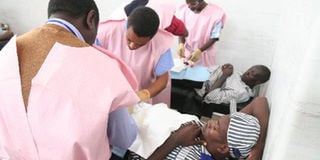
An inmate at the Naivasha Maximum Security Prison undergoes the cut inside the reform facility. Male circumcision is presently regarded as one of the strategies for controlling HIV/Aids.
East and Central African economies could save up to $20 billion in the cost of Aids programmes over the next 15 years by scaling up the voluntary male circumcision programme.
The savings would result from the circumcision of up to 80 per cent of adult and newborn males in 14 countries in the region.
The savings in funds for Aids programmes in these countries that include Kenya, Uganda, Tanzania and Rwanda would result from a significant reduction in adult HIV infections between 2009 and 2025, estimated at over four million.
However, this would only be achieved if 12 million male circumcisions on newborns and men aged between 15 and 49 years are performed in 2012, which has been designated ‘peak year’, followed by an average of between four and five million cuts between 2015 and 2025.
The enhanced male circumcision programme would require an investment of US$2.5 billion between 2009 and 2025.
This includes an additional US$420 million in the peak year (2012) and US$125 million annually from 2015.
The brief projects that this would translate into annual cost savings of between US$1.4 and US$1.8 billion after 2015, which would accumulate to over US$20 billion by 2025.
Male circumcision is presently regarded as one of the strategies for controlling HIV/Aids. Several studies have found out that circumcised males have a comparatively lower risk of contracting the HIV/Aids virus.
A recent study published in the Public Library of Science (PLoS) Medicine attributed this to the removal of the ‘vulnerable’ foreskin.
This followed trials that were conducted in Uganda, which suggested that circumcision reduced a man’s risk of acquiring herpes and other conditions that cause genital sores, hence HIV/Aids.
The latest policy brief is an attempt to promote the wide adoption of male circumcision in East and Central Africa in order to tap into its health benefits.
Titled ‘The Potential Cost and Impact of Expanding Male Circumcision in 14 African Countries’ it was prepared by the World Health Organisation, the Joint United Nations Programme on HIV/Aids (UNAids) with input from the United States Agency for International Development (USAid), the US Centres for Disease Control and Prevention (CDC) and the Office of the US Global Aids Co-ordinator.
It has developed estimates for the scale ups in individual countries, as well as the corresponding outcome.
In East Africa, Rwanda, whose HIV/Aids prevalence rate stands at 2.8 per cent and has the lowest circumcision rate of 10 per cent, requires the highest investment to enhance its male circumcision programmes to meet the 80 per cent target.
An additional US$32 million over the current male circumcision expenditure levels is required.
This will yield savings of up to US$200 million in the next 15 years.
Tanzania and Uganda require an additional investment of US$20 million and US26 million respectively into their male circumcision programmes.
The policy brief calling for an enhancement of the Hiv/Aids programme comes as Kenya, which has had a successful male circumcision programme running in one of its regions, Nyanza Province, concludes an accelerated circumcision drive that targeted 30,000 males in a month.
“We are pleased that so many men sought voluntary circumcision and that our health workers were able to meet that demand in such a short time,” said Nyanza provincial commissioner Francis Mutie.
The male circumcision programme is being run in Nyanza Province, whose Hiv/Aids prevalence rate stood at 14.9 per cent against the national figure of 8.7 per cent, according to the 2007 Kenya AIDS Indicator Survey (KAIS).
The province also had low male circumcision rates of 48 per cent, compared to the country’s average 85 per cent. It requires US$2 million to scale up, probably due to the comparatively smaller area of coverage.
Kenya is also way ahead of the other countries in its male circumcision programme. So successful has been the programme in Kenya that several African countries have sent delegations to draw from her lessons.
The programme has performed up to 75,000 cuts since its launch in November 2008, raising hopes that the procedure could gain acceptance among the non-circumcising communities.
“If Nyanza meets that goal, an estimated 900,000 HIV infections could be prevented, among men and women, over 20 years,” said Dr Mores Loolpapit a senior manager with the male circumcision consortium that implements the national cut strategy in conjunction with the government. The cut has gained wide acceptance since last year after Prime Minister Raila Odinga, came out in support of the medical procedure.
So far, four African countries have sent delegations to learn firsthand from the experience of the country’s voluntary medical male circumcision.
A statement from the Male Circumcision Consortium indicated that in October, Kenya played host to teams of health officials from Botswana, Swaziland, Tanzania, and Mozambique
A visit by delegations from four other countries that was planned for this month was put off. The visit is scheduled for next year.
If adopted, the scale up promises to further improve its implementation.
Unlock a world of exclusive content today!Unlock a world of exclusive content today!