Kenya admits Gulf region meat exports plan faltered, eyes new tack

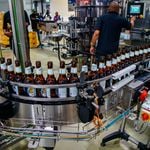
Workers at the Kenya Meat Commission plant during the launch of the Kenya Meat Expo on November 9, 2021. PHOTO | SILA KIPLAGAT | NMG


Kenya has set sights on a new business strategy to unlock meat and meat product exports to the Gulf region, revealing its craving to penetrate the expansive market that remains largely untapped, even after signing a trade pact with the United Arab Emirates (UAE).
The State Department for Livestock Development revealed that it will design a new export development programme aimed at positioning Kenya as a competitive supplier of export-quality red meat, particularly halal-certified products demanded in the Middle East.

Kenya, which finalised a Comprehensive Economic Partnership Agreement with the UAE in 2025, has been implementing a World Bank-funded project known as De-risking, Inclusion, and Value Enhancement (Drive) to help unlock opportunities for meat and meat product exports to the Gulf region.

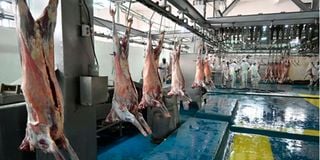
Meat production at the Kenya Meat Commission on June 9, 2022.

Photo credit: Sila Kiplagat | Nation Media Group

“However, recent results from the mid-term review undertaken on the Drive project show that, despite positive market conditions and complete feasibility studies, implementation has fallen behind, leaving export opportunities largely untapped,” the State department said as it made a tender call for a consultant to design a new strategy to unlock meat and meat product exports to the Gulf market.

The route-to-market studies prepared with the State Department for Livestock Development confirmed sustainable demand in the UAE and Saudi Arabia, for Halal-certified red meat export, recommending quick action to turn study findings into pilot shipments and long-term supply agreements.

“These studies highlight the importance of consolidating pastoral production, meeting Gulf Cooperation Council buyer standards for quality and safety while improving logistics and adopting Information Technology tools for livestock identification and/or traceability,” the State Department said.

The government says that it targeting to redesign the country’s meat supply chain to match the global standards.

“This entails mapping of aggregation infrastructure and the supply chain for livestock, adopting livestock traceability tools, and information shared and available. Stimulate adoption of modern meat processing practices to meet export standards, reviewing the suitability of export logistics infrastructure for the meat and meat products supply chain,” the State Department said in a brief.

Commercial diplomacy

Livestock development officials also plan to develop a recognised meat and meat products brand.

“[The consultant will] propose and implement, with the required actors, an effective, private sector-led model for commercial diplomacy to support Kenyan exports of meat and meat products. This will facilitate buyer discovery, B2B(business-to-business) matching, and pilot purchase order negotiations,” the State Department said.

Kenya has an animal herd population of about 22 million cattle, 23 million sheep, 35 million goats, and 4.3 million camels. In Kenya alone, the national demand for red meat stands at approximately 800,000 tonnes, while production is 607,000 tonnes.

However, the performance of the sector has dithered amid an array of challenges, including difficulty in assuring consistent supply levels to meet client orders; disjointed feeding and breeding programmes, which lead to high costs of animal nutrition and misalignment of production cycles to market demand cycles; inadequate cold storage facilities and expensive and insufficient airfreight services.

“Since 2015, the livestock industry in Kenya has suffered a serious decline with a loss of almost 40percent of the total production volumes,” the State Department said.

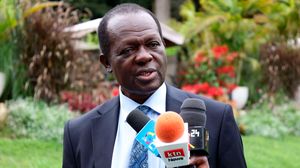
Investments, Trade and Industry Cabinet Secretary Lee Kinyanjui said earlier in the month, that discussions with Gulf partners reveal vast untapped potential.

Investments, Trade and Industry Cabinet Secretary Lee Kinyanjui address business community from Nakuru County on August 15, 2025 at Sarova Woodlands Hotel, Nairobi.

Photo credit: File | Nation Media Group

“The discussions we have had with countries in the Gulf region, like the UAE, offer us a huge opportunity for the export of meat and meat products. We are not able to even get to 10 percent,” he said during an episode of the Fixing the Nation programme on NTV on February 4, 2026.

Mr Kinyanjui added that Kenya should scale both livestock numbers and quality to compete effectively in the Gulf markets. “The conversation we should be having in some of these areas that are pastoral in nature is how to double our livestock population, and also quality,” he said.

President William Ruto has, in the past, linked livestock reforms to export ambitions. Dr Ruto’s spirited push for a national livestock vaccination programme in December 2024 was, for instance, largely informed by the potential to expand Kenya’s share of the UAE meat market.

“We are determined to carry out the vaccination programme for our livestock in an effort to increase prices for our livestock products and meet international market standards,” Dr Ruto said at the time, responding to critics of the programme. “We are using vaccines produced locally by Kenyan scientists with knowledge in this field. Leaders who have no understanding of the livestock sector and agriculture should spare us their ignorance.”

PAYE Tax Calculator

Note: The results are not exact but very close to the actual.