If there is one undeniable thing on Kenya’s roads today, it is this: More women are falling under the spell of high-end motorcycles, particularly superbikes.
These machines, for long perceived to be dangerous, masculine and intimidating, were once seen as the preserve of men. But that narrative is steadily changing. Kenyan women are rewriting the rules with every twist of the throttle.
Women-only riding communities such as Inked Sisterhood, Throttle Queens, Piki Dada and Women Bikers’ Association Kenya continue to grow, carving out space in what was once a male-dominated culture.
Several women bikers who spoke to BDLife said they have invested at least Sh1 million in brand new 600cc to 1,000cc sports or adventure bikes, and an average of Sh700,000 for an entry-level or second-hand sports bike.
For these women, the attraction is driven by a desire for empowerment, the pursuit of adrenaline and the thrill of defying social expectations. But there is also symbolism. A superbike is a bold emblem of success, freedom and self-determination. And those affirmations make every shilling worth it.
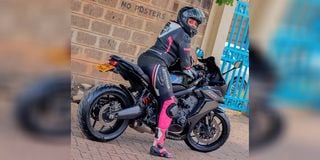
Fitness Instructor and Body Builder Lucy Ndirangu poses wih her Taro GP1 street bike.
Photo credit: Courtesy
LUCY NDIRANGU, fitness instructor
BIKE: Taro GP1 400cc
COST: Sh700,000
Bodybuilder and fitness instructor Lucy Ndirangu captures it vividly.
“A woman on a superbike will always stand out. In traffic, I have been given way, just because I am a woman on a sports bike. Men rarely get that.
“I find such moments so beautiful. It feels like acknowledgement, appreciation that a woman too can be in control of a big, sophisticated machine.”
Ms Ndirangu began riding only five months ago.
“I have always wanted to own a bike, but fear kept holding me back. But also, I am into breaking stereotypes. That is why I got into bodybuilding,” she says.
And of course, there is the adrenaline thrill.
“Anyone who’s never ridden a bike would not understand. It is not like driving a car. Imagine the excitement of cruising at 100 kilometres per hour on a winding road, the engine roar so loud you can barely hear yourself. Your reflexes come to play with every twist and turn, and how you respond to situations on the road matters greatly. You feel even the smallest detail of the road. It is a surreal moment where it is just you, your thoughts, and the road.”
Ms Ndirangu has already had one scary accident. It happened one morning as she rode to work in Nairobi, cruising at about 50 kilometres per hour.
“I was thrown off my bike when a speeding matatu hit me. I escaped unhurt, and that's because I had geared up properly. Without it, it would have been a fatal accident,” she recalls.
Ms Ndirangu says investing in quality, certified protective gear is non-negotiable, even though it comes at a steep cost.
“Falling is inevitable, even for experienced riders. That is why gear is crucial. It makes all the difference when it comes to safety. Even a slight hit on the pavement while on high speed, the super bike will fly. That is why when you start training as a biker, the first thing you are taught is how to fall. You have to let go of the bike, because it has spare parts, but you don't. If you hold onto it, you might get injured. My bike is 200kg, imagine it falling on me on impact.”
Ms Ndirangu spent about Sh200,000 assembling her kit. A certified helmet, she notes, averages around Sh20,000 but can cost as much as Sh300,000 depending on safety features. Her riding jacket and pants cost Sh16,000 each. Boots were Sh20,000, gloves Sh7,000, and knee guards Sh5,000.
“And remember, you are not getting just one pair because you will need a change. And that is before factoring in bike covers, reflectors, and insurance, which cost Sh15,000 because it’s a comprehensive one, and other essentials.”
Although she is still ‘a baby rider’ as she loves to describe herself, Ms Ndirangu’s goal is to test her adrenaline and riding skills further by doing an African tour on a superbike. It could be for fun, or to raise funds for charity, but the agenda is clear; it has to happen.
“I saved for a year to acquire the Taro GP1; now I have begun saving for my upgrade. I will need to raise at least Sh1 million because for this African tour, I will need an adventure bike, not a sports bike,” she says.
Unlike sports bikes, also known as street bikes like the Taro GP1, adventure bikes allow for off-road experiences. It survives on all kinds of trains, unlike a sports bike.
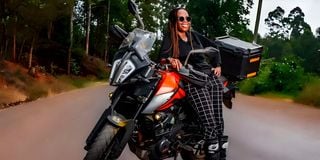
Cyber Security Engineer Mercy Mwikali with her KTM 390 Adventure on an adventure ride to Narok.
Photo credit: Courtesy
MERCY MWIKALI - Cyber Security Engineer
BIKE: KTM 390 Adventure
COST: Sh1.25 Million
“Muikali,” she laughs when I fumble with the spelling of her name.
Parked outside the room is her pride and thunder, a KTM 390 Adventure, her latest acquisition. A tall, powerful machine. Mwikali chose this upgrade deliberately. Not for aesthetics or Instagram. Not even for speed, but for freedom and a new experience. But her parents were concerned.
“My mother felt it was a waste of money. She wondered why I didn't just buy a car, which, in her view, is safer. She is always worried. I just don't know how to explain the thrill you get when on a bike.
Seeing her fully geared up offers her mother some comfort.
“My helmet cost Sh17,000 while my jacket cost Sh20,000.”
It has been over a year since she began riding the versatile beast built for weaving through city traffic and blazing through off-road trails.
“It is a 390cc bike. Some enthusiasts consider it a beginner bike, but I consider it mid-range. My previous bike was a Suzuki Gixxer 155cc,” says Mwikali, who has been adventure riding for four years.
She returned to riding last August after a frightening accident.
“I had gone to visit my parents, and while running errands, I parked the bike badly. As I tried to stabilise it, the stand sank deeper into the ground, destabilising the bike. It fell on me. I am a small girl, and the machine is about 190 kilos. My legs got stuck, and I was all alone. For 10 minutes, I was in the middle of nowhere, in pain, screaming for help,” she narrates.
By December, she was back on the saddle. And despite the ordeal, she still enjoys riding.
“Falls do happen. We get hurt sometimes, but that can’t take away the experience. I’ve been riding for a year now, but it still feels like a new experience every day. I just can’t get enough of it,” she says.
To upgrade, she sold her second-hand Gixxer, which she had acquired for Sh200,000, and topped up her savings to acquire the KTM 390.
She still has fond memories of the Gixxer that carried her from Nairobi to Diani and back, to long roads and longer thoughts. That trip of 1022 was the longest she ever did on the Gixxer as a beginner.
She upgraded for two reasons. To beat the Nairobi crazy traffic, but also to go for adventures on rough trains whenever she needed a change of environment. She knew an adventure bike would make her trip to the village quite an experience.
“I love speed, but I love comfort and off-road adventures more. Sports bikes look sleeker and sexier but are built for speed. I prefer something built for comfort. On an adventure bike, you can ride into gravel, mud, hills, and forgotten towns comfortably,” she says.
Investing in KTM was deliberate as the bike allows her to carry heavy loads, including a sleeping bag, rain gear, tents, utensils, cooking gas among other essentials, unlike a sports bike.
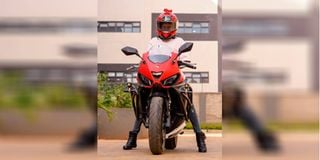
Beauty entrepreneur Alice Kimeu poses in Nairobi with her Honda CBR 650R racing super bike.
Photo credit: Courtesy
ALICE KIMEU - Beauty Entrepreneur
BIKE: Honda CBR 650R
COST: Sh1.5 Million
Ms Kimeu has been riding for six years. She recently upgraded to a Honda 650-R, spending not less than Sh1 million.
“I had been saving for five years for that,” says the mother of three.
But her parents, particularly her mother, weren’t impressed.
“She thought I had made a bad investment. She told me not to worry, because we were going to sell the bike and buy a small car that can also accommodate her grandchildren,” she laughs.
But Ms Kimeu just had to keep the bike.
“This is the only selfish thing I have for myself,” she says.
Her first bike was a Suzuki Gixxer 155 that she hasn’t let go of.
“I am a soft life girl. I don't fancy off-road bikes. I love adrenaline – the speed and torque. On a good day, I hit 170km per hour on Thika road,” adds Ms Kimeu, who commutes daily from Thika to Nairobi.
And the Honda sport tourer offers her just that.
“At top speed, the world narrows into a ribbon of tarmac. The wind becomes your companion.”
In those moments, she says, she reconnects with her inner child.
“In those moments, you feel at peace, like you are a child again. The highway becomes your playground. You stay in that happy place until suddenly you see a dog crossing the road, and you have to throw in your reflex skills or go meet your maker,” she laughs.
She has already had two minor incidents in six years. The first happened when she was still new in the game.
“I was still new to filtering,” she explains, referring to weaving between cars in traffic. “I accidentally bumped into someone’s rear light, and the bike fell.”
The bike slid into another lane.
“I thought I was going to die because the bike slipped and dragged my hand with it. I was so scared.”
But she had proper gear, and that made the difference.
Ms Kimeu initially took to biking to escape the crazy Nairobi traffic.
“One day, I talked to a neighbour who owned a sports bike, and I realised I could actually do it. That same day, I enrolled for riding classes without telling my parents. It was abrupt,” she laughs.
She then bought the Suzuki Gixxer, immediately sending her mother into panic mode.
“People speak as though they know when they will die and how death will come to them. Some said I had bought my own grave. But I only have one life, so I go for what makes me happy.”
Despite spending quite a significant amount on this new bike, she says she needs to own a third one soon.
I ask if that next purchase would be her dream bike.
“No. I will still need another one. Probably a Sh5 million plus bike.”
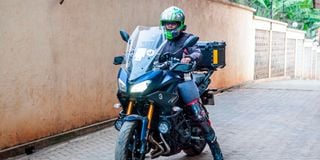
Havana Gari rides her bike on September 16, 2024 in Nairobi.
Photo credit: Billy Ogada | Nation Media Group
HAVANA GARI - Humanitarian
BIKE: Yamaha Tracer 900 Adventure
COST: Sh1.4 Million
In December 2024, Havana Gari and five bikers embarked on a six-month journey across 26 African countries.
“I wanted to understand Africa, says Gari, who grew up in Germany as a daughter to a diplomat. She fell in love with bikes there, but began exploring the sport in 2019 when her humanitarian work took her to Uganda. Since she would have to navigate the remote parts of the country, a good adventure bike made sense.
“There were no riding schools then. So, a mechanic in Uganda taught me the basics. It wasn’t until 2020 that I trained properly in Kenya.”
The trip had a second purpose: Raising Sh50 million to educate needy children.
“We raised Sh35 million, and we are waiting for more funds,” she says.
The journey required deep personal investment.
“For the trip alone, I spent Sh3.5 million to cover all the bills, including modifying the bike, logistics, visas, food, and accommodation. Fuel too, although we partnered with Shell for the stretch between Kenya and South Africa. After that, we were on our own.”
With over a decade of riding experience, she calls it biking therapy.
“When I’m on the bike, it’s just me and the engine. We have to be one. You do not simply sit on the bike. You merge with it. You feel it. You can’t afford to drift. I process life on the bike.”
For 15 years, Havana worked across Africa and South America advocating for refugee resettlement before funding cuts closed that chapter.
Now, she channels that instinct into motorcycle-led humanitarian missions.
The journey was not without danger. Off the West African coast, while shipping their bikes, pirates cornered them.
“I was the only woman among 14 men. Anything could have happened. We gave them all the CFA francs we had, and they let us continue with our journey.”
She visited slave corridors.
“That broke my heart. Every country from Nigeria onward has those scars.”
Before her Yamaha Tracer 900, named Luna, she rode a Suzuki Gixxer 155 named Mugabe, which she sold to fund the Africa ride.
Now she plans to buy it back.
“You build relationships with these machines,” she says. “He did seven countries with me. It’s time he comes home.”