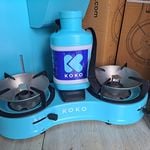
Kenya has cast doubt on the authenticity of the carbon credits generated by Koko Networks after the World Bank-backed clean cooking startup blamed the government for its collapse.
President William Ruto’s chief economic adviser, David Ndii, reckons that Koko’s collapse was due to several factors, including the “veracity of cookstove carbon credit and lack of transparency in the firm’s business model.”

“Koko’s case is uniquely multidimensional. The Paris Agreement itself, the veracity of cookstove carbon credits, our investor-unfriendly NDC regime and carbon market regulations, transparency of Koko’s business model, diplomatic meddling,” said Dr Ndii in a post on X (formerly Twitter).
Koko filed for administration on Saturday, arguing that it was closing shop after failing to receive letters of authorisation from the Kenyan government to sell carbon credits in compliance markets, which denied it substantial revenues to remain afloat.
Dr Ndii’s remarks hinted at behind-the-scenes happenings that might have led the Ruto administration to hesitate to authorise the troubled clean energy startup’s sale of carbon credits abroad.
His comments also signals Kenya’s defence in the expected legal dispute with Koko over compensation.
An agreement inked with the World Bank’s Multilateral Investment Guarantee Agency (Miga), which offers political insurance, legally binds the country to compensate investors if officials block or interfere with trade.
Koko is expected to file a claim for insurance from Miga, alleging breach of contract by the Kenyan government.
Last March, Miga insured Koko’s investment for $179.6mn (Sh23.1 billion), in what was the world’s first carbon-linked political insurance coverage. The policy explicitly covers government breach of contract.
The World Bank unit is expected to push Kenya for compensation.
Now, it appears the government and Koko could not agree on the authenticity of the carbon credits.
This suggests that the State either termed the credits non-existent or it believes Koko might have undervalued the emission rights to shortchange the government under a revenue share pact.
Koko has invested $300mn (Sh38.7 billion), with half that sum going on building a network to supply bioethanol to about 1.5 million low-income urban households.
Koko’s investors include the Microsoft Innovation Fund, Mirova and Rand Merchant Bank.
The company sells cooking stoves and fuel at subsidised prices via a distribution partnership with Vivo Energy and recoups losses by selling carbon credits.
The credits are generated through calculations about how much deforestation — and therefore carbon emissions — are avoided by low-income households switching from cooking with charcoal to using bioethanol made from sugarcane.
The credits are certified by the verification organisation Gold Standard.
However, cookstove credits, have been dismissed as largely worthless by researchers at the University of California, Berkeley.
In a 2024 peer-reviewed study, they concluded that the so-called clean cookstoves saved only a fraction of the carbon emissions claimed.
Koko has always insisted its methodology was robust and that selling carbon credits to the compliance markets was essential.
Most carbon credits are created and traded through compliance markets where the government limits the amount of greenhouse gas that companies can emit.
The credits can also be traded in the voluntary carbon markets, which revolve around companies and entities that voluntarily set goals to reduce or offset their carbon emissions.
In 2024, a US court charged two top executives of an American firm, C-Quest Capital (CQC) Impact Investors, with a presence in Kenya for obtaining carbon credits worth tens of millions of dollars using a fraudulent emission scheme involving cookstove projects in Malawi, Zambia and Angola.
The executives are said to have fraudulently secured over $100 million (Sh12.9 billion) from companies that wanted to emit larger quantities of greenhouse gases than the credits they had been allotted.
“They then sold those credits to unsuspecting buyers in the multi-billion dollar global market for carbon credits,” US Attorney Damian Williams said.
The stoves provided by CQC were supposed to replace polluting, inefficient open fires in poorly ventilated kitchens in rural parts of the country.
But they were found not to be efficient in cutting emissions.
On Saturday, Koko told the Financial Times that it had “commenced an orderly wind-down process in conjunction with the administrator and key creditors”.
The company said it had informed its 700 staff and 1.3 million customers that it was ceasing operations. All 700 staff will lose their jobs.
While underwriting cover for Koko’s projects spanning Kenya and Rwanda, Miga took steps to guard against abuse by requiring host countries to commit to compensating private investors if found guilty of frustrating their trade in carbon credits.
“If the government of [the country] fails to comply with its commitments outlined in Section 1 above, it shall compensate the Investor for the losses resulting from such non-compliance,” says Miga in a letter of authorisation template introduced in 2024.
“The scope and amount of such compensation will be determined in a manner that is equitable, transparent and consistent with prevailing industry standards and regulations in consideration of, among others, the prevailing market value of the affected Credits [and estimated revenue losses by the Investor attributable to the government of the country]’s failure to meet its commitments under this Letter of Authorisation.”
In November 2024, Miga introduced a letter of authorisation template to be used in contractual agreements between governments and private investors that want to sell credits into the lucrative compliance markets under Article 6 of the UN Paris Agreement.
The second part of the template, under the heading ‘Consideration and Proceeds,’ deals with host government fees for allowing a private company to sell carbon credits abroad.
These include upfront payments made when the project is registered and shared revenue, which the government takes as a fraction of the actual sales. The government is then required to recognise and back carbon credits once they are officially certified as genuine.
By accepting this certification as final, the state loses the right to dispute the quality of these credits later.