Kenya bets on Ethiopia imports, three new plants to avert power rationing

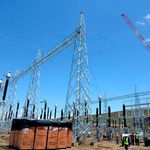
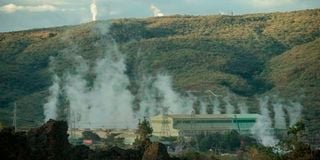
A wide view of Olkaria Geothermal Projects spread across Hell's Gate National Park on October 15, 2024.

Photo credit: Pool

Kenya is banking on three power plants and increased supply from Ethiopia this year to boost its unused electricity capacity, commonly known as the spinning reserves, and avert widespread power rationing amid a fast-rising demand.

The State Department for Energy expects a boost from three geothermal plants in Menengai with a combined generation capacity of 70 megawatts (MW), the country’s oldest geothermal plant, whose output has been increased now generate 63MW, and imports from Ethiopia, which are expected to double to 400MW from December this year.
Spinning reserve, also known as contingency reserve, refers to backup power that is available and ready to be dispatched quickly when there's a power outage.

Kenya’s spinning reserves remained below five percent for the past few years, compared to the global benchmark of between seven and 15 percent of the total power in the national grid.

The current peak demand of 2,439.06MW is slightly lower than the country’s maximum generation capacity of 2,882MW, excluding the 200MW imports from Ethiopia.

Principal Secretary in the State Department for Energy Alex Wachira said that the spinning reserves have remained below five percent in the past few years, leaving the country on the brink of a crisis amid a consumption spike.

“Unfortunately, we have been having a decline in our spinning reserves. But the two plants in Menengai and the KenGen one will have an additional 133MW. Remember, we will also double imports from Ethiopia to 400MW. This will help us go back to the eight percent that we see as safe,” said Mr Wachira.

British clean energy firm Globeleq and Chinese-backed Kaishan Group are developing two geothermal power plants, each with a capacity of 35MW. Additionally, the rehabilitation of the Olkaria I plant to increase its capacity from 18MW to 63MW is nearing completion.

The dwindling reserve margins have left Kenya facing bigger prospects of widespread outages in case a major plant like the 310MW Lake Turkana Wind Plant breaks down.

Increased connections with the total customers standing slightly above 10.06 million and increased economic activities have upped the pressure on Kenya Power to ensure enough supplies.

Globeleq and OrPower 22 are part of the three independent power producers (IPPs) contracted to build plants at the Menengai geothermal fields.

OrPower 22, which is fully owned by Kaishan Group of China, has completed its plant and will start trialing supplies to Kenya Power in March.

Globeleq expects to complete its plant in June. Sosian Energy has been supplying electricity from its plant since mid-2023.

State-owned Kenya Electricity Generating Company (KenGen) is upgrading its Olkaria I plant (Units 1-3) to increase its capacity from 45MW to 63MW. The plant has been out of service since 2023, when it was shut down ahead of the rehabilitation works.

Besides the three plants, Kenya Power will, from December 2026, double imports from Ethiopia to 400MW in line with the 25-year power purchase agreement that was signed in 2022.

Kenya Power has, since 2022, been importing 200MW of hydropower, shipments which have been critical in averting widespread blackouts amid a significant jump in consumption.

The country recorded five peak demands in 2025 alone, with the highest being a 2,439.06MW, which was on recorded on December 4, 2025.

PAYE Tax Calculator

Note: The results are not exact but very close to the actual.