MRM shifts main Mombasa plant to 60pc solar energy

 Mabati Rolling Mills (MRM) CEO Albert Sigei addresses the press at their Mariakani Plant on September 10, 2025.

Photo credit: Wachira Mwangi | Nation Media Group

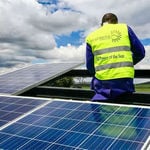
Building solutions company, Mabati Rolling Mills (MRM) has shifted its main factory in Mombasa to 60 percent solar power as part of a strategy to trim energy costs and curb carbon emissions.

The company now expects Sh38.7 million annual savings from the 2.9 megawatt-peak (MWp) solar rooftop project.

“The project will help save more than 50–60 percent of power, which we rely on the grid, and save up to more than $300,000 (Sh38.77 million) per year,” said CEO Albert Sigei.

Anders Lindgren, CEO of Safal Group, MRM’s parent company, said the project is commercially viable and forms part of a strategic shift by the organisation.

“It is the first step in our group-wide strategy to deploy the use of solar-generated energy across our operations in Africa in the coming years,” he said.

“By integrating solar energy into MRM's largest production plant in Mariakani, the company is addressing the challenges of climate change, lowering its carbon footprint, and complementing the use of renewable energy.”

MRM in January this year also revealed that it would install 727 kilowatt-peak (kWp) of solar power at its premises in Nairobi’s Industrial area and Athi River, Machako County, for its own consumption as part of a cost-cutting strategy.

A kWp is the amount of power solar panels can deliver in optimal conditions.

GridX Africa Development Limited, which develops and finances solar and renewable energy solutions for commercial and industrial companies across Africa, said a solar power system with a capacity of 592kWp would be mounted on the roof at MRM’s facility in Nairobi, while a 135kWp one would be installed in Athi River.

MRM joins a growing list of manufacturers, including Bio Food Products, Total Energies Kenya, Maisha Mabati Mills, Simba Cement, Unilever Tea Kenya, British American Tobacco, Africa Logistics Properties, Bidco, and Devyani Food Industries, that have shifted to their own solar power generation to cut operational costs and lower emissions.

Official records show that Kenya’s total captive power capacity hit a historic 574.6 megawatts last December.

As of December 2024, Kenya’s solar installed capacity was 485 megawatts, comprising 210.3 megawatts of grid-interconnected capacity and 271.3 megawatts of captive capacity. Captive power plants operate by generating electricity for the consumption of the owner, not for sale to the public.

PAYE Tax Calculator

Note: The results are not exact but very close to the actual.