Time flies with great content! Renew in to keep enjoying all our premium content.
Prime
Sugar board plans new cane growing zones
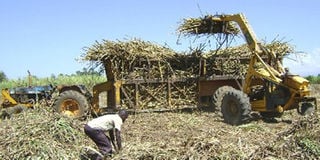
A farmer harvests sugarcane in Bungoma County. jared nyataya
The Kenya Sugar Board (KSB) plans to map out new cane growing zones amid expectations of fresh investments in capacity.
Increased cane poaching and the expected entry of more investors when the government privatises five sugar factories has prompted the regulator to identify additional suitable growing areas to accommodate the rising demand for the raw material.
“Kenya Sugar Board is in the process of commissioning a consultancy to identify suitable cane growing areas which will then form the basis for guiding potential investors into the industry,” Rosemary Mkok, KSB managing director said.
The country is mainly reliant on western Kenya farms for cane production even though an increase in the number of factories operating in the region has put pressure on resources.
The region currently plays host to all the 11 existing sugar factories, including the country’s largest miller Mumias. This has often led to vicious competition for raw material, leaving some factories operating below capacity.
Demand for sugarcane is expected to increase when the government implements a scheduled privatisation programme in order to cut inefficiency and boost competitiveness in the industry, ahead of the end of trade safeguards in March 2013, which limit duty-free imports from the Common Market for Eastern and Southern Africa (Comesa).
A tentative plan unveiled by the Agriculture ministry in early 2010 showed the government would sell a 51 per cent stake Sony, Chemelil, Nzoia, Muhoroni and Miwani sugar companies to strategic investors and reserve another 30 per cent for farmers.
Once the factories are profitable, the government would then sell the remaining 19 per cent in of the companies in initial public offerings.
The country remains a sugar importer, a position that has stirred interest from investors who are keen in seizing the opportunity to meet rising demand.
Ms Mkok said in 2012, the demand for sugar is expected to grow to 794,844 tonnes against a forecast production of 552,000 tonnes, presenting investors an opportunity to boost their fortunes.
“The projection is made against a backdrop of increased crushing capacity in the sugar industry despite the challenges of cane shortage experienced in 2011,” she said.
“With anticipated good rains and increased cane development, we expect 2012 to be a better year for production,” she said. Several players including Mumias and leading Mauritian sugar producer Omnicane that has partnered with a group of local investors, have also turned their attention to new cane producing zones along the coastal belt in a bid to boost production.
Mumias plans a Sh24 billion integrated sugar project in the Tana River District, to be jointly implemented with the Tana and Athi Rivers Development Authority (Tarda). A strategic plan on the proposed Tarda project showed that it would be irrigation-driven unlike the predominant rain-fed farming in the country’s sugar industry.
Faster cane maturity
The irrigation-based production offers many advantages including faster cane maturity and higher sucrose content. Sucrose is the substrate from cane juice that is refined into various products.
The project is also designed to rely on a nucleus estate that is expected to take up the bulk of the 16,000 hectares. Most millers in Kenya rely on small scale out-grower farmers for supplies, a situation that has worked against efficiency.
Omnicane is currently constructing a Sh16 billion integrated sugar project at the coast near Kwale with partners under the flagship of Kwale International Sugar Company Limited (KISCOL). Kenya currently has an installed factory crashing capacity of 30,109 tonnes of cane per day (TCD), but expects an additional 3,000TCD when the factory being constructed near by Omnicane and Kiscol commences operations in April 2013.