Time flies with great content! Renew in to keep enjoying all our premium content.
Prime
Cargo clearance slows down as TradeNet hits snag
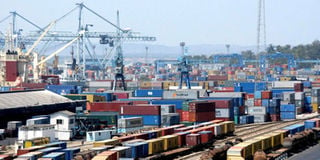
Cargo pile up at a Kenya Ports Authority yard in Mombasa. The Kenya TradeNet, a system meant to eliminate paperwork and ease cross-border trade, has prolonged goods clearance time threefold, drawing protests from traders. PHOTO | FILE
The Kenya TradeNet, a system meant to eliminate paperwork and ease cross-border trade, has prolonged goods clearance time threefold, drawing protests from traders.
Clearing and forwarding agents interviewed Tuesday said it now takes at least three days to lodge documents and clear cargo using the new system, as opposed to one day before it went live.
The Treasury made it compulsory for traders to start using the system on July 1 after it was interfaced with the Kenya Revenue Authority’s Simba system.
Shippers said the system could not generate documents, after going live, to enable them pay taxes. After lodging the Import Declaration Form (IDF) with the Simba system, says Mr Simon Wanjohi, a clearing agent, the documents could not be transferred to the TradeNet system.
Besides KRA, other government regulatory agencies whose approvals are supposed to be obtained via the system include the Kenya Bureau of Standards (KEBS), Kenya Plant Health Inspectorate Service (Kephis) and shipping agents.
Juma Tellah, Kenya Ship Agents Association (KSAA) executive officer said submission of manifests initially took up to four days when the system came live but is slowly improving.
“What we want is consistency and stability because when it takes too long to get a number after submitting the manifest this delays the entire process,” he said.
Car Importers Association of Kenya (CIAK) chairman Peter Otieno said their members also experienced the same problem, adding that they had to cancel the process several times in order to lodge the documents afresh, each time attracting a charge of $10 (Sh1,000).
Kenya Auto Bazaar Association (KABA) secretary Charles Munyori said an entry he made last week took more than five days to go through and that they had not been able to pay taxes due to the delays.
According to Mr Wanjohi, importers incurred losses since they had to pay extra fees arising from storage, which they had not budgeted for.
Daily storage charges for vehicles range between Sh1,500 and Sh2,500 depending on the size of the vehicle. A 20 foot container is charged Sh4,000 while importers pay up to Sh8,000 for a 40 foot container per day, said Mr Otieno.
“For instance, I paid Sh20,000 extra charges for a car I was clearing. If you look at this amount of money, it is not little because there are hundreds of people who have paid this fee, amounting to millions of shillings which came about due to failure by the agencies to fully integrate the system before allowing us to use it,” said Mr Wanjohi.
But Ms Ann Odero, corporate communications manager at KenTrade said they acknowledged there were challenges in the integration between the two systems in the initial stages, but added that the problems have since been sorted out.
“What we are experiencing are a few technical teething problems such as having to reset the passwords and we are addressing them without delay,” she said, adding that they were also going on with training programmes.
“A joint technical team comprising ICT experts from KRA and KenTrade is monitoring the situation and dealing with any issue arising from the system,” she told the Business Daily.
Unlock a world of exclusive content today!Unlock a world of exclusive content today!