KeNHA mulls plan to provide non-toll alternative routes for upcoming expressway

BDHighwayone

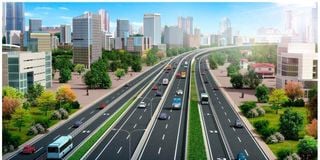
An artistic impression of Nairobi to Mau summit toll road. 

Photo credit: Pool

The government will identify alternative routes for motorists who do not wish to pay toll fees for the planned Nairobi–Nakuru–Mau Summit and Nairobi–Maai Mahiu–Naivasha highways.

In a statement, the Kenya National Highways Authority (KeNHA) said motorists will not be forced to pay for the two roads — including the 175-kilometre Nairobi–Nakuru–Mau Summit (A8) section and the 56-kilometre Nairobi–Maai Mahiu–Naivasha (A8 South) link.
“The Authority shall map out available alternative roads from Rironi to Mau-Summit where feasible, for consideration and use by the public, who may opt not to pay and use this Project,” said Acting Director-General Luka Kimeli.

“It is, however, imperative to note that the usage of the toll road shall be cheaper, as there shall be resultant savings in travel times, vehicle operating costs and safety,” Mr Kimeli added, assuring the public that the agency would be transparent and accountable throughout the implementation of the project.

Kenha said the mapped alternatives will be published to the public so motorists can plan journeys without using the toll road.

The preferred contractor for the Mau Summit Highway — a consortium of China Road and Bridge Corporation and the National Social Security Fund — expects to earn an operating profit of about $2.63 billion (Sh339.8 billion) over the 30-year concession by charging motorists a minimum toll of Sh8 per kilometre.

The availability of a free alternative has been a contentious issue since the project was conceived nearly nine years ago during the Jubilee administration, which initially awarded the contract to French contractors.

Successive officials have highlighted the benefits of the upgraded highways as an incentive for motorists to pay.

Transport Cabinet Secretary Davis Chirchir in July argued that the economic and emotional costs of long traffic jams on single carriageways are often greater than the cost of a toll.

“Will it be cheaper for you to get to Nakuru in the current traffic snarl-up, or will it be cheaper to pay Sh700 or Sh600 to reach Nakuru in two or three hours instead of four?” he asked.

Kenha, however, did not provide name of the alternative routes that non-paying motorists may use.

The absence of a designated free corridor alongside the planned Rironi–Nakuru–Mau Summit toll road has been a major sticking point, contributing to years of delays and to the ousting of the French contractors originally awarded the project.

The investment envelope for the project includes $1.49 billion (Sh193.4 billion) of capital expenditure and $753.8 million (Sh97.6 billion) of life-cycle costs covering operations, routine maintenance and periodic rehabilitation.

The financing is 75 percent debt and 25 percent equity — about $1.11 billion (Sh144 billion) in debt and $371 million (Sh48 billion) in equity.

At the heart of the model is a base toll of Sh8 per kilometre for passenger cars in the first operational year, with tolls escalating by one percent annually. Higher tariffs are set for heavier vehicle classes.

The concession runs for 30 years, with two years of construction followed by operations for the remaining period before hand-back.

The plan proposes Electronic Toll Collection (ETC) and a toll back-office to reduce leakage, speed transactions and enable reconciliation and enforcement.


PAYE Tax Calculator

Note: The results are not exact but very close to the actual.