He is one of a rapidly expanding community of farmers who have ditched the cultivation of maize for grass after being stung by the vagaries of climate change.
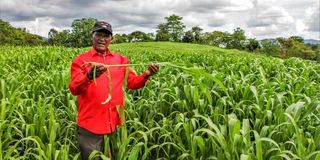
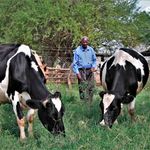
At 84, one would expect Mr Malika to have retired. But he is actively involved in overseeing the cultivation, baling and selling of grass as he manages a vibrant dairy enterprise which comprises 30 Friesian cows.
He produces 250 liters of milk daily from the dairy venture that is squarely hinged on the grass fodder enterprise. Beyond significantly cutting on the cost of feeds supplement, the assorted grass earns Mr Malika a tidy sum by selling hays and seedlings.
"Instead of cultivating maize, beans, and peas which require months of rainfall, we have opted for Bhoma Rhodes and Brachiaria grasses, and Sugargraze sorghum. The three grass varieties are of high value, do not require weeding and pest management and withstand drought," Mr Malika said during a farmers’ field day the Makueni county government hosted at his farm.
As government officials took the farmers through the advantages of the various high-value fodder grasses, and the process of making silage, Mr Malika tackled the need for keeping business records.
“Boma Rhodes takes 90 days to mature and yields between 70 and 80 bales per acre. Similarly, Brachiaria takes 60 days to mature. An acre of Brachiaria produces between 150 and 200 bales,” he said.
A thriving sorghum crop to which Mr Malika attributed a boom in milk production also caught the attention of farmers.
“This is sugargraze, a hybrid forage sorghum which is rich in sugar and whose stems are soft and highly palatable. It yields up to 40 tonnes of fodder per acre, taking 60 days to mature, and is good for making silage,” said Dennis Kibunja, a manager at Advanta Seeds International, the company which distributes the high-value grass.
Mr Malika produces more fodder than his dairy enterprise requires. He sells the surplus to dairy farmers in the region and beyond at Sh20 per kilo of hay.
Build resilience
His success in fodder farming has inspired many farmers who see him as a change agent in the region plagued by drought.
Experts link reduced production of farmlands in the region and beyond to erratic rainfall and prolonged drought.
To build resilience against climate change, the government and non-governmental organisations have been aggressively advocating for growing drought-resistant crops such as mug beans and sorghum, afforestation, harvesting rainwater, growing cover crops such as pumpkins and keeping livestock.
Recently, grass farming has become a motif in interventions to manage the adverse effects of climate change.
“Grass is a major candidate when it comes to managing climate change and the restoration of ecosystems. It requires less rainfall compared to conventional crops such as maize and does not require the application of chemicals to sustain,” said Mary Mbenge, an environmentalist and the chief officer at the Department of Climate Change in Makueni County government.
Scientists and entrepreneurs have tapped the emerging opportunities in the wake of climate change to develop products that address the concerns of farmers.
As livestock breeders churned out more productive and resilient breeds of cattle, scientists at Kenya Agricultural and Livestock Research Organisation (Kalro) have been producing and mainstreaming the cultivation of fodder grass.
“Over the years, the champion grass farmers have established vibrant networks by rallying their neighbours and show goers during farmers’ field days,” says Donald Njarui, the national coordinator Karlo’s plan to roll out Brachiaria cultivation in the country.
Expansive business
Dr Njarui decries that low value fodder grasses such as Napier grass are still popular among farmers in Central Kenya. He is, however, glad that Brachiaria is increasingly becoming popular in arid zones, and that farmers are actively involved in diffusing the higher value grasses.
At Masongaleni area, one of the driest in the lower Eastern region, fodder farming has thrown farmers a lifeline.
For instance, Festus Mwaniki has put more than 800 acres on tropical fodder grasses such as Masai love grass and African fox tail grass which are rich in essential proteins. Much of the produce sustains his expansive business of fattening cattle for the beef market.
He sells the rest, a bale at Sh 150. The Nairobi based businessman opted for grass farming after burning fingers in the cultivation of maize and mug beans.
Mr Mwaniki's fodder grass venture, which residents initially dismissed as unworthy, has inspired farmers to let go of traditional crops such as maize, beans, cow peas and pigeon peas and take up fodder farming among smallholder farmers in the region.
The trend, which is fanned by advisory from climate change management experts who recommend fodder farming as a suitable economic activity to build resilience against the vagaries of climate change, has been sweeping across the arid region with many small scale farmers now dedicating at least a portion of their farmlands to fodder grass.
A spot-check by Business Daily in the Mbooni area has revealed that racks for storing hay and maize residue have replaced traditional granaries for storing maize in most farming households.
“Maize no longer does well in this region. One does not need to be a dairy farmer to grow fodder grass, which we are selling in markets," said Jane Maweu, a grass farmer and a member of Kathonzweni Dairy Cooperative Society.
The farming of grass has spawned multiple enterprises and transformed region's that would otherwise have been derelict into hubs of food security. The good case is the arid Kathonzweni region where more than 300 households in the region keep dairy cattle which they sustain through fodder they grow on their plots.
Ironically, the arid region is among the biggest producers of milk in the county. Consequently, USAID through International Livestock Research Institute and Makueni County government has set up a Sh80 million milk processing plant in the region.