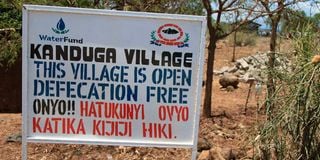
The number of people still practising open defaecation in Kenya stands at eight percent despite progress made over the past decade, according to a new United Nations report.
Open defecation involves people relieving themselves in fields, street gutters, bushes, bodies of water, and other open areas.
The latest Joint Monitoring Programme (JMP) report, published by the World Health Organization (WHO) and the United Nations Children's Fund (Unicef), shows that the open defecation rate has fallen from 12 percent in 2015 to eight percent in 2024, indicating a gradual improvement in access to sanitation.
However, the report notes that, with only a four percent reduction in nine years, Kenya is unlikely to meet the Sustainable Development Goal (SDG 6.2) target of eliminating open defecation by 2030.
"At less than half a percentage point reduction per year, Kenya would need to more than double its efforts to reach zero by 2030," it states.
Rural areas present the biggest challenge, with open defecation rates decreasing from 26 percent to 18 percent during the same period.
Nearly one in five rural residents still lack access to toilets.
In contrast, urban areas have achieved significantly lower rates, with open defecation dropping from four percent to two percent.
A survey by the Kenya National Bureau of Statistics (KNBS) revealed that Turkana has the highest rate of open defecation in the country, with 72.6 percent of households lacking proper sanitation. Mandera follows closely behind at 72.5 percent, while Marsabit and Wajir also report high levels of open defecation, at 67.9 percent and 63.6 percent, respectively.
Other counties where more than half of households lack proper sanitation included Tana River, Bomet, Samburu, Elgeyo Marakwet, Narok, and Nyandarua.
Conversely, counties such as Kiambu, Nairobi, and Mombasa had almost universal sanitation coverage, with 99 percent, 97.5 percent, and 96 percent of households, respectively, using improved toilet facilities. Other high-performing counties include Embu, Taita Taveta, and Murang'a.
In order to eliminate open defecation, Kenya will require at least 1.2 million new latrines by 2030, which will create a high demand for affordable sanitation solutions.
Globally, poor sanitation costs countries billions each year in lost productivity, healthcare expenses, and stunted economic growth.
In Kenya, for example, diarrhea and waterborne diseases are leading causes of childhood illness, resulting in a substantial economic burden.
Each case of illness related to poor sanitation results in a loss of school days and worker absenteeism, as well as increased household spending on medical treatment.
"Every day lost to preventable illness is a day lost for the economy," said the Ministry of Health.
According to a report by the Water and Sanitation Program, Kenya loses an estimated Sh27 billion each year due to poor sanitation. Open defecation alone accounts for approximately Sh7.3 billion each year in costs associated with premature deaths, healthcare expenses, and lost productivity.