Kenyans defaecating in public double to over 7.5 million

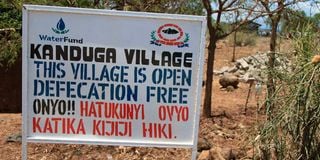
A sign in Kanduga village, in Tharaka Nithi county warning residents against open defaecation on October 15, 2020.

Photo credit: Joseph Kanyi| Nation Media Group

The number of Kenyans practising “open defaecation” has doubled in five years, despite health risks, a new report by the United Nations International Children's Emergency Fund (Unicef) shows.

Open defaecation is the practice of people relieving themselves in fields, street gutters, bushes, water bodies, and other open areas. This practice exposes them to diseases such as cholera, diarrhoea, dysentery, hepatitis A and typhoid.
According to Unicef’s annual report on Kenya, about 14 percent of Kenyans still practised open defaecation as of 2023, an increase of 6.6 percent from 2019, which equates to over 7.5 million people across the country.

"Open defaecation can pollute the environment and cause health problems and disease. High levels of open defaecation are associated with child mortality, poor nutrition, poverty, and large disparities between rich and poor," the UN agency said in its report.

Kenya aims to achieve 100 percent open defaecation free (ODF) status by 2030, in line with the UN Sustainable Development Goal 6.

Achieving ODF status means that a community has declared that all its families have stopped defaecating in the open and are now using new or rehabilitated toilets.

"Our efforts dovetail seamlessly with the broader goal of universal health coverage. We believe that everyone, regardless of socio-economic status or geographical location, should have access to basic sanitation services," said Mary Muthoni, Principal Secretary, Public Health.

The Unicef report also highlights that 1,825 villages were certified as Open Defaecation Free (ODF) in 2023, meaning that 466,610 people now live in an improved and safer environment, an increase from 180,360 the previous year.

In 2021, the government, in partnership with the UN children's agency and other partners, launched the Kenya Sanitation Alliance, led by the ministries of Health and Water, Sanitation and Irrigation and 15 county governments with the highest open defaecation rates, to eliminate open defaecation in Kenya by 2025.

According to Unicef, Kenya is one of the 26 countries in the world responsible for 90 percent of the world's open defaecation. Almost 85 percent of open defaecation in Kenya takes place in 15 counties namely Baringo, Garissa, Homa Bay, Isiolo, Kajiado, Kilifi, Kwale, Mandera, Marsabit, Narok, Samburu, Tana River, Turkana, Wajir and West Pokot.

In these high-burden counties, more than 80,000 people practice open defaecation and more than 10 percent of households defaecate in the open.

The report also shows that some 28 million Kenyans still lack access to safe water, while 41 million live with limited access to sanitation.

According to the Ministry of Health, about 9.9 million people directly consume water from contaminated surface sources, and only 25 percent have handwashing facilities with soap and water at home.

PAYE Tax Calculator

Note: The results are not exact but very close to the actual.