Copper scrap single largest Kenya’s export to China

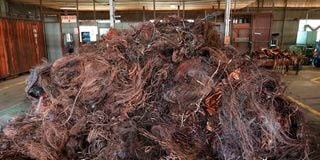
Scrap copper delivered at the Numerical Machining Complex factory, pictured on February 28, 2025. 

Photo credit: File | Nation Media Group

Copper waste and scrap is now Kenya’s single largest export to China, marking a shift in the country’s export structure following closure of titanium mines in Kwale and tighter controls on raw ore exports.

Data from the Kenya National Bureau of Statistics (KNBS) shows that Kenya exported copper waste and scrap worth Sh4.6 billion to China in the first nine months of 2025, surpassing the Sh3.24 billion shipments recorded for the whole of 2024.
The performance marked a rise from Sh1.18 billion in 2023 and Sh303.46 million in 2022, underscoring the rapid ascent of scrap copper as Kenya’s dominant export commodity to the Asian manufacturing hub.

The surge has seen copper scrap eclipse agricultural exports such as tea and coffee, as well as mineral ores that previously anchored Kenya’s sales to China.

Latest quarterly data shows shipments worth Sh1.66 billion in the first quarter of 2025, Sh1.68 billion in the second quarter, before easing to Sh1.26 billion in the third quarter. Copper waste and scrap were Kenya’s top export to China in the three quarters.

Copper scrap’s rise has come in the wake of closure of titanium ore mines in Kwale, operated for over a decade by Australia’s Base Resources.

KNBS figures indicate that exports of titanium ores and concentrates to China stood at Sh12.06 billion in 2022 before falling to Sh9.90 billion in 2023 and further to Sh4.25 billion in 2024 as Base Titanium, a subsidiary of Australian firm Base Resources, scaled down operations ahead of the initial December 2024 closure.

Base Titanium officially concluded its mining operations in Kwale, Kenya, with a final bulk shipment to the US on February 12, 2025. China had, over the years, been one of the main buyers of Kenya’s titanium minerals—ilmenite, rutile, and zircon.

With titanium shipments drying up, copper scrap has filled the vacuum, reflecting China’s growing appetite for secondary raw materials amid global supply constraints for refined copper.

Patrick Kanyoro, chairperson of the Kenya Chamber of Mines, said the dominance of copper scrap in Kenya’s shipments to China is driven by policy shifts and structural gaps in Kenya’s mining sector.

“There are two main reasons. The first is that the government stopped the export of raw copper ore from Kenya, insisting on in-country value addition. The second is that Chinese companies have intensified their search for scrap copper as their country is hungry for copper, and this is handled by the scrap metal dealers,” Kanyoro said.

The KCM chair said while the policy intent of promoting value addition is sound, implementation has been uneven and slow. According to Kanyoro, local miners require Mineral Dealer Processing Licences to add value to copper mined in Kenya, but the approval process has been “painfully slow and skewed in favour of foreign companies”.

“Our members need these licences to add value, but the system favours large foreign players. We must pursue organic growth, not just wait for big investors who may not be willing to commit under unpredictable policy,” he said.

Copper was among the initial 14 minerals declared strategic in October 2023 by President William Ruto’s administration, placing it under the control of the State-run National Mining Corporation. The designation was part of terms for lifting a four-year moratorium on prospecting, mining, and trading licences imposed in December 2019 by the previous regime of President Uhuru Kenyatta.

Under the Mining (Strategic Minerals) Regulations, 2017, strategic minerals are those deemed essential to Kenya’s economic, technological, or national security interests. Other minerals classified as strategic are cobalt, graphite, tantalum, lithium, niobium, coltan, nickel, tin, and radioactive minerals such as uranium, thorium, rare earth elements, and chromite.

Restrictions on tsavorite trade were lifted in 2025 due to NAMICO’s limited capacity to manage the green gemstone or green garnet.

However, industry players say there is still no clarity on the minimum level of value addition required before exports can be approved.

“There is an obvious lacuna in the policy framework,” Kanyoro said. “We need meaningful stakeholder engagement so policy responds to national development aspirations, not short electoral cycles.”

The boom in copper scrap exports to China raises concerns on vandalism of public infrastructure, particularly power transmission equipment.

In May 2024, Kenya Power chief executive officer Joseph Siror called for a ban on export of copper waste and scrap, linking the trade directly to vandalism of electricity infrastructure.

“Vandalism of energy infrastructure has been rampant, causing detrimental effects on the economy,” Siror said at the time, citing unplanned outages, safety risks, and disruptions to critical facilities such as hospitals.

He said Kenya Power’s investigations showed a correlation between scrap metal trading and vandalism. He noted that between January and May 2022, when scrap dealing was banned, Kenya Power recorded zero vandalism cases. After the ban was lifted, 76 transformers worth Sh68 million were vandalised between May and December 2022.

Losses rose in 2023, when 365 transformers worth Sh328 million were destroyed, excluding the wider economic cost of unserved energy, lost business, and safety risks, which he said ran into billions of shillings.

PAYE Tax Calculator

Note: The results are not exact but very close to the actual.