Time flies with great content! Renew in to keep enjoying all our premium content.
Prime
Factory to process second batch of pyrethrum since its revival
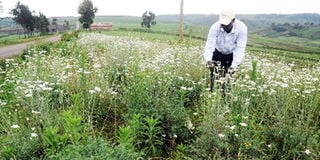
Pyrethrum farm at Mau Narok in Nakuru County. FILE
The pyrethrum factory is set to process flowers for the second time since its revival five months ago, even as it grapples with shortage the raw material.
The first consignment of 100 tonnes was processed in November following the government’s move to bail out the indebted Nakuru-based factory that had been closed for six months.
Pyrethrum Regulatory Authority (PRA) managing director Alfred Busolo said that three tonnes of flowers were being received in a day, an improvement from two tonnes a week in October and November.
“The volumes are still low but we appreciate that there have been an improvement in supplies given the fact that initially it would take us three days to fill a tonne,” said Mr Busolo.
Some farmers have been withholding the crop in protest over money the factory owes them for crop deliveries. The factory has a crushing capacity of 25 tonnes in a day and they have made projections of 2,500 tonnes yearly to meet the required supply.
Mr Busolo said that PRA would clear all the debts that they owe farmers in order to attract enough stock for crushing on a daily basis. The factory owes farmers Sh38 million after paying Sh17 million between October and December.
The authority pays Sh100 in advance per kilogramme, while the second payment is determined by the quality of the flower, which is paid as bonus.
Pyrethrum Growers Association chairman Justus Monda warned that merging PRA with other agricultural institutions as provided under the Agriculture Fisheries and Food Authority Act (AFFA) 2013 was likely to stall progress in reviving the factory.
“Pyrethrum authority should have been left to operate as an independent entity in order to achieve the desired growth,” he said.
Until the sub-sector went under, Kenya was a major producer of the crop in the world, accounting for 70 per cent of the total demand.
Most of the pyrethrum produced is meant for export with the local market consuming less than two per cent.
Unlock a world of exclusive content today!Unlock a world of exclusive content today!