How new budget will shape Kenya’s mobile gadgets market

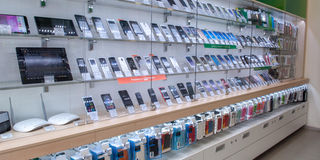
A mobile phones shop. 

Photo credit: Shutterstock

Assemblers of telecommunications equipment and devices, including mobile phones, laptops, and tablets, will continue enjoying a preferential tax rate on the importation of materials, lower than the regular charge that governs trade within the East African Community (EAC) bloc.

This is after the EAC Council of Ministers granted Kenya’s request for an extension of duty remission, boosting the government-led efforts to lower the cost of these devices as it seeks to accelerate digital connectivity in the country.
The extension of the duty remission scheme allows manufacturers to continue importing phone assembly inputs at a rate of zero percent of the customs value, in a programme set to run until the end of June next year.

“To promote local assembly of telecommunications equipment, Kenya was granted an extension of duty remission on inputs for assembly of telecommunications devices including mobile phones, laptops, and tablets,” said Treasury Cabinet Secretary John Mbadi during his 2025 national budget address on Thursday.

The EAC tariff imposes taxes on imports from outside the partner countries – Kenya, Uganda, Tanzania, Burundi, Rwanda, South Sudan, Somalia and the Democratic Republic of Congo (DRC).

Pundits have termed the extension of the relief a key step in spurring the local assembly of mobile devices.

“Remission of duty on such inputs will incentivise the local assembly of mobile phones. This proposal is in line with the objective of the government to promote the local production of mobile phones,” wrote analysts at legal firm Bowmans.

The gain could, however, be watered down by a proposal contained in the Finance Bill 2025, which seeks to exempt the supply of locally assembled and manufactured mobile phones from value-added tax (VAT), moving it from zero-rated treatment in a development that signals weightier costs for consumers.

Exempt supplies are not subject to VAT and do not allow recovery on related costs, while zero-rated supplies are taxed at zero percent but still permit reclaims on inputs.

Businesses dealing in zero-rated goods can reclaim input VAT, potentially lowering costs, whereas those offering exempt goods cannot, which may lead to higher operating expenses.

The President William Ruto-led Kenya Kwanza regime has, since inauguration, spelled out an ambitious scheme to accelerate the local manufacture and assembly of mobile phones as part of the State-led program to upscale digital connectivity in the country, as well as slash the devices’ import bill.

Official data from the Kenya National Bureau of Statistics (KNBS), for instance, shows that the value of telecommunications gadgets imported into Kenya rose 68.1 percent to hit Sh15.2 billion during the first three months of this year compared to the similar period last year, in a trend largely influenced by demand.

According to KNBS, telecommunications equipment includes computers, laptops, and smartphones, as well as networking equipment that is inclusive of their parts and accessories such as microphones, television cameras, digital video camera recorders, electric sound amplifier sets, and radio and TV transmission apparatus, among others.

This year, January accounted for the bulk of the shipments worth Sh6.4 billion, pointing to a heightened appetite for electronic devices as a bigger population in the country becomes more tech-savvy.

In 2023, the government set up a consortium comprising Safaricom, Jamii Telecom, and Chinese mobile devices Shenzhen TeleOne Technology in a joint venture to locally assemble low-cost smartphones that would ease access for consumers on retail shelves.

At the time, it was estimated that the devices would retail at around $40 (around Sh5,170 at current conversion rates), touted as the lowest price on the continent.

The consortium, dubbed the East Africa Device Assembly Kenya (EADAK) with a factory based in Athi River, is one of only two companies assembling phones locally, alongside asset financing firm M-Kopa.

The current policy developments come at a time when Kenyans have accelerated the uptake of smartphones, purchasing a historic 4.1 million pieces during the three months that ended last December.

The latest data from the Communications Authority of Kenya (CA) shows that the number of smartphones in active use stood at 41.5 million at the end of December last year, up from 37.4 million last September, representing a 10.9 percent growth.

The demand is set to climb amid an ongoing shift towards a digital economy where the bulk of transactions, including government services, are now online.

PAYE Tax Calculator

Note: The results are not exact but very close to the actual.