The Treasury has rejected a proposal to build a Sh468 billion expressway linking Nairobi and Mombasa, amid fallouts about the financial muscle of the private firms behind the project, prohibitive land acquisition costs, and lack of policy sweeteners that would guarantee the venture's sustainability.
The ambitious four-lane greenfield highway, stretching 500 kilometres, was championed by American private equity firm Everstrong Capital, through its Kenyan subsidiary, Usahihi Limited.
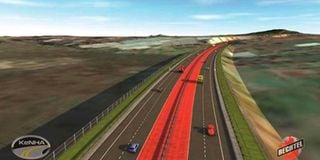
It was to be developed under a public–private partnership (PPP) model — with Everstrong designing, building, operating, and maintaining the road for 30 years, while collecting toll fees to recover its investment.
However, at its 54th ordinary meeting on July 2, 2025, the National Treasury’s PPP Committee ruled that the proposal “does not meet the relevant criteria” under the PPP Act, 2021, and directed the Kenya National Highways Authority (KeNHA) to consider restructuring it as an expansion of the existing Mombasa Highway instead of a new alignment.
It has now emerged that one of the most critical blows to the project came when Portuguese construction giant Mota-Engil — a key technical and financial partner — pulled out of the planned venture.
Mota-Engil, which has developed construction projects in around 50 countries, including roads, motorways, railways, airports, ports, and dams, was to provide crucial equity to kick-start construction and attract additional debt financing from commercial banks and local pension schemes.
“When they [Usahihi] went to the development phase, they came back with other contractors to meet the technical capacity, but the shareholder to replace Mota-Engil was not there,” PPP Directorate Director-General Kefa Seda told Business Daily.
Without a replacement equity partner, the committee concluded that the project lacked the requisite financial muscle for approval.
Mota-Engil, a major player in Kenya’s road annuity programme, would have brought not only construction capacity but also credibility with financiers. Mota-Engil is 40percent owned by the Mota family and 32.41 percent by China Communications Construction Company Ltd.
Its exit left Everstrong to rely on its parent’s thin balance sheet capital and new local partnerships — including a joint venture with billionaire businessman Peter Munga through a firm known as Quickpass Limited.
Regulatory filings show Everstrong Capital (Kenya)—the local subsidiary of the Mauritius-based Everstrong Capital— holds a 50 percent stake in Quickpass, with the remaining half owned by Kiewa Group, a Munga family business.
Equally damaging was the proposal’s push for a greenfield venture that would require land purchases along the construction corridor.
Preliminary estimates placed the acquisition bill at Sh12.9 billion — costs that, in a PPP model, would be passed directly to road users through tolls.
Seda warned that these “pass-through” costs would push toll charges to unsustainable levels. Initial estimates suggested motorists could pay Sh12–13 per kilometre, translating to about Sh5,280 for a full journey between Nairobi and Mombasa. The toll charges were expected to be even higher for heavy commercial vehicles.
The government is mindful of Kenya’s troubled history with land speculation in major projects.
The Standard Gauge Railway (SGR) faced queries by the Auditor-General's office over Sh1.04 billion in unsupported land compensation payments, while Mombasa's Dongo Kundu bypass project was rocked by allegations of inflated valuations totalling Sh14 billion, with Sh1.4 billion in payments halted for audit.
By shifting from a greenfield to a brownfield approach — expanding the existing A8 highway (the old Mombasa Road) within its current road reserve — the government hopes to avoid speculative land buying and inflated valuations that have derailed other infrastructure projects.
Everstrong had also sought government support through policy directives that would have guaranteed traffic volumes on the road and revenue. Chief among them was a request to compel trucks and long-distance buses to use the expressway — an approach reminiscent of the 2018 policy forcing cargo to the Chinese-built SGR to ensure its financial viability.
The US firm argued that 75 percent of toll revenue would come from heavy trucks, making guaranteed usage essential to the project’s bankability.
However, the government was reluctant to impose such restrictions, wary of sparking a backlash from road transport operators and conflicting with existing freight policies.
Everstrong also requested certain tax exemptions to improve project viability, but these were not granted.
Without these incentives, the committee reckoned the project was not going to be viable.
The collapse of the Everstrong plan marks the second time in less than a decade that an American company’s bid to build the Nairobi–Mombasa Expressway has failed.
In 2018, engineering giant Bechtel had proposed constructing the road, but talks collapsed over financing terms. Bechtel rejected Kenya’s offer to recoup its costs through toll collection, preferring a government-funded model instead.
For the US, the shelved expressway is another missed opportunity in a region where China has outpaced it in infrastructure investment, funding, and building mega projects such as the SGR and major highways, including the Nairobi Expressway.
Had it gone ahead, the Nairobi–Mombasa Expressway would have been the largest US-backed infrastructure project in Africa and the continent’s biggest toll road.
KeNHA has now set its eyes on expanding the existing Mombasa, a process that might be initiated either directly by the private sector, or a Privately-initiated Process (P-i-P), or the government.
While the initiative would still require significant investment, it is expected to be far cheaper and faster to implement than the greenfield plan.
Founded in the US by infrastructure dealmaker Philip William Dyk and incorporated in Mauritius for African operations, Everstrong had pitched the expressway as a flagship project showcasing its ability to deliver large-scale, privately financed infrastructure in emerging markets.
As part of its evaluation of the individuals behind the Nairobi-Mombasa Expressway, the PPP Committee found that Everstrong LLC, the US-based holding company started by Mr Dyk, lacked the financial capacity to undertake such a big-take project.
However, the company had partnered with Mota-Engil for the project, giving it the financial heft to build the multibillion-shilling project.
Everstrong Capital, led by Mr Dyk, has maintained a relatively low profile in the public domain but is increasingly emerging as a key infrastructure financier in East Africa.
In addition to the expressway, the firm has interests in energy (including Athi River’s Gulf Power Plant), telecoms (SealTowers), and e-mobility (EV Africa).