Iran war threatens Kenya’s Sh700bn Gulf trade

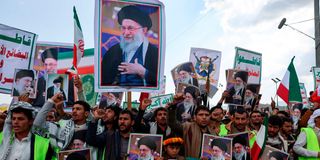
People hold placards with pictures of late Iran's Supreme Leader Ayatollah Ali Khamenei at a protest against Israel and the US strikes on Iran, following the killing of Ali Khamenei in Sanaa, Yemen on March 1, 2026. 

Photo credit: Reuters

The widening conflict in the Middle East in the wake of joint US-Israel strikes against Iran has put Kenya's trade worth over Sh700 billion at risk, with ramifications for inflation on costly fuel.

The strikes killed Iranian Supreme Leader Ayatollah Ali Khamenei on Saturday, sparking chaos as Iran retaliated with attacks on Gulf cities, airlines halted flights and tankers carrying oil and other products suspended transit through the key Strait of Hormuz.
A surge in insurance costs, a spike in cargo freight charges and costly energy look set to trigger inflationary pressures on households struggling with diminished disposable incomes.

Brent crude jumped 10 percent yesterday to about $80 a barrel and Middle East leaders say prices could hit $100, triggering a sharp rally at local pumps.

Fuel prices make a big contribution to inflation in Kenya as it relies heavily on diesel for transport, power generation and agriculture, while kerosene is used in many households for cooking and lighting.

Lee Kinyanjui, the Cabinet Secretary for Investments, Trade, and Industry, said in a post on X that prolonged conflict in the Middle Eastern nations of Saudi Arabia, United Arab Emirates (UAE) and Bahrain would have a direct impact on Kenya’s export basket that stood at Sh165 billion in 2024.

Kenya exports tea, coffee, meat and flowers as well as re-exported jet fuel to these countries, setting the stage for reduced earnings to farmers, freight carriers and oil marketers.

Shipments from these countries like fuel, fertiliser, machinery and electronics worth Sh554 billion could be derailed.

Mr Kinyanjui said the projected disruption in Gulf trade comes as trade between Kenya and Middle East countries has surged in the quest for diversification.

“The ongoing conflict in the Middle East will have a direct impact on Kenya’s export basket. We enjoy thriving trade with Middle East countries, where supplies of meat, vegetables, coffee, tea and flowers top the list,” he said.

“In a world increasingly dependent on one another, disruption to trade and travel can have far-reaching consequences, even in faraway lands. While we hope for a speedy resumption to normalcy, the reality of geopolitics remains unpredictable.”

Bombs continued to rain down on the Iranian capital for the second day as the president has branded the killing of the country's Supreme Leader a 'declaration of war against Muslims'.

Iran has retaliated with a series of strikes across its neighbouring Gulf states, with explosions heard in Qatar, Israel, Bahrain, Kuwait, Iraq, Oman and Saudi Arabia.

US President Donald Trump promised to strike Iran 'with a force that has never been seen before,' after the Islamic Revolutionary Guard Corps (IRGC) announced they had attacked nearly 30 US military bases across the Middle East on Sunday morning.

The hardening of positions will rattle markets.

A bigger risk, analysts said, is complacency in markets that have assumed the fallout would be limited, like it was during last June's "12-Day War" in Iran or during Russia's numerous attacks on Ukraine, and dismissive of any comparisons to Iran's 1979 regime change.

Air travel across the world remained heavily disrupted on Sunday, with thousands of flights cancelled.

Airports in Dubai, the world’s busiest terminal, and Doha remained closed while airlines across the Middle East cancelled almost all of their flights on Sunday.

Kenya Airways (KQ) announced the indefinite suspension of flights to Dubai and Sharjah.

The Middle Eastern hubs are a major travel artery, and the Gulf carriers like Emirates and Qatar Airways have built business models on connecting passengers from the centres to Asia and Europe or America.

This has implications for Kenya not only of delayed shipment of perishable goods -- fruits, flowers and vegetables -- but also re-exported jet fuel that occurs when Gulf carriers fuel at Jomo Kenyatta International Airport.

Re-exports of jet fuel have become a top foreign exchange earner for Kenya behind tea and horticulture, underscoring Nairobi’s status as an aviation hub.

In the three months to June 2024, re-exports to the UAE stood at Sh27.41 billion, in what look set to make its Sh100 billion annual business for local oil marketers.

The conflict has rattled insurers, with some telling ship owners they would cancel policies and raise coverage prices by up to 50 percent for vessels travelling through the Gulf and Strait of Hormuz.

Insurers are pricing in the heightened risk, including the possibility of Iranian proxies attempting to board and seize ships.

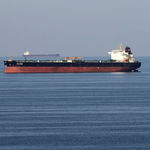
For instance, an oil tanker was attacked off the coast of Musandam in the Strait of Hormuz on Sunday morning as part of Iran’s retaliation.

Higher insurance costs will filter into the import costs from the Middle East and translate to higher prices for the final goods for consumers.

Kenya’s top imports, which include refined petroleum, palm oil, wheat, packaged medicines and cars imported mostly from China, the UAE, India, Malaysia and Saudi Arabia, are likely to be affected logistically.

The situation could test Kenya’s fuel supply deal with three State-owned Gulf firms—Saudi Aramco, Emirates National Oil Co and Abu Dhabi National Oil Co — given the pact guarantees Nairobi a steady supply of oil.

The deal is based on fixed freight and premium costs, which were negotiated downwards by about 13 percent when Kenya renewed the deal in April last year.

Global oil analysts expect a surge in crude oil prices.

Most tanker owners, oil majors and trading houses have suspended crude oil, fuel and liquefied natural gas shipments via the Strait of Hormuz, trade sources said, after Tehran warned ships against moving through the waterway.

More than 20 percent of global oil is moved through the Strait of Hormuz.

This could upend the price of petrol, diesel and kerosene that Kenya has agreed with the Gulf firms under the 180 day credit plan, which is meant to ease pressure on foreign exchange reserves and support the shilling.

Official data shows Kenya has seen a consistent rise in exports to the Middle East, with the value nearly doubling in three years to Sh164.65 billion in 2024 from Sh84.96 billion in 2022.

UAE tops with exports from Kenya worth Sh101.34 billion, followed by Saudi Arabia (Sh27.2 billion), Yemen (Sh7.38 billion and Iran (Sh6.81 billion).

The country imports over Sh500 billion worth of goods from the Middle East annually, with the figure standing at Sh554.45 billion in 2024 from Sh616.32 billion in the previous year, according to government data. UAE accounted for imports worth Sh337.25 billion in 2024, followed by Oman (Sh71.3 billion), Saudi Arabia (Sh52.35 billion), Israel (Sh6.7 billion and Iran (Sh2.45 billion).

Follow our WhatsApp channel for the latest business and markets updates.


PAYE Tax Calculator

Note: The results are not exact but very close to the actual.