Kenya’s economy is set to expand faster in 2026 as inflation remains unchanged, reflecting a recovery that global lenders indicate will test the balance between growth and cost-of-living measure.
The latest World Bank’s Kenya Economic Update shows that market perceptions expect inflation to hold at 5.0 percent in 2026, unchanged from forecasts for 2025 and 2027, and higher than the 4.5 percent recorded in 2024.

At the same time, the multilateral lender projects real gross domestic product (GDP) growth of 4.9 percent in 2026, up from 4.7 percent in 2024, indicating a gradual strengthening of economic activity.
The outlook suggests that the economy is emerging from a period of weak growth, marked by tight financial conditions, softer household demand, and disruptions from floods and political unrest.
It however remains to be seen if the improved growth outlook will rev up jobs.
In 2024, the Kenyan economy added the fewest jobs since the 2020 coronavirus pandemic as growth slowed, dealing a blow to the Ruto administration's plan to ease the mounting youth unemployment.
About 782,300 new jobs were created in 2024, down from 848,100 new hires a year earlier. Last year's figures are yet to be released.
According to the World Bank, real GDP growth slowed to 4.7 percent in 2024 but gained momentum in early 2025 as monetary conditions eased and public investment picked up.
“Real GDP growth slowed to 4.7 percent in 2024, but it accelerated in the first half of 2025, growing by 4.9 percent in quarter one of 2025 and 5.0 percent in quarter two of 2025,” the lender said.
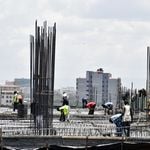
The recovery has been supported by improved performance in construction, driven by lower interest rates, increased public investment and the settlement of road-related arrears.
“The construction sector is recovering, supported by a reduction in monetary policy rates, increased public investment, and payment of road arrears,” it wrote in the update.
The World Bank projects real GDP growth to average 4.9 percent over the 2025 to 2027 period, underpinned by macroeconomic stability and a gradual recovery in private sector activity.
It raised its growth forecast for Kenya, citing low inflation, easier monetary policy, stronger credit growth and resilient agriculture as key drivers behind the revision.
However, the lender’s inflation outlook indicates that price pressures may firm alongside the growth recovery rather than continue easing.
Market perceptions captured in the update show inflation stabilising at 5.0 percent in 2026, suggesting that stronger demand and recovering investment could exert upward pressure on prices.
The International Monetary Fund (IMF) shares a similar view, projecting real GDP growth to rise to 4.9 percent in 2026 from a forecasted 4.8 percent in 2025.
The IMF also expects inflation to increase to 5.2 percent in 2026, up from a projected 4.0 percent in 2025, signalling firmer price pressures as the economy gains momentum.
These projections, however, contrast with the Central Bank of Kenya (CBK)’s more benign inflation outlook over the next year.
The country’s apex bank has recently cut its inflation forecast for the next 12 months, saying it expects consumer prices to continue easing before reaching lows of about 3.7 percent by June 2026.
Inflation stood at 4.5 percent in November, down slightly from 4.6 percent in October, reinforcing the CBK’s view that price pressures remain contained in the near term.
“Our focus for inflation going forward for the 12 months up to November 2026 shows that inflation will remain below the midpoint of our target range and will not exceed the five-percent rate,” CBK Governor Kamau Thugge said.
The CBK attributes the expected moderation in inflation to exchange rate stability, improved food supply and subdued growth in core inflation.
Core inflation, which excludes food and fuel and accounts for about 81 percent of the inflation basket, is expected to anchor overall price growth over the next year.
Non-core inflation, covering food and fuel, is expected to rise temporarily due to seasonal pressures before easing as harvests improve and rains boost food supply.
The CBK’s inflation outlook has provided room for continued monetary policy easing aimed at supporting the recovery of private sector credit.
The central bank has cut its benchmark rate multiple times, citing stable inflation and a steady exchange rate as key factors supporting the decision.
Private sector credit growth has shown signs of recovery, reaching a 19-month high in November as falling borrowing costs stimulated demand for loans.
The CBK says the improvement reflects better credit demand rather than excess risk-taking, consistent with a gradual and controlled recovery.
The global lenders, however, caution that sustained credit growth and stronger domestic demand could gradually feed into inflation over the medium term.
The World Bank notes that the recovery in construction and infrastructure investment is playing a growing role in driving output growth.
While the revival of construction activity supports employment and demand, it also increases exposure to imported inputs and energy costs.
Stronger household spending, expected as borrowing costs fall and incomes stabilise, could further lift demand-side inflation pressures.