Kenya ranked fourth in Africa’s crime on ‘wash wash’ and heroin deals

Photo credit: Compiled by John Waweru | Designed by Stanslaus Manthi

Heroin trade and financial crimes ranked Kenya fourth in Africa for cross-border crimes, underscoring how the country’s position as East Africa’s logistics and financial hub is also turning it into a high-value transit and laundering corridor for organised networks.

Data from the ENACT Organised Crime Index shows Kenya’s criminality score rose to 7.18 in 2025, up from 6.14 in 2019, placing it 4th in Africa and 1st in East Africa. The criminality score ranges from 1 to 10, with higher figures indicating acute law-breaking.
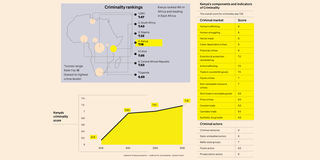
Kenya’s ranked behind the Democratic Republic of Congo (7.47), South Africa (7.43) and Nigeria (7.32).

Kenya’s position reflects the growing sophistication and diversification of criminal markets operating alongside the formal economy.

These markets exploit Kenya’s role as a regional transport and logistics hub, using ports, highways and warehousing networks that also serve legitimate trade.

The ENACT Organised Crime Index under the Institute for Security Studies, Interpol and the Global Initiative Against Transnational Organized Crime measures organised crime across Africa and assesses countries’ resilience to criminal activity.

ENACT ranks countries using two measures: a criminality score (1–10) reflecting the scale of illicit markets and criminal actors, and a resilience score assessing the ability of institutions to prevent and respond to organised crime.

At the core of Kenya’s illicit economy are human trafficking and smuggling, the heroin trade, cyber and financial crimes, each scoring 8 out of 10. The heroin trade exemplifies Kenya's vulnerability to Indian Ocean trafficking routes, with criminal networks exploiting maritime corridors and inland distribution channels that replicate legitimate supply lines.

The report reads: "From South-West Asia to Kenya, especially in or near Mombasa, there have been multiple seizures of hundreds of kilograms on ships in the Indian Ocean. This shows how important Mombasa is to the heroin trade."

Kenya's digital transformation has also changed organised crime. Cyber-dependent crimes and financial crimes, both with a score of 8, are now the most entrenched markets.

A hacking attack against Kenya's Micro and Small Enterprises Authority allegedly revealed sensitive material on the dark web, including employee records, government correspondence, financial statements, and business registration information, which was then offered for sale.

Organised crime groups, including foreign actors, perpetrate financial crimes, with credit card fraud and identity theft becoming prominent.

For instance, unregulated financial systems, such as hawaladars, further enable the laundering of illicit proceeds. The anonymity makes it attractive for money laundering, terrorist financing, and evading sanctions.

Follow our WhatsApp channel for the latest business and markets updates.

PAYE Tax Calculator

Note: The results are not exact but very close to the actual.