Time flies with great content! Renew in to keep enjoying all our premium content.
Prime
Kenya steps up fight against top crimes with new law
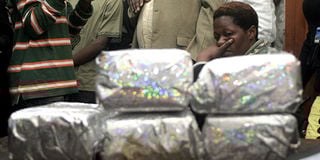
A Ugandan woman suspected of drug trafficking at Nairobi's Jomo Kenyatta International Airport, June 6, 2010 after she was arrested with cocaine worth Sh85 million wrapped in 10 packets and packed in two plastic boxes bearing UN logos. Photo/JAMES NJUGUNA
A Bill seeking to clamp down on organised crime received Presidential assent this week, moving Kenya closer towards effectively prosecuting the rising cases of syndicated crime.
President Kibaki signed the Prevention of Organised Crime Bill on Wednesday, which will deal with suspects and institutions that have been cited as intermediaries in syndicates.
Among organised crime threats that continue to fester are tax evasion syndicates, drug trafficking, cyber crime, identity theft, counterfeiting, money laundering, and human trafficking.
Although the Bill is seen as a major milestone in the fight against organised crime, enforcing the law stands out as the significant challenge for the government.
“It’s a step in the right direction, but enforcing the law will require a lot of structures and goodwill,” said Mr Ashif Kassam, the managing partner at advisory firm RSM Ashvir.
Like in many countries where organised crime thrives, the high level involvement of government officials at all levels has been cited as a major stumbling block to dealing with the fraudulent activities.
The loose laws have in the past failed to clearly define what organised crime is, making Kenya a major syndicate hub in Africa.
In the absence of clear laws, criminals have had a wide berth of operating syndicates seemingly undeterred by the existing provisions of prosecution under the Penal Code.
The proposed law also criminalises persons who aid organised crimes including lawyers and professionals who knowingly handle assets gained from the vice.
Observers had argued that while law firms can stand behind the veil of client confidentiality, the law should be crystal clear on how rogue lawyers who play a critical role in deal-making should be brought to book.
In Kenya, besides investing in real estate, organised criminals have used the capital markets as a conduit of clearing up “dirty cash”.
This recently prompted the Capital Markets Authority to recommend new regulations to be included in the Proceeds of Crime and Anti Money Laundering Act 2009 to monitor incidents of using the bourse to wash dirty money.
Money laundering refers to a process in which criminals use legal structures to clean the proceeds of drug trafficking, gun smuggling, terrorism and corruption.
The US Department of State in its 2009 International Narcotics Control Strategy Report on Money Laundering says Kenya’s financial system may be laundering over Sh7.7 billion every year.
The report says that criminals have been taking advantage of Kenya’s inadequate anti-money laundering regime for years by evading oversight or reportedly paying off enforcement officials, other government officials, and politicians.
International Police (Interpol) last year upgraded their regional office in Nairobi, citing the need to increase focus on emerging transnational crimes.
The Prevention of Organised Crime Bill, 2010, that identifies money laundering and prearranged crime, and facilitates seizure of assets suspected to have been bought from using proceeds from such activities.
Already there are allegations that money from suspect sources, running into billions of shillings has been used to buy and develop property in Kenya, a move being blamed for distorting property prices in the country.
Recent data shows that at least Sh164 billion, or about 30 per cent of the annual tax collection, entered the country in 2009 from unknown sources.
Unlock a world of exclusive content today!Unlock a world of exclusive content today!