Time flies with great content! Renew in to keep enjoying all our premium content.
Prime
Kenya undecided on need to enter new IMF deal
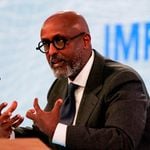
Chairperson of Presidential Council of Economic Advisors Dr David Ndii gives a speech during an Economic Forum at Serena Hotel in Nairobi on November 7, 2023.
Kenya is undecided on whether it needs a new funding programme with the International Monetary Fund (IMF) despite initiating talks on a new deal with the fund.
David Ndii, the chairperson of the Presidential Council of Economic Advisors, said there has been no consensus on the importance of a new financing deal with the IMF, even as a section of government officials push to wean the country off debt from the multilateral lender.

In September, Kenya commenced discussions on a new funded arrangement with an IMF team visiting Nairobi following an untimely end to an earlier deal in March.
IMF Mission Chief to Kenya Haimanot Teferra indicated that technical discussions are to continue in Washington before a determination is reached on the new funding arrangement.
Dr Ndii said Kenya’s ambition of becoming an upper-middle-income country implies stepping away from the IMF’s financial assistance, appealing to markets about its fiscal maturity.
“Do we need an IMF programme? I don’t think we have a meeting of minds internally on why we need it, but that’s because of uncertainties on shocks,” he said.
“In the long haul, our goal is to transition from a lower-middle-income to an upper-middle-income country. Part of that means being more market-facing than seeking multilateral financing.”
The difference in opinion among the country’s policy makers mirrors that of market analysts, some of whom see the IMF as critical to Kenya’s economic plan, while others don’t see urgency in the push for fresh funding from the multilateral.
Analysts calling for a fresh programme reckon the presence of the fund would make Kenyan policies to improve its fiscal standing more believable.
“It’s really the signalling, whether you have a funded programme or not. The IMF brings credibility and is an external anchor that, if the government is committed to a programme with it, it will lead to improved fiscal outturns,” David Rogovic, the Vice President-Senior Credit Officer, Sovereign Risk at Moody’s Ratings, said previously.
Some analysts believe that Kenya can wait before seeking a successor programme as it has no major upcoming external payments following the buybacks of Eurobonds maturing in 2027 and 2028, respectively.
Churchill Ogutu, an economist at investment bank IC Group, for instance, said a new programme would be more pressing after the 2027 polls as Kenya will be approaching major maturities that start with the repayment of a 2031 Eurobond.
“I think Kenyan authorities can muddle through. A balance of payment risk is no longer a threat, with the building of forex reserves and improvement in external balance with recent methodology tweak, and as such, the case of a programme should be around 2028 when gross financing needs are elevated, and when Kenya has built adequate room for a substantial access under normal funding limits of the IMF,” he said.
Dr Ndii suggested that Kenya could opt for a standby facility where funding from the IMF is available on a need basis.
Kenya has had such a deal, which expired in March 2018, holding Sh193.8 billion ($1.5 billion) standby arrangements (SBAs) and standby credit facilities (SCFs).
IMF's SBAs are short-term financial agreements that provide funds to member countries facing external financing needs, including addressing a variety of balance of payments problems. The SCF is a concessional financing tool for low-income countries facing short-term balance of payments needs, whether actual or potential.
Kenya, however, did not tap from the precautionary facilities, which were likened to an insurance policy by the Central Bank of Kenya. Dr Ndi suggested that Kenya, being a member of the IMF, would, in any case, receive support through the multilateral lender's crisis funding facilities.
He said that the government's key goal is to lift Kenya’s credit ratings to become an investment-grade rated sovereign issuer.
“My target for stability is not relationships with the IMF but relationships with markets. The KPI that I would like to see better is an investment grade rating, which I see as the appropriate focus," he said.