Time flies with great content! Renew in to keep enjoying all our premium content.
Prime
Rising consumption piles pressure on planners to fix Uganda’s sugar
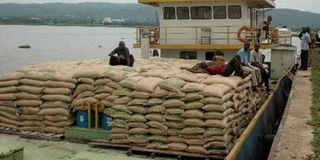
Workers aboard MV-Satnam, which docked in Kisumu on April 9, wait to offload sacks of sugar imported from Uganda. Sugarcane growing was introduced in Uganda in the 1930’s by the Mehta Group. Photo/Jacob Owiti
Uganda will need three more years to produce enough sugar to surpass its consumption needs, going by available statistics.
But this will only come to pass if the country applies the right interventions to fix both internal and external bottlenecks; top among them the failure to operationalise the sugar policy designed to guide the sector.
Although Uganda’s planners have worked towards expanding the sector, a combination of low production and increased regional demand has continuously conspired to push the commodity prices up.
According to data from the Uganda Sugarcane Technologists Association (USTA), Uganda is expected to consume 371,744 tonnes of sugar this financial year. But combined production is expected to reach 350,000 tonnes.
Kakira is estimated to produce 165,000 tonnes, Kinyara 110,000 and SCOUL 60,000 tonnes. The New Sango Bay projects are expected to produce 15,000 tonnes. This means that there would be a shortage of 21,744 tonnes this year.
Further, the country is expected to consume 387,476 tonnes in 2012/13 compared to 377,000 tonnes which all factories are projecting to produce.
Mr Jimmy Kabeho, the chairman of USTA, says the country produces less sugar compared to what it consumes, but the gap is always bridged by importation.
“We normally import about 50,000 tonnes per year to bridge the gap, although this at times affects the future of the industry,” Mr Kabeho says.
“If not well controlled, as it was the case last year when the country had a shortage, importation allows a lot of bad sugar to be dumped.” Mr Kabeho alleges that there are about 100,000 tonnes of bad sugar, which was imported when the government waived taxes from the imported commodity to ease the crisis. This sugar, according to him, has affected sales of locally manufactured stocks because they are sold cheaply.
He reveals that by the end of April, the three major factories combined had over 70,000 tonnes of sugar in stores.
“With all those billions in stock, factories cannot do extensions, pay workers and farmers (out growers), buy inputs and run other operations,” Mr Kibeho says.
However, Mr Kabeho’s view appears too complex to a consumer who is currently buying a kilogramme of sugar at USh2,600 compared to USh10,000 in August last year.
It also raises a debate whether the government is working closely with other stakeholders to find solutions to high commodity prices and the related scarcity.
Over the years, Uganda has struggled to get enough sugar. This has turned sugar from being simply an ingredient for beverages to a political subject.
Last year, the retail price, which was at around Ush2,500 per kilogramme in February, rose to Ush10,000 in August despite the 50 per cent reduction in excise duty on the commodity by the government in the 2011/12 budget.
Experts blamed the mess to a temporary closure of Kinyara, the second-biggest sugar processor, as it struggled to secure enough cane to sustain production and a prolonged drought that affected the country in 2010.
The shortage forced supermarkets in Kampala and other major towns to start rationing the sweetener while some traders hoarded stocks, escalating the crisis.
Sugar shortage dates back to dictator Idi Amin’s regime after the expulsion of Asians in 1972 in the infamous ‘economic war’. The two main sugar factories – Sugar Corporation of Uganda Limited (SCOUL) owned by the Mehta family and Kakira Sugar Works owned by the Madhvani family, closed or significantly reduced production.
Amin tried to bridge the gap by building Kinyara Sugar factory but it failed to resolve the problem.
Mr Cyprian Batala, assistant commissioner for trade in the Ministry of Trade and Industry, agrees that the country partly depends on importation, but he dismisses claims of shipping in bad sugar.
“Where is the bad sugar sold?” Mr Batala asked.
“According to the National Bureau of Standards, all the sugar which was imported is good for human consumption,” he adds.
He, however, says his ministry is fighting hard to double production in order for the country to become a commodity exporter rather than importer.
Statistics show that Uganda’s sugar consumption rises every year. In the 2009/2010 fiscal year, it was predicted at 342,170 tonnes. It grew to 356,651 tonnes in 2011 and is expected to reach 371,744 this fiscal year.
Experts further predict that the demand will increase to 387,476 tonnes and 403,874 tonnes in 2014 and 2015, respectively.
Unpredictable weather
But as demand increases, weather patterns are becoming hostile and land—a key factor to cane production— is becoming scarce.
According to an official of Kakira Sugar Works (KSW), the largest sugar producer in the country, accounting for about 50 per cent of the total output, companies depend on out-growers for 90 per cent of the cane they need.
This is simply because there is land shortage in the main sugar growing areas in Uganda which include the eastern region on the eastern banks of the Nile and in Masindi in North western Uganda.
Unfortunately, some outgrowers are abandoning cane growing and switching to other crops.
Cane farmers reduce
According to statistics from Uganda National Association of Sugarcane Growers (Unasgo), about 500 outgrowers aborted cane growing between 2008 and 2010, due to what they distributed as ‘unfair treatment’ by millers.
Mr Kabeho says since January, all cane growing areas have not received good rains, an issue that could affect the output. But he rushes to say low production will not cause scarcity due to the current stable supply.
As a long-term solution, Mr Batala says government has licensed eight new sugar companies and each has a crushing capacity of over 200,000 tonnes per year.
Those include Mukwano Sugar Factory in Masindi District, Tirupati Sugar Factory in Nakasongola District, Uganda Crop Industries in Buikwe District and Kafu Sugar Factory in Masindi District. Others are Kamuli Sugar Factory in Kamuli District, Sugar Allied Industries in Kaliro District, Kenlon Sugar Factory in Namasagali, Kamuli District and Bugiri Sugar Company in Bugiri.
“All those companies have started ground work [land opening and planting]. Very soon, we will emerge as the leading sugar exporter in the region. We will be able to export to Burundi, Northern Tanzania, Kenya, Southern Sudan, Rwanda and other countries,” the commissioner says.
Support outgrowers
According to him, the companies are required to plant over 5000 hectares of sugarcane and also distribute seed cane to outgrowers who would support the factories.
The factories have to support many outgrowers in order to support government’s prosperity for all programme.
However, since the type of cane grown in Uganda take 18 months to mature, this means that those new companies will have their first products in 2015.
But some of the listed projects like of Tirupati and that of the Madhvani Group, in Amuru have faced stiff resistance as residents claim the companies want to grab their land.
In fact, for Tirupati, President Museveni intervened and blocked it, saying it will displace hundreds of residents.
Mr Miraj Barot, Tirupati managing director, says his company bought 9,500 hectares of land in Nakasongola to establish a Shs96 billion sugarcane project.
It is quite interesting that Mr Museveni halted the Tirupati project yet he is generally known to be an advocate of more sugarcane growing. On two occasions, he has suggested that Scoul take part of Mabira natural forest to grow sugarcane.
Recently, about 60 women from Amuru District stripped naked before officials of Madhvani Group of Companies, in protest to eviction from land they claim is rightfully theirs.
Meanwhile, Moris Ngabitho, Unasgo executive director, says once government doesn’t wake up to improve cane varieties, so that the yield per acreage is increased and also operationalise the sugar policy, sugar production will remain low.
“Farmers are abandoning the crop because they are demotivated by the yield. Government and companies have failed to make research on the improvement of the cane varieties currently grown in the country,” Mr Ngabitho says.
He explains that canes grown in Uganda produces only 65 tonnes per acre compared to those grown in other neighbouring countries which produce over 130 tonnes per acre.
He also accuses millers for failing to pay farmers well and financing extensions.
Canes currently grown in Uganda are of poor species with a low sugar recovery of 8.5 per cent and a maximum of 10.5 per cent under exceptional circumstances.
This is far below the 13.5 per cent recovered in countries like in South Africa, Swaziland and Brazil and where governments of those counties are working towards a recovery of 16 per cent.
Situations of less pay, low sugar recovery and poor soils are worsened by the long gestation period of the cane.
In Uganda, canes take 18 months to mature but in countries like South Africa and Brazil, they spend less than 12 month.
Sugarcane growing was introduced in Uganda in 1930’s by the Mehta Group. Madhvani group joined the business six years later with a view of feeding their industries.