Treasury grapples with Sh176bn bills for legal breaches

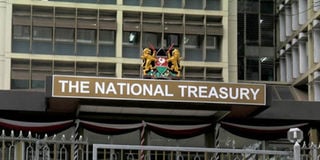
The National Treasury head office in Nairobi.

Photo credit: File I Nation Media Group

The National Treasury is exploring alternative sources of revenue beyond the exchequer to clear a ballooning backlog of court awards against the government, signalling the strain of contract breaches, unlawful dismissals, human rights violations, and other legal disputes on public finances.

The latest development follows concerns raised during last November’s Public Sector Hearings, where participants questioned the continued failure by the government to honour compensation arising from court orders.
In its response, the Treasury acknowledged the scale of the challenge, citing limited fiscal space and a lack of budgetary provision for some awards.

“Some of the awards have not been paid due to limited resources or a lack of provision,” Treasury wrote in the Draft 2026 Budget Policy Statement. “There is a plan in place to explore alternative ways to raise resources to comply with the court awards.”

Treasury data shows that historical court awards against ministries, departments, and agencies amounted to Sh185.89 billion as at June 2025, but only Sh9.74 billion has been settled, leaving an outstanding balance of Sh176.14 billion.

The unpaid awards have become a key driver of pending bills, worsening cash-flow pressures, and risking squeezing resources for service delivery at a time the government is grappling with gaping revenue shortfalls.

The Treasury says part of the problem lies in internal disputes within government, which end up being resolved through costly litigation. It has issued a circular directing state agencies to avoid suing one another.

“The Government had issued a circular directing all State agencies to avoid suing one another in courts, instead use internal dispute resolution mechanisms,” the Treasury said.

Many of the awards stem from unlawful, irregular, or poorly executed administrative decisions by public officers, exposing taxpayers to compensation claims, penalties, and interest.

Budget documents show the State Department for Agriculture carries the largest burden, with court awards amounting to Sh57.16 billion in June 2025. A measly Sh50 million of the claims has been paid, leaving Sh57.11 billion outstanding.

The Medical Services department follows with unpaid awards of Sh40.55 billion, none of which had been settled in the review period.

The State Department for Lands and Physical Planning has accumulated Sh13.26 billion court awards, but has paid Sh535.8 million, leaving Sh12.72 billion outstanding.

Security agencies have also amassed significant liabilities for unlawful and irregular decisions as of June 2025. The Ministry of Interior and National Administration has unpaid court awards totalling Sh10.38 billion, while the National Police Service owes Sh1.92 billion, with no payments made in either case.

Infrastructure agencies also feature prominently, with the Roads sector owing Sh9.9 billion, while Transport has outstanding awards of Sh8.93 billion, largely linked to compensation disputes, contract terminations, and land acquisition cases.

The National Treasury, which oversees public finance management, is also not spared, with unsettled Sh4.11 billion court awards, despite paying Sh1.14 billion.

The data further shows that several constitutional commissions and independent offices are also exposed.

The Registrar of Political Parties has outstanding awards of Sh3.04 billion owed to the Orange Democratic Party, the main opposition party, and the Independent Electoral and Boundaries Commission owes Sh213.5 million, and the National Police Service Commission has paid a near-negligible Sh368,000 against awards totaling Sh47.7 million.

Only a handful of institutions have fully cleared their liabilities, including the Kenya Wildlife Service, which paid the full Sh736.6 million awarded against it, the National Gender and Equality Commission (Sh17.46 million), and the State Department for Housing (Sh532.87 million).

The Public Service Commission (PSC) has warned that the rising number of lawsuits points to deeper governance failures. The PSC has, in the previous report on the status of compliance of Kenya’s public service institutions with the constitutional values and principles, stated that frequent litigation is a sign of poor governance and weak adherence to the rule of law.

“Litigations against an institution are an indicator of poor governance, a result of which decisions are frequently challenged. It is also an indicator of non-compliance with the rule of law,” the PSC said.

The commission urged the Attorney-General to audit civil proceedings against government institutions, pursue out-of-court settlements where possible, and ensure that public officers whose decisions result in costly lawsuits are held personally liabl

Follow our WhatsApp channel for the latest business and markets updates.

PAYE Tax Calculator

Note: The results are not exact but very close to the actual.