Time flies with great content! Renew in to keep enjoying all our premium content.
Prime
Treasury raises housing levy pool target to Sh97bn
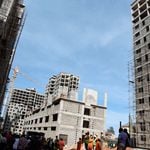
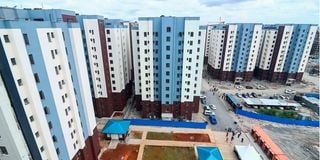
View of the new Mukuru Housing Estate Phase 1, Nairobi on May 27, 2025. The program is part of government's effort to improve housing affordability and reduce socioeconomic disparities.
Photo credit: Wilfred Nyangaresi | Nation Media Group
The government has revised upwards the amount it expects to collect from the Affordable Housing Levy for the current financial year, reflecting stronger compliance and enforcement of the monthly charge on pay slips that has, in the past, stirred legal, political, and economic debate.
Supplementary budget documents tabled in Parliament by Treasury Cabinet Secretary John Mbadi show that the statutory deductions are now projected to reach Sh97 billion from Sh95 billion estimates earlier this fiscal year.
The upward revision comes after the Kenya Revenue Authority (KRA) collected Sh73.2 billion in Housing Levy receipts in the financial year 2024-25, outpacing the Sh63.2 billion that had been projected by the National Treasury during that period.
If achieved, the receipts will represent a jump of 32.51 percent over the collections in the fiscal year ended last June.
A total of Sh54.16 billion was remitted by employers and employees towards the housing development levy in the first year of enforcement, which ended June 2024, narrowly missing the target of Sh54.58 billion by Sh415 million or 0.76 percent.
The collections in the debut year were, however, paused for three months between January and March 2024 after the deductions from employees — whether on permanent and pensionable terms or contract-based terms — were initially declared unconstitutional by the courts in late 2024.
Judges found the levy discriminatory because it applied only to workers in formal employment, creating unequal principles under employment law.
The ruling prompted lawmakers to move swiftly and enact the Affordable Housing Act 2024 to cure the defects identified by the courts. President William Ruto signed the Act into law on March 19, 2024, paving the way for the KRA to resume the deductions after the scope was expanded to include workers in the informal sector.
The Ruto administration has maintained a firmer stance on compliance with the Housing Levy despite stiff resistance from critics who have questioned its legality, fairness, and the speed at which the proceeds are being deployed.
“Three years ago, when we said we would deliver affordable housing, the cynics dismissed it as a fantasy. When they realised we were serious, they called it impossible. And when we broke ground across the country, they suggested that the projects would stall,” Dr Ruto told Parliament during his third State of the Nation Address last November.
“Today, those doubts have given way to a very different question from Kenyans everywhere: How do I get one of those units?” Employers are required by law to deduct 1.5 percent of gross monthly pay from employees and match the contributions towards the housing levy.
Despite the robust inflows into the affordable housing fund, absorption of the cash has lagged due to the phased nature of construction projects, which take time to plan and implement. As a result, at least a third of the proceeds has been temporarily invested in Treasury bills — short-term government securities that mature between three and 12 months.
Latest data shows that 1,795 finished units were put on the market in the financial year ended June 2025, with 93 percent of those houses being snapped up against a 50 percent target set by the Board.
Three projects were completed in that period, comprising 1,080 units in Nairobi’s Mukuru and 110 units in Homa Bay, which were both fully occupied, while 605 houses at Bondeni in Nakuru got an occupancy rate of 80 percent.
The report adds that the target for potential homeowners was missed, with 292,326 Kenyans registering on the Boma Yangu portal against a target of 565,800.
The housing levy is a central pillar of the affordable housing programme (AHP), which seeks to provide housing solutions across income segments.
The segments are social houses for those earning below Sh20,000 a month, affordable units for workers earning between Sh20,000 and Sh149,000, and middle-income affordable housing for those with salaries above Sh149,000.