The government has started easing restrictions on trading in strategic minerals, citing inadequate capacity at the National Mining Corporation to exploit and deal in some of the reserves.
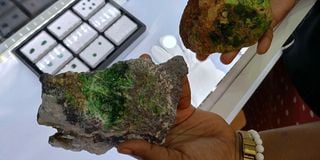
The State Department for Mining has temporarily lifted restrictions on the trading of tsavorite, one of Kenya’s most prized gemstones, allowing miners and dealers to resume business.
“Whereas these minerals should be handled by the National Mining Corporation, the Corporation, as currently structured, does not have plans to deal with Tsavorite,” Mining PS Harry Kimtai wrote in a letter dated October 16, 2025, to Voi Gemstone Value Addition and Marketing Centre.
“In this regard, you are directed to support and facilitate all miners, dealers, and traders of this important gemstone to undertake legal trading in the mineral through the Gemstone Value Addition and Marketing Centre.”
The minerals agency is the investment arm of the national government and has the power to engage in mineral prospecting and mining.
Mr Kimtai noted in the letter copied to the Mining Cabinet Secretary Hassan Joho and Taita Taveta Governor Andrew Mwadime that the directive will remain in force until the agency puts in place the necessary mechanisms.
The easing of restrictions follows a broader policy framework adopted by President William Ruto’s administration, which in October 2023 declared about 14 minerals as strategic to Kenya.
The classification was part of the conditions for lifting a four-year moratorium on the issuance of prospecting, mining, and trading licences imposed in December 2019.
Under the Mining (Strategic Minerals) Regulations 2017, minerals deemed strategic are those considered essential to Kenya’s economic, technological, or national security interests.
Minerals, which Kenya has declared strategic, are cobalt, graphite, copper, tantalum, lithium, niobium, coltan, nickel, tin, and radioactive ones such as uranium and thorium.
Also listed are rare earth elements, chromite, and tsavorite—the green gemstone, or green garnet, found almost exclusively in Kenya and Tanzania. The declaration means that while industrial and construction minerals were cleared for licensing in October 2024, activities involving strategic minerals continue to be vetted on a case-by-case basis.
Mr Kimtai said the government is strengthening the institutional capacity at the minerals agency— the investment arm of the State Department for Mining— which “is expected to spearhead exploitation of these [strategic] resources at the mining stage”.
“The government, having declared strategic minerals in October 2023, continues to engage investors interested in exploring for these minerals on a one-by-one basis,” the PS told the Business Daily.
“The capacity of the National Mining Corporation continues to be enhanced as the country races towards full exploitation of its abundant mineral resources.”
The decision to temporarily lift restrictions on tsavorite trading coincides with an ongoing court battle between the Kenya Chamber of Mines and the State over the implementation of the strategic minerals policy.
The chamber, which represents mining companies and dealers, sued the government claiming that the classification of certain minerals as strategic was effected without a transition period, leaving many of its members stranded with stockpiles they are not able to sell.
The lobby group said earlier its members were sitting on more than 40,000 tonnes of strategic minerals such as copper, chromite, and beryllium, which they could not export.
KCM Chairman Patrick Kanyoro said that a ruling on the case, initially slated for October 14, 2025, has been delayed to a later date.
“A trading company claiming exclusive rights to process copper sought to be enjoined to the case before the judgment was delivered. The court allowed the party to file its documents by November 2, 2025,” he said.
By channelling all legal trade through the Voi Gemstone Value Addition and Marketing Centre, the State hopes to improve traceability, boost local processing, and enhance revenue collection from tsavorite.
The bulk of the gemstone production, largely by small-scale miners, is said to have historically left the country unrecorded, with a smuggling ring operating from Taita Taveta to Tanzania and beyond.