Three years ago, Elisabeth Gomis, a French film director was tasked with the responsibility of writing a concept for a forum of the cultural and creative sectors in Africa.
“I knew the music industry was already set up but what are the other disciplines that need to be highlighted,” recalls Gomis, a former journalist who traces her roots to Guinea Bissau. “We went for disciplines that have high economic potential, starting with video games which is the creative industry that makes the highest amount of money in the world, even more than cinema. So, we were like ‘if this is true for the global north, why can’t the money flow into Africa.’”
The global gaming industry earned over $187 billion in 2024 with Africa’s market hitting $1.8 billion, according to the annual report by the Pan Africa Gaming Group (Pagg). Kenya contributes $46 million in gaming revenue, behind Egypt ($338m), Nigeria ($300m) and South Africa ($278m)
The first Forum Creation Africa in Paris in 2023, connected video games and related disciplines like animation and webtoons while this year’s event in Lagos, Nigeria, added other high-growth innovations to the programme: immersive world (virtual reality/augmented reality), video special effects, digital fashion and sound design.
Gomis was appointed as Director General of MansA – Maison des Mondes Africains (House of African Worlds) in 2024, a cultural institution dedicated to the promotion, transmission and celebration of contemporary African and Afro-diaspora cultures.
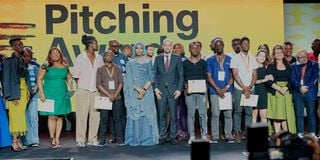
It was under MansA’s umbrella that more than 1,000 artistes, creators, producers and actors from over 40 African countries and Europe, recently met in Lagos to explore partnerships that would result in dynamic story-telling platforms and new economic models.
“Networking with creatives from across Africa revealed that we all face variations of the same challenges. There are issues Nigerians have already overcome that we can learn from, and others to which South Africans may have found solutions,” notes Salim Busuru, a Kenyan comic creator whose pitch won the webtoon category.
Kenyan illustrator and Avandu co-founder Salim Busuru after winning his pitch at the Création Africa Forum on October 17, 2025.
Photo credit: Thomas Rajula | Nation Media Group
“While you flip the pages of a comic, you scroll up and down a device for webtoons. The genre is the same, but the format is different,” he explains.
Busuru’s winning pitch was for his current project Moran, an action-adventure comic based on African mythology. “The story is based on three cultures across Africa, the Ashanti, Maasai, and Zulu, and explores what African tribes would pick from Western culture and integrate into their own way of life, and which practices they would reject,” he explains.
“My motivation has always been visualising African stories because we grew up seeing Western animations with alien creatures like dragons.”
With his team of five artists and writers, Busuru has been developing the story for one year now. “We are currently in pre-production and thanks to this successful pitch, we will travel to France next year and meet editors and publishers and hopefully clinch a deal to market the project in Europe and other parts of the world.”
Gomis cites a self-taught gaming creator from Guinea after presenting a winning pitch in 2023, asked to learn the whole value chain for video games and was connected to a tutor for 15 days, met engineers who helped him transform his project. “At the end of the day we are creating entrepreneurs, they come sometimes as artists and they finish the mentorship as entrepreneurs but you also have to do advocacy to financiers and policy makers to deploy your business plan.
Using her own background as a documentary filmmaker, Gomis urges Africans in the creative and cultural sectors to transcend their production roles and seek ways of moving into the executive rooms to influence decisions.
“As a director of films, you need to talk to a producer to find the money and that means you give up your rights. It means you are not fully responsible for what you are putting out in the world and my journey made me alive to this. Now that I am entering spaces that I never imagined before, I see that you have to be inside the room, you cannot be outside, to keep your story authentic from the beginning to the end,” says Gomis.
She adds, “If you lose one step in the process, your narrative will be changed because it doesn’t fit the requirements of this person or the other. You have to be responsible for the project from the idea until the project is delivered and it gives you power and your story is not erased or diluted just to make it more conventional.”
This year's Forum Creation Africa attracted high-powered guests like the Nigerian Minister for Art, Culture, Tourism and the Creative Economy Hannatu Musawa, the French Foreign Minister, Jean-Noël Barrot and the CEO of Access Bank, Aigboje Aig-Imoukhuede.
While touring the demonstration room, Aig-Imoukhuede was so excited about the creativity exhibited that he declared his company’s interest in supporting the developments in Africa’s creative sector.
“We need to accelerate because some people who have power and money are ready to finance,” declares an excited Gomis. “So, as people in the creative sector, we can speak totally freely and we can invite the policy makers, we can invite people with money to have discussions with us and at the end of the day reach a deal, maybe support for production, or a prize for a pitch.”
Gaming enthusiasts at the exhibition during the second Création Africa Forum in Lagos, Nigeria, held from October 16 to 18, 2025, which brought together over 400 creatives from across Africa.
Photo credit: Thomas Rajula | Nation Media Group
For creatives like Busuru the success of the forum in Lagos is a challenge to the African Union to come to terms with the creative sector as the next frontier for social and economic transformation on the continent.
“It is a huge challenge to do any collaboration with my Nigerian colleagues when I have to apply for a visa and fill out formalities like landing and exit cards. Let us just remove these barriers and allow the youth to travel and flourish.”
According to Gomis, some governments have done better than others by investing in the creative sector. “Benin has designated culture as the second pillar of the economy, Morocco has created a whole ecosystem for video games, Senegal is investing big in cinema and of course the creative industry is giving a good image to Nigeria with its Afrobeats.
This is the moment for the youth to go and tell their leaders “Ok, it is the French Government who supported this in Nigeria. You are here, you are the Minister of Culture in Nigeria; I am a young Nigerian working in those fields, what can we do?”
At that time what can you do as a Minister? You are forced to listen and act because your own people are looking at you. The fact that our Minister travelled from Paris to be here, forced the policy makers in Nigeria to make a move because it is your country here and it can’t be a foreign state that is running the show.”