The past few weeks have offered theatre lovers plenty of acts to keep them hooked. It started with Foolish Forties, a one-woman show by Dr Zippy Okoth, which has been on the trend in a countrywide tour that saw it go through Kisumu, Mombasa, and Nairobi.
This coming week, another one-woman act is set to take centre stage at the Macmillan National Library, in a show dubbed Elements, starring Wakio Mzenge and directed by Stuart Nash.
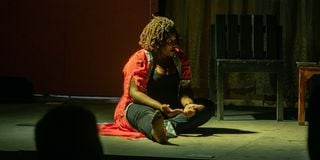
For Stuart, Elements is a big jump from The Trial of Dedan Kimathi, which at some point had over 100 acts on stage. Elements by John Sibi Okumu is simply a one-woman playing 12 characters in a library setting.
“It is a lot easier to direct, as compared to previous projects like The Trial of Dedan Kimathi,” Stuart says.
Elements was initially written as a collaboration aimed at building relations between Kenyans and the French. It was first commissioned by the Alliance Française and written for a French Guadalupian actress. It builds on the issue of identity from the viewpoint of John Sibi Okumu.
It is based on the building of the East African Railway from Mombasa to Kisumu and is curated as a love story of an Indian who fell in love with a Luo girl, which led to the birth of a young man.
The young man would go to study in the UK, where he met another woman from Jamaica with Irish and African descent. The two would have a relationship culminating in the birth of a girl called Dana, who becomes the central figure in Elements.
Dana, who is half Indian, half African, half Irish, half Jamaican, battles the considerations surrounding issues of identity in the quest to find herself. Elements is reflective of not only generational but also racial and childhood trauma on a stage.
Dana fights to find a footing in a society that doesn’t know where to place her.
As an author, Dana’s outlet is her books, whose stories are influenced by her experiences growing up, which affects even her children.
In Elements, we meet Dana when she is remembering the death of her son a year ago. It is the opening of a can of worms where she reveals the things that have influenced her writing on stage; it is a therapeutic session where she is mourning her son, and in it, she cascades into a vulnerable state to find meaning and healing.
For Wakio, Elements has three audiences: the people who are viewing the play, her students in whom she is preparing her presentation, and finally herself in her own room as she is preparing the presentation.
“This is the trickiest part of this act; to be able to distinguish the audience in the room, the imagined student audience in my head, and also to myself in my house just rehearsing,” she says.
She says the ability to hold people’s attention for one and a half hours simply stems from being honest.
“By being authentic in my delivery and by being present in that situation is what pulls me through. Audiences usually connect with feelings; you cannot connect with your audiences if you are not feeling it yourself. Authenticity is the only thing that allows me to connect with the audience for one and a half hours,” she says.
In Elements, 12 different characters come to play in the performance.
“I have directed the play before, and my biggest fear was that people would not be able to get it,” she says, “but they got it. Elements is about one woman who embodies other characters, which is a delicate act. In Mombasa, it turned out to be a therapy session once the play was done because we ended up having an intimate conversation with the audience. I thought we should have carried a therapist or a counsellor,” she says.
“Dana, a celebrated author, represents successful women who are perceived to have gotten everything going on well with themselves. We have isolated such women so that there is no one to speak about their challenges or express their vulnerabilities. We see that with Dana, where she is at home by herself, imagining an audience, that’s how terribly isolated some of those women who are doing well are.”
Dana represents high-flying women battling their own misunderstood demons who find comfort in toxic relationships or unwarranted spaces that make people question their sanity and existence.
“I am interested in creating a conversation with men who care about the well-being of women around them because they know that a woman doing well is society doing well.”