Dressing for the season: How holiday fashion has become personal purposeful and African

Zawadi oversized jacquard knitted vest, worn with the Waridi shirt by New York based Kenyan designer Anyango Mpinga.

Photo credit: Pool

It is December and wardrobes across Kenya have already shifted. The weight of the year loosens, calendars open to reunions and celebrations, and fashion, quietly but deliberately, takes centre stage.

Holiday dressing has always carried meaning — a visual marker of joy, gratitude and renewal. But in recent years, that meaning has evolved.
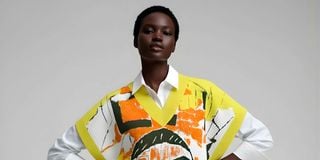

For New York based Kenyan designer and visual artist Anyango Mpinga, says holiday fashion today is no longer about excess or rigid glamour. It is about intention, comfort and identity — and above all, freedom.

“Holiday fashion has become more personal,” she says. “People are no longer dressing to impress systems. They are dressing to honour themselves.”

Across Kenya’s cities and towns, festive fashion has undergone a quiet transformation. Gone are the days when celebration meant enduring restrictive silhouettes or sacrificing comfort for spectacle. Today’s holiday wardrobe reflects the realities of modern life — travel, long days, shifting temperatures and multiple events in a single day.

Ms Mpinga sees this shift as both practical and philosophical.

“The pandemic changed how we relate to our bodies,” she says. “People want to feel good in what they’re wearing. They want elegance, yes — but they also want softness, breathability and movement.”

Her approach mirrors a broader trend: flowing maxi dresses, relaxed tailoring, statement shirts and fabrics that drape rather than constrain. It is fashion that invites the body to exist naturally.

“There’s no celebration if you’re uncomfortable,” she adds. “Clothes should move with you, not against you.”

Ms Mpinga’s work sits at the intersection of fine art, fashion and spirituality. Known for her abstract cubist paintings and bold visual language, she has spent years exploring identity, autonomy and African aesthetics on canvas. Translating that vision into wearable form was a natural evolution.

“My art has always been about the human form and the human spirit,” she explains.

Her holiday-ready collections reflect this philosophy. Prints drawn from her paintings appear on resort wear silhouettes designed to transition seamlessly from daytime gatherings to evening celebrations.

“These pieces are about claiming space,” she says. “They say: this body is mine, this life is mine.”

One of her most striking holiday offerings comes not in clothing, but in accessories. Her raffia bag collection, Faces of the Earth, draws inspiration from Sukuma masks of Tanzania, a nod to her cultural heritage.

In Sukuma tradition, masks are more than decorative objects. They serve as vessels of ancestral wisdom, used in ceremonies to communicate with the spiritual realm and preserve community memory.

“I wanted to honour that history. These masks carry stories, protection and continuity. Translating that energy into something functional felt powerful.”

Endrika large raffia tote bag by New York based Kenyan designer Anyango Mpinga.

Photo credit: Pool

Handwoven in Madagascar by women artisans working with Adelino Studio, each raffia bag is embroidered with abstract facial motifs derived from Ms Mpinga’s paintings. The colours, she explains, are inspired by the chakra system, which is a universal language of energy and balance.

“Each bag becomes a modern talisman,” she says.

No two bags are identical. Each piece bears the subtle variations of handcraft — a deliberate rejection of mass production.

The collaboration with artisans in Madagascar was not without challenges. During production, political unrest and a coup in Antananarivo brought work to a standstill.

“There was a moment when everything paused,” she recalls. “But the women finished the pieces when it was safe. What came out of that period was not just product — it was resilience.”

For her, sustainability goes beyond environmental considerations. It is about people, dignity and continuity.

“Sustainability is cultural preservation,” she says.

This ethos resonates strongly during the holiday season, when consumption peaks. Ms Mpinga encourages buyers to invest in fewer, meaningful pieces — items that last beyond December.

“A hand-embroidered bag or a well-made garment carries value long after the season ends,” she says.

She designs with versatility in mind. Her pieces are intentionally trans-seasonal, built to be layered, restyled and reimagined.

“For daytime gatherings — brunches, family visits, market walks — keep it simple,” she advises. “Let the print or the accessory do the talking.”

For evening events, she suggests elevating the same outfit with sculptural jewellery or a statement bag. The clothes, she says, should form a canvas rather than compete for attention.

“Holiday fashion should work for real life,” she adds. “We move a lot during this season.”

Her approach reflects a broader shift toward practical glamour — fashion that adapts rather than dictates.

This holiday season, Ms Mpinga observes several key trends shaping how Kenyans dress. Artisanal craftsmanship is taking centre stage, as consumers increasingly ask, “Who made this?” Bold colour palettes — jewel tones, sunset hues and spiritually significant shades — are replacing predictable festive reds and greens. Cultural confidence is growing, with African prints and silhouettes worn unapologetically across all settings.

If she had to narrow it down, Ms Mpinga says three wardrobe items instantly elevate any festive look they include, a statement bag. “A distinctive bag changes everything,” she says. “It’s the first thing people notice.”

Sculptural earrings that frame the face and create instant presence and a perfectly tailored shirt.

“Natural fabrics with beautiful drape are key,” she says. “Glamour doesn’t mean tight.”

She also champions elegant flats and block heels — a quiet rebellion against painful footwear.

“Our feet carry us through life,” she adds. “We should honour them.”

She believes Kenyan designers are redefining modern holiday fashion by blending tradition with innovation.

“Local designers understand our realities — the climate, the occasions, the bodies. That matters,” she says.

By supporting local fashion, she argues, consumers invest not just in clothing but in creative ecosystems and cultural continuity.

Her connection to fashion is deeply personal. Growing up, her mother would commission New Year’s dresses from a tailor — garments made specifically for her.

“That taught me that clothing can be intentional,” she recalls.

Her mother, who passed away last year, remains a guiding influence.

“She believed beauty was a form of dignity. That philosophy lives in my work.”

This holiday season, Ms Mpinga is deliberately breaking the rule that art belongs only in galleries: “Why can’t your bag be a canvas?” she asks.

She also rejects the idea that statement pieces should be saved for special occasions.

And finally, she challenges the false choice between comfort and impact.

For her, holiday fashion is ultimately an act of presence: “It’s about honouring your ancestors, celebrating your body and showing up fully,”
As December unfolds, her designs invite wearers to do just that — to celebrate loudly, consciously and beautifully.

“Wear your art,” she says. “Carry your story. And never apologise for taking up space.”


PAYE Tax Calculator

Note: The results are not exact but very close to the actual.