This Christmas, pyjamas are the new Sunday best

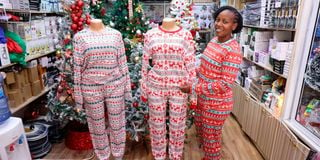
Caroline Wanjeri Murimi, pictured at her shop, Carole Home Solutions, in Nairobi on November 28, 2025. There has been a surge in Christmas pajama sales as the festive season nears.

Photo credit: Bonface Bogita | Nation Media Group

Christmas used to be a chance for Kenyans to dress up. Great fuss would be made over Christmas clothes and shoes, with parents even budgeting for the expense early in advance and children counting down the seconds until they could show off their new purchases.
But the times are different now.

A new trend is taking over, where Kenyans are increasingly turning to a more dressed down option for the festive celebrations: matching Christmas pyjamas.

Across Nairobi, this cosier option has become one of December’s biggest retail drivers and few know this better than Caroline Murimi, the owner of Carole Home Solutions, an outlet that stocks everyday household staples.

“I have been in business for seven years now, but I started stocking Christmas pyjamas and other festive items about four years ago,” says the entrepreneur. “This decision was based on a gap I saw - there was demand for these items, but the supply was lacking.”

With the Christmas pyjamas being capital-intensive and the time frame of selling out your stock being very short, she understands why some people would shy away, but business has been on an upward streak ever since she took the risk.

“People have embraced photo shoots and the idea of creating memories, and there is also the factor of seeing other families looking good in coordinated fits and wanting the same for themselves.”

This shift has made it so that the once niche curiosity is now an urban essential seeing buyers this year, making orders and purchases earlier than ever.

“Kenyans used to be last-minute shoppers but it seems like they’re catching up with early planning,” Ms Murimi notes. “A lot of people would usually come in December, but this year, for some reason, they started ordering as early as November 1st.”

The best sellers

Her best sellers are the red polycotton family sets, which she says are light enough to sleep in, but also durable enough to last all year.

For the children, her sets go for around Sh1,500 while the adult’s set averages at around Sh1,900. Sales, she reveals, are mostly driven by social media - Tik Tok and Instagram.

Still, the logistical headache is real.

“We barely sleep in December. I get three to four hours a night just so I can ensure that I clear my entire stock,” she admits.

“But it’s also challenging when we clear our stock and the demand is still there. You can’t really predict the demand in a year, but it’s frustrating when some sizes sell out and customers are forced to compromise. It makes you wish that China was closer so you can just go and restock some more.”

Someone else with a front-row seat to the festive fad is Edwin Mokaya, co-founder of Keliam Kids Baby Shop. While the shop mainly sells baby furniture, children’s clothes, and maternity essentials, they also stock Christmas fits: pyjama sets, festive t-shirts, and thrift rompers, when the festivities come around.

This addition crept its way into their shelves slowly at first, then all at once after they noticed how long their customers took trying to choose lounge/night wear sets for each member of the family.

“That’s when we realised there was a gap, both for matching family sets and for adult pyjamas because we were initially stocking for children only,” says Mr Mokaya.

He says the festive trend is being pushed by young parents, especially those celebrating a baby’s first Christmas - a milestone that often comes with a themed photo shoot. If the baby has siblings, demand goes up. But it is not limited to families alone. He also attests to seeing groups of friends and chamas hopping onto the trend.

“And social media, particularly TikTok, plays the biggest role in the momentum of this trend,” the businessman mentions. “I think this is where the matching pyjama idea really grew because it allows families to share more real-life family moments.”

Naomi Makori, also a co-founder of the baby shop, adds that the willingness of Kenyans to splurge a little more toward the end of the year plays a big role in driving sales.

“People spend without much thought in December,” she observes. “If mummy wants coordinated fits for the entire family, that’s it, they are buying them.”

Their brand-new cotton two-piece sets range between Sh2,700 to Sh3,500, while their thrifted rompers, which fly off the shelves as soon as they land, start from as low as Sh450 all the way up to Sh1,200.

“These rompers are unique, cosy, top-notch when it comes to quality, and very cost-effective,” says Ms Makori. “It’s not a surprise that they sell out so fast.”

Something else that moves quickly are their Christmas-themed t-shirts which are priced from Sh300.

“For these we only have smaller sizes for children aged 0 to 5 years, and they mostly sell towards the end of October when schools are about to close,” Ms Makori says. “I think it’s because most schools have end-year school activities and they tend to go for anything Christmas-themed for those.”

The business pain

For the baby-centered business, their biggest pain is import delays.

“If stock delays, our customers can sometimes get very impatient and end up either buying somewhere else or giving up altogether,” says Ms Makori. “We’ve come to learn that proper planning is everything.”

Edwin Mokaya (right) and his wife, Naomi Makori, wear matching Christmas pajamas at Keliam Kids Babyshop in Utawala, Nairobi, on December 5, 2025.

Photo credit: Bonface Bogita | Nation Media Group

One of those representing the new wave is George Mbugua of Haven Brands. His daughters started reminding him in August about the matching Christmas pyjamas he’d promised to buy this year.

“They had requested them in 2024, but by the time they did, it was too late. The shades and quality that we wanted were all sold out,” the father of four says. “This year, my third born, who is turning six, was careful to remind me early in advance so there would be no excuses.”

For the Mbuguas, this will be their first Christmas in matching pyjamas, and the idea, Mr Mbugua says, was generally conceived by his girls.

“I bought them, but it definitely was not my idea,” states the 36-year-old. “My children have cousins in the United States, so I think when they video-called them last Christmas and saw them all matched up in their festive pyjamas, they also wanted to do the same.”

Finding them cute on everyone else, Mr Mbugua got one for each of the girls and another for his wife, but none for himself.

“That was the agreement. I told them, if Daddy is buying, he is not wearing them. At most, I’m just the camera guy.”

The plan, he believes, is to wear the comfortable sets, the night before Christmas.

“We usually gather upcountry as a family and have a bonfire on the night of the 24th. We grill some meat, dance to some music, and the adults have some drinks while the children play. I think that is when we really celebrate our Christmas as a family, so I know for a fact that this is where the matching pyjamas will come alive.”

And like many others who are buying the matching wear, a photoshoot is in the mix for the female-dominated household.

As a matter of fact, they have already done one photoshoot, but Mr Mbugua anticipates one more after they do the annual migration to their rural home for the festivities.

“The pyjamas have some green patterns, so my first born daughter, who is a teenager now, thinks the bush setting upcountry will blend very well with the patterns and she wants us to take more photos there.”

Not certain about posting these photos on social media, the most that the young father is contemplating, is printing and framing them.

“I’m not active on social media, and though my wife does better, she rarely ever posts the children,” he says. “I work in the branding industry, so I am thinking of printing those that have a nice background. Framing is an option, but because my girls love fridge magnets, I’m sure I’ll make some for them.”

There is also Brenda Cherotich, whose son is aged one year and some three months. She was the brains behind her family’s festive tradition and the idea came to her after she saw it online and fell in love.

“This is our second year wearing matching Christmas clothes,” she says. “The first time we did it, my son was three months old and it was his very first Christmas. He was too young then to realise what was going on.”

The family of three get their synchronised fits early in December, and organise a day at a studio for a photo shoot. These photos, Ms Cherotich says, she posts all over her social media but also keeps them well to give to her son when he turns eighteen.

For Ms Cherotich, it’s all about the memories. “When I was young, Christmas was all about food. But that doesn’t apply to the younger generation. They eat these nice foods everyday. So I wanted to make nice memories for my child and I take photos, so that he will grow up associating Christmas with family time and shared moments of bonding.”

Additionally, she cherishes these photo shoots even more because they provide an opportunity for her and her son to spend time with the man of the house.

“He’s a very busy man,” she states. “For him to come and join us in doing a Christmas matchy-matchy photo shoot means that he values us enough to sacrifice his time at work.”

Beyond the photo shoot however, the family wears their comfy suits all through December, after all, the young mother comments, the whole of December is Christmas isn’t it? They lounge in them, sleep in them, and on Christmas Day, when they are with the rest of their family, they dress up the baby in them for representation.

PAYE Tax Calculator

Note: The results are not exact but very close to the actual.