Imagine stepping into a restaurant where you cannot rely on your sight to walk to your table or pick up your fork or knife, and instead, the aroma of food and the feel of cutlery guide you.
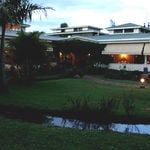
That was the experience at Dining in the Dark at Nairobi’s Karen Country Club — an event that let diners experience what it is like to eat out as a blind person.
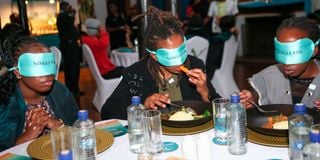
At the entrance, each of us was blindfolded and guided into a pitch-black restaurant. Finding our way to the table, we were led by blind waiters and waitresses. As “blind” diners, we needed to have trust, patience, and surrender to our guides.
The guides knew the room well, having memorised every corner, every chair, and every table assigned to them. They guided us calmly, making sure that each person found their seat as they settled us into a world where they, not us, held all the power.
The dining experience lasted nearly three hours, during which we, still blindfolded, were served a full three-course meal.
Eating without sight is far more complicated than one might imagine. How you pick up and use your fork and knife is very frustrating, and at some point, even food slipped off the fork before it reached my mouth.
Participants during the Dining in the Dark event held at Karen Country Club in Nairobi on September 27, 2025.
Photo credit: Billy Ogada | Nation Media Group
I had to rely on my fingers, on the textures I could feel, on the aroma from the warm plate, and on the taste buds that came alive when I finally managed to put food in my mouth.
Every bite became like a guessing game, around the tables, you could hear diners asking: ‘Did you taste chicken? Fish? I think I tasted cheese. I found something on my plate that tastes like beetroot.’
The light banter helped us figure out what was on our plates.
Evelyn’s world
One of the waitresses of the day was Evelyn Ogola. She lost her sight 10 years ago after an intracranial pressure condition that damaged her optic nerves. She can now only sense a faint light with her right eye.
“This is actually my first time serving as a blind waiter, and it has been a good experience. At first, I was a bit anxious, but it went well,” she said.
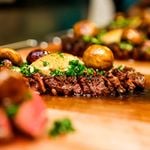
Singleton-infused dessert served during the Dining in the Dark event held at Karen Country Club in Nairobi on September 27, 2025.
Photo credit: Billy Ogada | Nation Media Group
Ms Ogola had a way of knowing what we were too embarrassed to admit. At one point, she asked, “Your plate seems full; it seems like you haven’t even eaten?” How could she tell?
“When I held your plate, I felt it, and it was still warm, so I knew there was still some food,” she explained.
Since it was a blind date, Ms Ogolla, just like the other guides, tried to calm the anxiety among the diners, especially that uncertainty that cames as we waited for our next meal.
“Will I be served what I don’t like? Will my food have so much soup? Will the food be so hot for my fingers?” I kept asking myself.
For the visually-impaired, especially when in formal dining circles, the “clock method” is often used when describing what is on the plate. Food is described as if arranged on a clock face; for instance, potatoes are at three o’clock, vegetables are at nine o’clock, and meat is at six o’clock.
Her advice for those who host or dine with the visually impaired, she said, “Kindly describe what’s on the table, what’s on the plate, describe to them where the cutlery is, tell them on your right this is what is there, on their left, so that they get a feeling of what is there, so that they don’t feel like out of place. Briefly, just describe what they are having to make them feel at home.”
Participants dine in complete darkness during the Dining in the Dark event held at Karen Country Club in Nairobi on September 27, 2025.
Photo credit: Billy Ogada | Nation Media Group
Trevor Koronei, one of the organisers who is a dual member of Karen Country Club and the Global Shapers Community, said the event was more than just dining. He explained it to be about filling a gap in society.
“Internally, we see a gap in society and pursue it. We wanted to support people with visual impairment, for people to feel that sense of compassion,” he said.
Dining in the Dark, he added, was designed to awaken empathy by taking away one sense and sharpening the others. “The concept of the evening is for a sensory experience, of taste, smell, touch, and hearing. All those different aspects will be highlighted, essentially we need to focus on that and feel what it is to have dinner without your sight.”
A chef who cooks for your senses
In the kitchen, Chef Polycap Emmanuel of Karen Country Club had crafted a menu with precision, knowing that on this night their plating would not be admired, neither would the colours be noticed. What mattered was the texture, aroma, and taste.
“For starters, we did a beetroot and feta salad. The beetroot was roasted using cinnamon and honey, and then the mango was soaked in a reduction of vinegar and sugar. We had rocket leaves, some walnuts, and just a touch of feta cheese,’’ the chef said.
“All these were cut into small cubes, just to make it a bit easier because the diners had blindfolds on them, so they couldn’t see what they were eating. We made sure that every dish we served was in terms of portioning very few things on the plate, things that they can actually either handpick or use cutlery easily, so that it’s not a struggle,” the chef added.
The main courses carried the same thoughtfulness. Beef fillet roasted and soaked in 15-year Singleton and thyme juice, roasted chicken supreme steeped in mushroom and 12-year Singleton reduction, a panko-crusted fish fillet dressed in lime butter with Singleton sauce, and for vegetarians, mushroom risotto arancini. The picks were all served with buttered mashed potatoes alongside vegetables.
Participants during the Dining in the Dark event held at Karen Country Club in Nairobi on September 27, 2025.
Photo credit: Billy Ogada | Nation Media Group
Chef Polycap said that the inclusion of Singleton whisky in multiple dishes was intentional. Whisky, especially single malts from regions such as Speyside or the Highlands of Scotland, is celebrated for its aromatic complexity.
Depending on its origin, it can carry different notes like smoke, peat, fruit, honey, or spice. The spirit stays on the palate even after the bite is swallowed, and its vapours rise into the nose, which helps to amplify aroma and aftertaste.
The night’s dessert, too, had an inclusion of a sensory trail: a tiramisu with its rum-soaked base, an apple tart, and a chocolate-orange gâteau infused once again with Singleton malt.
“The sense that we most considered was the smell and then the aftertaste of the Singleton malt alcohol,” Chef Polycap said. “Once you eat something, you might not feel it at first, but as you proceed and take time to actually dig into the dish, you get the fruity flavours of the Singleton malt.”
Fashion that includes
For Angela Wanjiku, the experience carried a personal weight. As the founder and creative leader at Hisi Studio, her life’s work revolves around accessibility. Their label designs are curated with an adaptive fashion where their clothing is tailored for persons with disabilities.
Participants during the Dining in the Dark event held at Karen Country Club in Nairobi on September 27, 2025.
Photo credit: Billy Ogada | Nation Media Group
“Our adaptive fashion is targeted at persons with disability. We work with visually impaired people to make sure that fashion is accessible to them. We add braille to the pieces we produce as well as tactile phrases and prints. We also integrate assistive technology (AI) through our tags, and have QR codes that give an audio description of the garment,” she said.
However, Ms Wanjiku observed that in this set-up, it was a new aspect because they have been dealing with the daily activities when it comes to dressing, but not around food, restaurants, and etiquette around dining.
“This has been very different. I have done lessons on orientation with mobility, but never on eating.”
Seated in total darkness, Ms Wanjiku said she realised just how much dining relies on sight. The comfort of seeing food arranged neatly on a plate and the unspoken reassurance that you are “doing it right.”
However, she admitted to having surprised herself. “Yes! To be honest, the difference was that I had no vision, but it was good, and I am satisfied. I did it with a lot more ease than I thought I would, given that I am a professional in this field.”