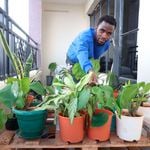
When Pamela Raburu was moving into her third home, she never imagined that a garden would raise its value. She had rented twice before, which she felt was like “pouring money down the drain.”
“Back then, I realised that renting was just pouring money away,” she says.
“I used to pay Sh20,000 for a two-bedroom apartment, and when I wanted a three-bedroom apartment, the rent was Sh30,000. Then I did the maths: 10 years of rent would cost millions, and I would have nothing to show for it. That’s when I decided to buy a house on a mortgage. It wasn’t easy, but today I have peace of mind knowing that I live in my own home.”
She bought a house in Kitengela for Sh3.8 million which sits on an eighth of an acre in a gated community. That was about ten years ago and Kitengela was dry and rocky. Now she has turned her home into a thriving little jungle that wraps around her home. She estimates the house would cost well over Sh10 million, thanks to the renovations and her breathtaking garden.
But why did she choose to buy a ready house and modernise, rather than buy land and build?
“If you’re planning to buy a home, take my advice: choose a gated community. Don’t isolate yourself in a big standalone house. When the children move out and you’re all alone, loneliness can set in. I’ve seen people living alone in beautiful houses, slowly slipping into depression. That won’t be me. I have my neighbours, my community, and my joy,” Pamela says.
“Yes, we share one main gate and each compound is private, but we all interact. I step out, see my neighbour, and say hello. Sometimes we share tea, dinner, or just a laugh. That human connection is priceless.”
When Pamela moved into her home in 2015, the land around it was bare.
Most of the homes had either murram or rocks at the front and backyards. A few people had a tree or two in their compounds.
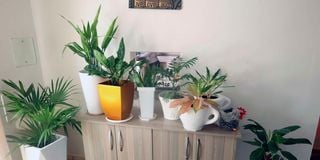
Indoor plant arrangement at Pamela Raburu's house at Meridian Park in Kitengela,Kajiado County on October 30, 2025.
Photo credit: Evans Habil | Nation Media Group
“I planted this big tree,” she says, pointing at a medium-sized indigenous tree.
Over the months, she made changes to the garden as she refurbished her house, transforming it into a space where she would love to have her friends and family.
Five years later, the pandemic hit, and people started working remotely. Then boredom crept in.
“A friend took me to visit her friend who lived in Garden City. She had a breathtaking garden, lush, vibrant, and filled with all kinds of plants,” she says, “I was inspired. I found myself thinking: what can I do at home now that most people are working remotely? I had some plants along my driveway, but they weren’t very attractive.”
She then started to slowly add new plants.
“It wasn’t a big project, but it kept me busy and happy during that period,” Pamela says.
Then, in 2022, during a conference at a university, one speaker posed three questions that would forever change her mindset: ‘What makes you different? What’s your passion? What can you do beyond your career?’
“That question struck me deeply. It was a moment of awakening. I realised that I could turn my newly found love for plants into something more meaningful, and possibly even a business.”
Using the small amount of money she had received for the conference, Pamela bought a few plants and started a small nursery. She became intentional about learning about flowers.
“I began collecting plants whenever I travelled, experimenting and growing my knowledge. I turned to what I call my ‘University of YouTube’. On social media, I followed gardeners from around the world, learning about different types of plants, how to water, their lighting needs, and soil composition.”
During this time, Pamela noticed that many local plant vendors did not know much about plant care, and she wanted to learn more.
“Now, whenever I buy a new plant, I research its name, its ideal light conditions, whether it’s for indoors or outdoors, and how to care for it. That’s why my plants look healthy and vibrant,” she says.
When BD Life visited her home on a Wednesday afternoon, it was raining heavily.
“My garden loves the rain,” she chuckles.
Her grass stands out, especially in Kitengela. She has grown Arabica grass, a thick, carpet-like variety, also considered water-thirsty. Five years ago, it cost her Sh20,000.
Her garden is designed in a container style with a mix of ornamental plants and a collage of colour and form. She has red, pink, and white Crown of Thorns blooming beside geraniums and nasturtiums, while Callisia repens 'Pink Lady' spills from clay and concrete pots in shades of pink and purple.
Eleven varieties of palm trees sway softly in the breeze, ten types of philodendron climb and curl, and five monstera stretch their broad leaves towards the light.
Pamela Raburu flower garden at her home at Meridian Park in Kitengela, Kajiado County on October 30, 2025.
Photo credit: Evans Habil | Nation Media Group
And then there are her beloved aglaonemas, 15 varieties of them glowing like living art. “They’re my favourite,” she admits. “Their leaves are like paintings, each one different, but all beautiful.”
Her verandah is another green haven, lined with over 10 thriving plants that frame her mornings in soft shades of green. Hanging pots dangle above, their rhipsalis and pothos trailing like cascading ribbons. In one corner sits her succulent collection: a charming cluster of echeverias, aloes, and haworthias, each one a tiny terracotta sculpture.
“That’s my quiet corner,” she says. “Low maintenance, but full of charm.”
We step inside, and the house feels like an extension of the garden: alive, fresh, and calm. Around 20 houseplants occupy various corners, giving the rooms a soft glow.
Her favourite aglaonema stands proudly by the dining room entrance, its leaves spreading wide as though to welcome her home.
“That one,” she says, “fondly greets me every time I walk in.”
The first plant she bought was a golden palm in Mombasa. “I tried growing it indoors, but it didn’t thrive. Eventually, I moved it outside, and it thrived.”
She has bought plants from all over Kenya, including Mombasa, Nyeri, Eldoret, and Kisumu, as well as from Dar es Salaam.
Sometimes, she buys neglected plants, nurses them back to health, and then sells them on.
“It’s not really about profit. I just love taking care of them. This is my therapy, it keeps me sane.”
Sh15,000 Bismarck palm
What defines her choice of plants? “I mainly buy plants for their beauty. If I see one online that I love, I’ll look for it until I find it,” she says.
Her prized possessions include cycads and Bismarck palms. I bought some when they were young for around Sh5,000 each.
“Today, a mature Bismarck palm of that size sells for around Sh15,000,” she says.
A typical day in her garden involves watering, propagating, changing the soil, removing weeds, and moving the plants around to ensure they each get the right amount of light and shade.
Pamela Raburu Aglaonema at her house at Meridian Park in Kitengela, Kajiado County on October 30, 2025.
Photo credit: Evans Habil | Nation Media Group
To her, plants definitely add value to a property.
“If I ever decide to sell this home or convert it into an Airbnb, the garden would significantly increase its value. The beauty and serenity of this space are priceless,” she says.
Dying plants
Of course, the gardening journey hasn’t been without challenges. “When I started, I lost many plants, mostly due to using the wrong soil, overwatering, or too much sun,” she explains.
Mixing soil remains her biggest challenge. “I now buy soil and pumice from suppliers in Gikambura and Redhill, paying between Sh1,000 and Sh1,200 for a 90 kg bag. It’s expensive, but worth every shilling.”
One plant, from the Aglaonema family, continues to test her patience. “I’ve changed the soil several times, but it still struggles. Nevertheless, I won't give up,I'm determined to see it thrive.”
Over time, Pamela has learnt to understand the rhythms of Kitengela’s climate. She waters the plants according to their needs. “This place may be dry, but with the right care, even Kitengela can bloom,” says the 57-year-old.
Early retirement
For decades, she worked in the civil service as a human resources professional. However, in April, she took early retirement, not because she was tired, but because her heart was calling her elsewhere.
“I wanted to nurture myself,” she says gently. “To take care of my mental and physical health and to live with intention.”
She gifts plants to friends, schools, and hospitals, especially to her clients, the bereaved, and the sick.
“It’s a quiet kind of therapy.”
Now retired, she starts her mornings at 6.30 am with a prayer, followed by 30 minutes of exercise. Then she has breakfast in her front yard, where she soaks up the sunlight for vitamin D and reflection.
Her two children no longer live at home, and her granddaughter visits occasionally.
“It’s an empty nest now,” she says. “But these plants, they’ve become my new children. They keep me company. They respond when I care for them.”
Travel to see gardens
Her love for plants has taken her to many countries.
She remembers visiting the Kirstenbosch National Botanical Garden in Cape Town, where she climbed Palm Mountain and collected wild stems to take home.
“Wherever I go, I find myself bringing back a plant,” she says.
“I also went all the way to the Cape of Good Hope and climbed Palm Mountain. Out of love for plants, I picked a few stems. “I even bought a small succulent with rectangular leaves for around Sh400.”
Her next dream destination is Thailand, where she hopes to visit the Nongnooch Tropical Garden in Pattaya.
“It’s one of the most beautiful gardens in the world. One day, I’ll save up and go just for the love of plants,” she says.