A teacher who climbed Kilimanjaro 300 times, turned hiking into career

James Kagambi became the first Kenyan to reach the Everest peak in 2022. 

Photo credit: Pool

Mountaineering is a divine passion to him. A return home to where he belongs. To everyone else, he is James Kagambi. To those who know the sound of crampons biting into ice, he is KG. His life has balanced the security of convention with the risk of passion.

The 65-year-old is a Kaimosi Teachers Training College alumnus, which should mean that, like many of his classmates, he would now be enjoying retirement after decades in the classroom. James, however, taught for only about five years before devoting himself to the mountains.
The passion later became a career spanning more than four decades, including summits of five of the seven highest peaks in the world.

His family, like many in the 1960s, believed in the safe path. Success was becoming a teacher or civil servant, a respectable job with a pension and the stability to raise a family. Mountains were for tourists. Hiking was for wazungu. For sons of peasant farmers, mountains were scenery, not a life’s work.

On the morning of May 12, 2022, KG placed the Kenyan flag on the roof of the world at 8,849 metres, becoming the first native East African citizen to summit Everest. It was a succinct moment of prayer and thanksgiving, disbelief and gratitude, carrying the flag of his country and representing the dreams of countless climbers.

James Kagambi was welcomed at Jomo Kenyatta International Airport in Nairobi, Kenya, on May 23, 2022, upon his arrival as the first Kenyan to reach the summit of Mount Everest.

Photo credit: File | AFP

“People imagine you scream when you get there,” he says. “But the truth is, you are too tired to scream. You are just grateful that you are alive. For me, it was a prayer of thanks, a moment of history, but also a moment of silence.”

In the 1980s, KG was a primary school teacher in Nyeri, posted to a small “forest school” near the edge of Mount Kenya National Park. He taught five days a week, but his weekends were given to the outdoors.

“I’d be in the forest every chance I got,” he says. “Sometimes I’d see elephants, sometimes nothing at all. Being outdoors gave me a sense of freedom I couldn’t find anywhere else.”

His daily walks cut through fields and wooded areas. A deep connection with nature shaped his choices. “I loved the outdoors from the beginning,” he says. “I could spend a whole day walking, just to see what was behind the next hill. When I later met mountains, it was like meeting a friend I had always been waiting for.”

As a teacher, his love of physical activity stood out in the teams he coached. He took pupils to district tournaments and trained athletes for provincial meets. “I put my all into teaching but I could feel my calling was somewhere else.”

He says he began “by accident,” yet that accident took him to the roof of Africa more than 300 times. Yes, KG has summited Mount Kilimanjaro more than 300 times. To match his record, you would have to summit daily for almost a year. He has also spent 15 years in Chile’s remote ice fields, training generations of rangers and rescue teams.

James Kagambi, left, leads a team of Kenyan mountaineers to the summit of Point Batian on Mount Kenya to raise the national flag on December 12, 2013, to mark 50 years of independence.

Photo credit: Joseph Kanyi | Nation Media Group

Sighting of snow

The transformation from rural schoolteacher to the first Kenyan on Everest is the story of a man who said yes to opportunity, kept moving when others stopped, and measured success not only by summits achieved, but by how many returned alive.

His first sighting of snow on Mount Kenya changed everything. “The first time I saw snow,” he says, “I thought, ‘How can ice just sit on top of a mountain like that?’ I touched it, and I knew — this is where I belong.” He returned often, learning the terrain and tagging along with visiting climbers. At first, he was an oddity: a Kenyan teacher wanting to climb with foreigners.

It is Laozi, the ancient Chinese sage who once said, “When the student is ready, the teacher will appear.” During a school holiday, he joined friends on a climb. At Point Lenana, touching snow made him come alive. “On my way down, I knew there was something there for me. I didn’t know what yet, but I knew.”

A year later, he enrolled in a rock-climbing course run by the National Outdoor Leadership School (NOLS). “I’d never been on a real rock face before. But once I started, it felt natural,” he says. At the end, the instructors offered him a job. He declined, wanting to coach his school sports teams at nationals. “But in my heart, I knew I’d be back.”

His decision to resign from teaching in 1987 shocked his family. “My dad was a teacher. Most of my brothers and sisters were teachers or married to teachers,” KG says. “When I told people I was serious about mountaineering, they laughed.”

“‘Hiyo si kazi ya mtu amesoma.’ (That’s not work for an educated person.) They thought I had lost direction.” The ridicule only strengthened his resolve. He used his modest teacher’s salary to buy basic gear and train relentlessly.

On weekends and holidays, he climbed. He endured blisters, thin air, and failure — but also tasted freedom he had never known in classrooms.

He started as an assistant instructor, earning far less than he did teaching. His learning was fast: glacier travel, rope systems, avalanche safety, leadership under pressure. On free days he would travel to Naivasha to he climbed rock faces at Hell’s Gate National Park, building a reputation for skill.

He wanted to prove that a Kenyan could lead, not just carry loads. “People doubted me. They looked at me and wondered what an African was doing in such spaces. The mountain doesn’t care about your passport. It only cares about how well you prepare.”

His new lifestyle also shaped his family life. He married later than his peers and missed much of his children’s early years. “I didn’t have much time with my children when they were young. My wife did most of the parenting.” Only Covid-19 slowed him down. Before the pandemic, the longest he stayed continuously in Kenya was two weeks. “I’d be here for a short break, then off to another mountain somewhere in the world.”

The mountain decides

Over the years, KG became one of NOLS’ most trusted instructors. He taught across North and South America, including the Rockies, the Cascades, Alaska, and the Himalayas. Chile became his second home. From 1999 to 2016, he spent up to six months a year in Patagonia, teaching mountaineering and leadership.

The Patagonia region is characterised by jagged peaks, roaring winds and glaciers stretching beyond the horizon. There are few places on Earth that are as rugged or demanding. It was here that KG honed his skills, teaching young climbers and future guides how to survive and thrive in the wilderness.

“Patagonia taught me patience. The weather changes five times in a day. You prepare, but the mountain decides.”

He typically taught about thirty students per expedition, travelling by foot, ferry, or small plane into remote wilderness. Many peaks had never been climbed. “The mountains aren’t tall like the Himalayas, but they’re wild. You can spend days just getting to the base of a climb.”

The environment was a teacher as much as he was. Storms trapped teams for days. Glaciers shifted underfoot. “I learned to adapt to situations. It stretched my patience. Patience is not something I was known for.”

Some locals had never seen a Black person. “Children would try to rub my skin off,” he laughs. He received generosity rather than hostility. “Sometimes they’d slaughter a cow in my honour, feed us for days.” He eventually trained more than a thousand climbers in glacier travel, ice techniques, rescue, and outdoor leadership.

One student told him, “You’ve changed how I see Africa. I didn’t know there were climbers like you.” He understood that every climb was representation. “I wasn’t just James. I was Kenya. I was Africa.”

James Kagambi at the Base Camp, en route to the summit of Mount Everest.

Photo credit: Pool

His years in Chile strained family ties. “Sometimes I would come back after months, and I could see in my family’s eyes that they wondered if I belonged to them or to the mountains.” The work nonetheless gave him purpose. “I may not be rich,” he says, “but I am wealthy in experience. I have lived on mountains that most people only dream of.”

KG had carved his name as one of the most respected African instructors in global mountaineering circles.

Back home, he helped improve safety on the region’s highest peaks. He helped form the first Mount Kenya Rescue Team, trained guides in the Rwenzori, and developed ranger programmes on Kilimanjaro. Mount Kenya gave him his first snow. Patagonia taught patience. Kilimanjaro stole his heart.

“People ask me, ‘Don’t you get bored going up the same mountain?’ Every climb is different. The people are different. The weather is different. Even I am different.” Kilimanjaro became his classroom. Guiding required vigilance.

As a guide, he has led groups of tourists from all over the world. CEOs, students, retirees, thrill-seekers up Africa’s highest peak. Each expedition brought its own challenges: altitude sickness, fatigue, fear.

“Guiding is not about getting to the top yourself. It is about getting other people there safely. You have to watch them closely, read their bodies, listen to their breathing. A good guide knows when to push and when to say stop.”

His guiding philosophy is unwavering: “Summiting is optional, coming back alive is mandatory.” That philosophy has saved lives. He always insists they turn back, sometimes against their will. “Some get angry at me for denying them the summit,” he says. “But later, when they recover, they thank me. Because what use is a summit if you don’t come back?”

Beyond guiding, Kilimanjaro gave him a platform to mentor young Kenyan and Tanzanian guides, teaching skill, integrity, leadership, and humility. “A young porter once told me, ‘Baba, you are the reason I want to be a guide.’ That, to me, is bigger than any summit.”

Summiting Everest

For years, Everest lived in KG’s imagination as both a dream and a challenge. In 2022, he joined the Full Circle Everest Expedition, the first all-Black team to attempt the world’s highest mountain. “Here we were, Africans, African-Americans, Black climbers from different countries saying, ‘we belong here too.’ I knew if I made it, it would not be just my summit. It would be Kenya’s summit. It would be Africa’s summit.”

James Kagambi (third from the right) is pictured with the Full Circle All Blacks team.

Photo credit: Pool

At sixty-two, he was older than most teammates. Everest tested every breath. “There were nights I thought, maybe I am too old for this,” he says. “My body was tired. My lungs felt like they were on fire. But I remembered all the ridicule I had faced, all the sacrifices, all the years. I told myself: I am here now. I must finish. I felt Kenya on my shoulders; I carried my village, my country, and the whole of Africa. It was not just me standing there. It was all of us.” The historic images travelled the world. In mountaineering history, it was a milestone. 

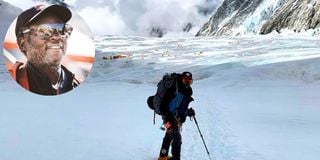
James Kagambi takes a breather on his way to the summit of Mount Everest.

Photo credit: Pool

Asked if he will retire, he responds: “Climbing is life. Even when I am old, I will still climb something, maybe not Everest, but a hill near home. Because mountains are where I meet myself.”

PAYE Tax Calculator

Note: The results are not exact but very close to the actual.