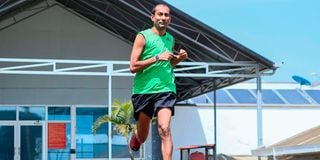
Nayan Savla, 45, a businessman in Nairobi, runs barefoot.
He believes the fitness world has become overly obsessed with gadgets and shortcuts. For the past four years, he has ditched heavily padded running shoes, choosing instead to trust what the human body was designed to do.
“Our bodies come with a readymade design which, when explored, will reveal so much that we ignore, including our natural walking and running gait,” he tells BDLife.
Nayan started running barefoot in 2021, using specialised grip socks. This was not a sudden fitness experiment. He had been an athlete for years, had completed an Olympic-distance triathlon in 2018 and would cycle indoors during the Covid lockdown.
Nayan bought an elliptical bike, which he could use to simulate outdoor cycling, often riding 100 kilometres at a time while staring at a screen where the rides were projected.
When restrictions eased, he went back to running on the road in cushioned trainers. Almost immediately, old injuries returned. That was when he began to question his footwear. He swapped carbon-plated shoes for grip socks and started running barefoot.
Nayan Savla's specialised grip socks.
Photo credit: Wilfred Nyangaresi | Nation Media Group
Looking back, he says it was one of the best decisions he has made.
“I started noticing that the aches and pains I used to have just weren’t there anymore,” he says. “The shoes were comfortable, yes, but they had changed how I ran. They had created an artificial gait that weakened my natural biomechanics.”
His biggest test came when he ran 80 kilometres around Lake Naivasha over two days. He carried shoes for rough, rocky sections but ran most of the distance in socks.
“After Lake Naivasha, I got the confidence that, you know, I am on the right path,” says Nayan, emulating Shambel Abebe Bikila, the Ethiopian marathoner who famously won the 1960 Summer Olympics in Rome barefoot, crossing the finish line in 2:15.
That experience made him question the idea that runners need thick layers of foam and air pockets to protect their joints. Running with less cushioning, he says, helped him feel the ground better, naturally correct his posture and gradually ease the hip and knee pain he used to struggle with.
Fitness, for Nayan, is not a solo pursuit. He has made it a family mission.
Nayan Savla stretches during a workout session at his home in Nairobi on January 29, 2026.
Photo credit: Wilfred Nyangaresi | Nation Media Group
He believes children learn more from what they see than what they are told. His two children, born in 2013 and 2016, have grown up watching discipline in action.
“If your children see you do it, then for sure they are going to follow in your footsteps.” When they were younger, he would ask them to record him doing push-ups in their living room before going to school. “Seeing is believing,” he says.
Nayan Savla stretches during a workout session at his home in Nairobi on January 29, 2026.
Photo credit: Wilfred Nyangaresi | Nation Media Group
Indoor climber
He even redesigned his home to reflect that mindset. Some sofas were removed from the living room and replaced with an indoor climbing frame. To visitors, the lack of seating might seem odd. To Nayan, the living room is meant for movement, not sitting still.
“The more active the children are, the stronger their foundation will be. If you plant this in the memory of young children, they develop this sense that their abilities can also get to that level.”
Most weekends, the family takes part in the “We Run Nairobi” runs and walks. At first, Nayan had to slow down to match his children’s pace. Over time, everyone found a rhythm they could maintain.
The results have been remarkable. His daughter is recognised by the Mountain Club of Kenya as potentially the youngest Kenyan girl to reach Point Lenana on Mount Kenya. She has also summited Uhuru Peak on Mount Kilimanjaro and has been named Sports Girl of the Year for two consecutive years. His son has won medals as a swimmer and hiker.
Beyond running, Savla and his family are avid cyclists. On a relaxed Sunday morning, you might find them riding 35 to 50 kilometres through the hills of Kiambu or around Westlands.
“My children are not scared [of cycling on the road],” he says. “They make friends along the way and genuinely enjoy it. It’s also our way of bonding as a family.”
Nayan Savla does push ups during a workout session at his home in Nairobi on January 29, 2026.
Photo credit: Wilfred Nyangaresi | Nation Media Group
Vegetarian and intermittent fasting
On food, the Savlas are vegetarians, and Nayan follows a strict intermittent fasting routine. He “squeezes” all his daily meals into a six-hour window, usually between 1pm and 6pm.
“I don’t have a normal eating routine. For example, I don’t have breakfast in the morning and lunch at noon. My first meal is after 1pm, my second meal is maybe two hours later, and in the evening, we have dinner with the family at around 6pm.”
He says the long fasting window gives his body time to rest and recover. He avoids processed sugar entirely and rarely eats out. “You've got to be deliberate, just cut out the sugar, avoid eating out too much, don't have too much processed food.”
For Nayan, the benefits of this lifestyle go far beyond physical fitness.
“Many working fathers struggle to spend quality time with their children, especially when they’re young. The demands of life make it impossible. Cycling, hiking and running with my children kills two birds with one stone, bonding with my family and keeping it healthy at the same time.”
Still, he admits it comes with sacrifices.
“It will call for a few trade-offs here and there. You can’t show up for running early Saturday morning if you came back home at 3am from a nightclub. That kind of fun has its place, but so does family. At the end of the day, men must ask themselves what kind of family am I raising? What kind of values do I want to instil in my children? Once you meet the most important truths of your life regarding your loved ones, it is not difficult to make these choices.”