Time flies with great content! Renew in to keep enjoying all our premium content.
Scalp folds: What those creases on your scalp really mean
In some cases, especially among African men, it can present as acne keloidalis nuchae (AKN), a chronic, scarring folliculitis that causes firm, keloid-like bumps on the back of the neck and occipital scalp.
If you look closely at some men, you will notice a fold or two on their scalp. Often, they are not painful or itchy, just slightly raised ridges that become more noticeable after a fresh haircut or when you run your fingers over. But, are they harmless or an underlying skin problem?
Dr Venkatesh Narasimhan, a clinical and cosmetic dermatologist at the Aga Khan University Hospital, says a skin fold on the scalp is normal.
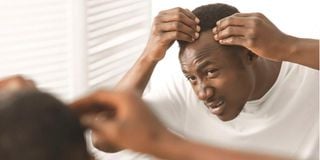
So, what causes it? "Nothing. It is a fold. Like when you fold your arm, there's a crease that forms in your elbow, right? So, there are folds that can happen on the scalp. They are not an issue."
He adds that men who have insulin resistance and are overweight may notice these folds more because they have more skin. Even neck movement can create temporary folds.
"When you extend your neck forward or backward, you can see folds and that is normal," he explains. If you place your hand on the back of your head and extend your neck, you will feel a fold form and that is no cause for alarm.
However, he says it is important to rule out cutis verticis gyrata, a rare, generally benign, chronic scalp disorder characterised by marked thickening and folding of the scalp skin, creating a brain-like appearance. "With cutis verticis gyrata (CVG), there are a number of folds in the skin of the scalp and they form vertically, horizontally, and diagonally. It is very distinct," he says.
Dr Narasimhan explains that the condition can occur as ‘primary essential’, where the changes are limited to the scalp skin with extensive folds and no other associated issue.
It can also occur as ‘primary non-essential’, which may be associated with neurological or developmental conditions, as well as eye findings such as cataracts, hearing problems, or chromosomal abnormalities.
Then there is secondary CVG which occurs due to another underlying disorder such as psoriasis, myxedema, or neurofibromas, among others.
Can someone be born with scalp folds?
"Yes, although there is no standardised age when folds develop and it is also unlikely for normal scalp folds to grow into cutis verticis gyrata."
Allergies, chronic dandruff, and long-term scratching do not cause scalp folds. But men can still develop bumps after shaving, which are often simple folliculitis.
In some cases, especially among African men, it can present as acne keloidalis nuchae (AKN), a chronic, scarring folliculitis that causes firm, keloid-like bumps on the back of the neck and occipital scalp.
"It commonly affects individuals in their early 20s to 40s."
Dr Narasimhan says AKN is often triggered by clean shaving practices. "The African hair is naturally curly. Shaving close to the skin can lead to ingrown hairs as the hair grows back and lodges under the skin."
This can trigger inflammation and infection, leading to scarring that may be atrophic or keloidal. His advice is to trim instead of clean shaving, leaving a small length of hair above the surface of the skin. He also recommends warm compresses using a clean towel, applied two to three times a day on the day of and the day after trimming.
For men who already have keloids, Dr Narasimhan says, treatment options include steroid injections to flatten the scars or surgical excision, though recurrence can be high, hence radiotherapy is needed.