Time flies with great content! Renew in to keep enjoying all our premium content.
Prime
Over 40? Why fitness expert says your exercises should end after one hour
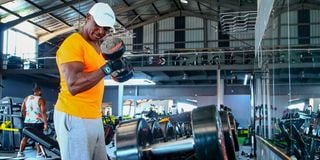
Collins Omondi, fitness consultant and enthusiast, performs dumbbell bicep curls during his routine workout at Alpha Fit Gym along Kiambu Road on October 2, 2025.
Photo credit: Wilfred Nyangaresi | Nation Media Group
At 49, Collins Omondi’s body still bears the sculpted lines of his competitive bodybuilding days, a testament to three decades of iron discipline. His chest, shoulders, and arms carry the story of a life shaped by weights and willpower. Yet, he laughs at the idea that he is still the powerhouse he was in his 20s.
“I’m not as strong as I used to be,” he says. “But the more I lift, the better I feel. I sleep better. I move better. I plan to keep lifting until I’m 80.”
Collins’s fitness story began in his teenage years, sparked by a neighbour who had an imposing physique.
"People used to talk about him, and I thought to myself, I also want to build that kind of physique," he recalls. By 17, he was exercising. By 19, he was competing.
The 1990s were a golden era for bodybuilding in Kenya. Gyms, in those days, were crude and ill-equipped. Many gyms were located in makeshift spaces where dumbbells were fashioned from concrete and paint tins, iron bars were unpolished, and young men pushed their bodies to extremes.
Collins Omondi, fitness consultant and enthusiast, performs the machine shoulder press during his routine workout at Alpha Fit Gym along Kiambu Road on October 2, 2025.
Photo credit: Wilfred Nyangaresi | Nation Media Group
“We didn’t have fancy equipment; it was hardcore. You had to learn to balance your sessions, otherwise your body would end up looking unbalanced,”.
Collins thrived in this hardcore environment, finishing second at Mr Kenya in 1996. He won his middleweight category in 1997 and represented Kenya at Mr Universe competitions in the Czech Republic and Turkey.
After retiring from competitive bodybuilding in 2003, Collins turned to fitness consulting, first in Botswana, then spent over a decade in Southern Africa, where he discovered that fitness consulting could be lucrative for those who knew their craft.
He returned to Kenya with specialised knowledge and a claim to fame. He vaunts without proof that he was one of the first instructors to introduce spinning classes in the country.
"I learned of spinning while I was competing abroad, so in 1999 I started the programme at Arena Gym in Nairobi. This was the first gym to introduce spinning in Kenya," he says.
What was then a niche cardio option has now become a full-blown craze, Collins observes.
Collins Omondi, fitness consultant and enthusiast, performs the machine deadlift during his routine workout at Alpha Fit Gym along Kiambu Road on October 2, 2025.
Photo credit: Wilfred Nyangaresi | Nation Media Group
“Spinning has become trendy in Nairobi. The music, the energy, the fun… make workouts addictive, which is good. But it is also the easiest workout to overdo,” he notes.
Research supports spinning's benefits. Better leg strength, lower blood pressure, improved cholesterol. For people over 40, spinning can be a lifesaver since it is low-impact and easy on the joints. But Collins watches Kenya's current spinning fever with growing concern.
What was meant to be an accessible, moderate workout has morphed into something potentially dangerous. He warns that many Kenyans are now pushing their bodies beyond safe limits on spin bikes.
“A 30 to 45-minute spin is okay. But when people push past an hour, it can lead to muscle breakdown. Remember, your glutes and quads are some of the largest muscles in the body; you burn massive energy using them. Overdo it, and the body pays the price. That can lead to a lot of muscle breakdown, which is not healthy because having muscles is very fundamental to the body's functionality,” he says.
Because the muscles engaged in spinning are among the body's largest, demanding enormous energy, for beginners or those unaccustomed to vigorous lower-body exercise, the risk of overexertion is real and potentially severe.
Collins’ beliefs are echoed in global studies. An American Journal of Medicine study documented cases of rhabdomyolysis in spinning beginners.
This is a disorder where severe muscle breakdown releases proteins that can poison the kidneys. Symptoms include swollen legs and difficulty walking.
"Spinning wasn't meant to be an everyday workout. You have to allow the body to recover. When spinning becomes a daily habit, the cumulative intensity can lead to fatigue and declining performance rather than fitness gains. Even if you become a spinning pro, daily sessions may still be too much," Collins argues.
He claims the trendy nature of spinning has created a market flooded with undertrained instructors who prioritise entertainment over safety.
Collins Omondi, fitness consultant and enthusiast, performs the Chest Press exercise during his routine workout at Alpha Fit Gym along Kiambu Road on October 2, 2025.
Photo credit: Wilfred Nyangaresi | Nation Media Group
“If you decide to dabble in spinning, it is best to do it gradually and ensure you are under a certified spinning coach, someone who understands the basic principles of spinning.”
Since returning home due to a severe case of homesickness after spending 12 years in South Africa, Collins has found his calling by working with clients over 40.
He believes this demographic is severely neglected by Kenya's youth-focused fitness industry. He has now dedicated his career to helping clients over 40 rethink their approach.
"I realised it is one age group that is highly neglected, and as you age, your body changes. I know how difficult it is to fix your body past 40.”
For women, calcium loss from menstruation becomes critical after 40. For men, testosterone levels drop significantly. Without strength training, consequences arrive swiftly. Bones begin to thin, muscle mass decreases, and complications multiply.
He observes that many in this age bracket avoid gyms, preferring golf or other recreational activities. While not inherently bad, these activities take longer to deliver fitness benefits. Meanwhile, the need for structured exercise has never been greater.
"Nowadays, we need to work out more than ever because of the food that we eat. Most of the food we eat now is processed. When you lift weights, your bones become dense, so it actually reverses that process of osteoporosis," Collins explains.
His own training approach has evolved with his body. Where he once trained six days weekly, he now works out three times, allowing more recovery time. His weight loads have decreased, but his repetitions have increased.
"I know I can lift as heavy as an 80kg dumbbell, but I don't dare," he says. Instead, he sticks to 30-40kg for chest work, 25 -30kg for shoulder presses.
The reasoning is simple.
"When you are at my age, you become susceptible to injuries. The moment I get an injury, it takes a bit of time to heal."
He says his inspiration to keep lifting into his 80s is an 84-year-old Japanese man he met during his time in Botswana.
Collins Omondi, fitness consultant and enthusiast, performs the machíne squat press during his routine workout at Alpha Fit Gym along Kiambu Road on October 2, 2025.
Photo credit: Wilfred Nyangaresi | Nation Media Group
“The man's posture was impeccable. He could stand upright, had steady hands, agile movement and a lean physique that could pass for a 50-year-old. He told me he had been weightlifting consistently since he was 20. Those are the things that actually motivate me.”
From his more than two decades of experience, he believes one shouldn’t spend more than an hour weightlifting.
"Working out should be at least 45 minutes and a maximum of an hour. You should not train beyond that because after one hour of workout, your body plateaus and anything else you do is counterproductive."
Fueling your body with the right foods is also key to aging well.
“I eat lots of sweet potatoes, boiled eggs, rice or ugali with fish or beef and vegetables, lean protein with vegetables at dinner, and I only eat when I am hungry. As you grow older, your body fat percentage rises because your metabolic rate drops. My body fat at the moment stands at 16 percent.”