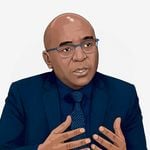
There are no forests of bulky, suited, neckless bodyguards when Dr Abraham Korir Sing’Oei arrives. His arrival is, in fact, the antithesis of power. Which means he doesn’t arrive, he shows up. With only one car, I'm told.
Impeccably suited and striding through the hotel with an easy, officious elegance, save for the lapel pin of the flag, he could easily pass for an auditor, an investment banker, or a corporate executive. In truth, he is a lawyer, an international law expert and convener of the Open Government Partnership for Kenya.
He studied law and global public policy at the University of Nairobi, the University of Pretoria, the University of Minnesota Law School, and the University of Cape Town.
He has served as a research fellow at the Centre for Justice and International Law in Washington, DC, and as senior legal adviser to the current President during his tenure as Deputy President. Today, he is the Principal Secretary for Foreign Affairs in the Ministry of Foreign and Diaspora Affairs.
Sing'Oei, in case you are piqued, means “red bull,” in the tongue of his mother. Only, this is a bull that isn’t led by its horns. It’s the quiet secret of his diplomacy, perhaps, moving the world without making a sound.
Who's shown up for this conversation today, the Principal Secretary, or the person behind the title?
Well, you wanted to engage with the Principal Secretary of Foreign Affairs of Kenya. That's the office I occupy.
That's great. But can we also get the other guys in; the father, the husband, the man?
[Laughs] You can get all those guys in. Those guys are here.
There's always that one phone call that changes the trajectory of your life. What do you remember of that day and the emotions that came with it?
It was a really intense time. We had just come from an election, and I had been deeply involved in the process, supporting the current president as his legal advisor.
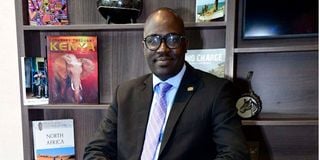
Principal Secretary for Foreign Affairs Abraham Korir Sing’Oei during an interview at the Radisson Blu Hotel on October 14, 2025.
Photo credit: Francis Nderitu | Nation Media Group
I was, of course, looking forward to serving in government, but not necessarily in this particular capacity. At the time, I had travelled to Casablanca, Morocco, as part of the Kenyan contingent to the Open Government Partnership, a platform I'd been part of for over five years.
Morocco was hosting the ministerial summit for the partnership, and I was there attending sessions when, around 10am Moroccan time, I received a call.
I saw it was from the President. I stepped out, went up to my room, and called him back. That’s when he told me I had been nominated as Principal Secretary for Foreign Affairs. Honestly, it was overwhelming. I remember falling to my knees, literally, and just feeling this deep sense of awe that the President had deemed it fit to entrust me with that responsibility. It was profoundly emotional.
You know, most people will live and die without ever uttering those words: “The President called me and I called him back from my room.” Do you sometimes find it surreal that you find yourself at this station in life?
[Chuckles] It’s certainly very humbling to have the President call you. Sometimes I have to literally pinch myself, how did I get into this space? Did I ever see myself here, in public service? No, but I saw myself as someone who would make a difference in people’s lives, maybe through other means. I've always been drawn to what I call empowering paradigms, platforms that can uplift others.
Straight out of university, I began working on the rights of underprivileged Kenyans, minorities, as we called them.
In the early 2000s, it wasn’t common for a young lawyer to go straight into community work, but that's where I felt the law mattered most, in the service of people.
By the end of that journey, we'd secured major gains: constitutional recognition of minorities through provisions like Articles 56, 100, and the Equalisation Fund in Article 204.
Afterward, I went back to school, then joined the US government in development assistance. When the new Constitution was adopted, I began to imagine serving citizens more directly, in a representative capacity.
I even considered politics. My friends thought I’d lost my mind. That decision led me to William Ruto. Before then, we didn’t know each other.
My first instinct had been to approach Martha Karua, I tried for weeks to get an appointment, unsuccessfully. Later, I met Danson Mungatana and Paul Muite. Paul told me something that stayed with me: that our politics was still shaped more by tribe and region than by ideas. He's the one who suggested I meet Ruto.
When I finally did, I was surprised. He gave me an appointment, and kept it. When I arrived, he was waiting for me. We spoke for two hours about everything: his vision, his plans, and his hopes for the country. By the end, he asked me to work with him as he set up a new party. The rest, as they say, is history.
After a year, I told him I wanted to run for office. He laughed, he never saw me as a politician. So yes, I thought politics would be my next platform for empowerment. Apparently not.
When President Uhuru Kenyatta was elected and Ruto became Deputy President, I joined his office as legal advisor. That's what I did for the next seven years — until that call inviting me to serve as Principal Secretary.
Is there something that happened in your childhood that set you on this path?
When I was about 10, my father was arrested on trumped-up charges, accused of trying to shoot a policeman in Kitale, where I grew up. It was shocking. He was incarcerated for over a year without bail as the trial dragged on. It was a terrible time. The case nearly broke him, and us.
We spent everything we had on legal fees. But in the end, he was acquitted, and when he was released, I remember thinking, that's what I want to do. If a lawyer can ensure justice for someone so powerless, that's the job I want.
That moment changed the course of my life. It also shaped the kind of law I wanted to practice, working for marginalised and disadvantaged communities: the Nubians in Kibera, the Ogiek, the Ilchamus, and the Maasai of northern Kenya.
I spent years with them, driven partly by what I'd seen at home, the sting of injustice and the conviction that someone has to fight it.
What kind of a guy is your father?
First, let me say that I've had what I'd call a beautiful relationship with women — starting with my mother. She's been a huge influence on my life. Then my grandmother, who passed away a few years ago, and now my wife. My mother and grandmother were both great storytellers. They inspired me, prayed for me, and shaped how I see the world.
Principal Secretary for Foreign Affairs Abraham Korir Sing’Oei during an interview at the Radisson Blu Hotel on October 14, 2025.
Photo credit: Francis Nderitu | Nation Media Group
My dad was a bit of a tough guy back in the day. When we closed school for the holidays, we'd have to work on the farm. He was the only one allowed to wear a watch, and he used it to his advantage. We were supposed to stop working at one o'clock, but his clock was always an hour behind.
So, in reality, we worked until two o'clock. But since he was the only one with a watch, we couldn't argue. He'd finally say, "It's one o'clock now, you can go home." The other day, I bought him a really good watch. I reminded him of that story and said, "Dad, remember this? Here's a watch that actually tells the right time." We laughed about it.
What philosophy have you anchored yourself to over time?
[Pause] That's a big one. When I worked in the non-profit sector, I had a small poster on my wall that said something like, “It doesn't matter who gets the credit.” I think I was quoting someone else, but the message stuck.
So, this whole idea of “attribution shopping”, wanting to be seen to have done this or that, has never meant much to me. I'm not big on that. It actually frees me to focus on the work itself, rather than constantly looking back to see if anyone noticed what I did.
What matters to me is the constant desire to do more. Yesterday's achievements are gone; I'm always thinking about what comes next. Whether or not we get credit isn't the point. The point is to make a difference.
I imagine that being in the political position you're in must be quite isolating. What does that look like for a person on the outside looking in?
Yes, it can be quite isolating, first, geographically. The route I take from home to the office is the same every day, almost at the same hours.
After a while, you stop noticing what's happening around you; new places, new faces, even how the city is changing. You just move within this narrow corridor of routine. The demands of work don't help.
On a good day, I might manage to return five calls to friends. Most weekends get packed with engagements I've postponed during the week, so they're not really restful either. You can easily find yourself working seven days a week.
Still, I try to stay normal. Sometimes I'll decide, no, today I'm going to Kosewe, or CJ's, or Java for breakfast. I sit there alone. Sometimes people come over to say hi, sometimes they just leave me be — both are fine.
I like that small act of normalisation. I still play tennis, run, and jog with friends when I can. Those little routines keep me grounded.
How has the office changed you?
It hardens you. Public service does that. You're constantly on the receiving end of criticism, some of it fair, some of it not. And with today's digital world, that criticism travels fast, often unfiltered.
Over time, you have to make a choice. You can cave in under the weight of it, let it crush you, or you can decide: this is part of the territory. I've learned to choose strength, to grow a thicker skin, not out of arrogance, but out of necessity.
The job demands it. So yes, you adapt. You become harder, not in the sense of losing empathy, but in learning how to withstand the noise so you can actually do the work.
Where does the rooting come from? Because obviously you have to be anchored to something.
Yes, it comes from faith, though not in the traditional sense. For me, faith is really about understanding that I'm in the right place, and that things will be alright as long as I put my best foot forward. I don't believe I got here by chance.
Principal Secretary for Foreign Affairs Abraham Korir Sing’Oei during an interview at the Radisson Blu Hotel on October 14, 2025.
Photo credit: Francis Nderitu | Nation Media Group
There's a kind of divine orchestration that brought me to this space. And I trust that the same force that led me here will, if I stay aligned, keep guiding me, whether that means remaining here or moving on to somewhere I can do even more good. That understanding grounds me. It keeps me centered.
How old are you now?
[Chuckles] I've hit the big five-oh (50).
What would your 40-year-old self, tell you now?
[Long pause] That's interesting. [Pause] Toughen up a bit. But also learn to be more adaptive, more accommodating. Be less reluctant to step up when it's needed. And, have more fun!
How has having a high-profile job changed your friendships?
People begin to feel you're no longer accessible. And then, depending on the positions you take on certain issues, you might alienate some friends.
So yes, it affects friendships quite a bit, actually. But for someone like me, who's always had just a few close friends, I try to maintain those connections, to check in, to support each other still.
And how has the job changed the kind of husband you are?
Yes, it's tough, being in a high-profile position means I'm hardly ever home. My wife feels it a great deal. Luckily, she's equally busy; she travels, I travel — sometimes we're both away at the same time.
But it's also taught us to give real premium to the time we do have together. We try to be creative with it, to get out, to create memories that help carry us through the stretches when we're apart.
What do you fear now as a man in his 50s?
What do I fear now? Honestly, not much on a personal level. I think I’ve ticked many boxes. I’m happy with what I've been able to achieve, and I feel I've been true to myself in many respects. There's still work to be done, of course, there always is. But my real anxieties lie beyond me — in the world, and in my country.
The world feels... unsettled. Like the forces of disorder are stronger than ever, while the institutions we’ve long relied on for anchorage don’t seem as steady as they once were. Even here at home, the contradictions feel sharper.
We seem to talk at each other more than to each other. The spirit of tolerance, of accommodation and understanding, it's far lower than it should be. And that worries me.
In this season of life, the biggest challenges revolve around the feeling that you never quite have enough. Not enough time, not enough patience, not enough emotional bandwidth, especially when it comes to your children.
You might have the material resources to give them the best, but still feel like something is missing, that you're not always present enough, or tuned in enough. That sense of inadequacy can be heavy. The feeling that you don't have enough time to do everything you want to do, that's a big one for me.
Do you have regrets?
In high school, I used to do music. I loved it, even wrote a bit of it. But somewhere along the way, I just dropped it. Yesterday, I was at the Australian High Commission with the Deputy Minister of Foreign Affairs of Australia, and these children from Ghetto Classics were performing — playing the cello, the clarinet, all these beautiful instruments. And I thought, man, I could have been doing that now. I actually felt quite bad about it.
I also regret not studying foreign languages. I'm trying now to cobble together some time, energy, and motivation to work on my French, though, to be honest, it's not going great. Oh, and I'm not the greatest swimmer, which is another regret. I love swimming. I just never got as good as I should have.
Looking back, when were you happiest? When were you saddest?
The saddest moment was when I lost my grandmother. We were very close. We could sit in a room together, not say a word, and still have a perfect understanding.
With her, I never had to perform. She just got me. Losing her was... hard. One of my happiest moments, on the other hand, was when I got my PhD. That was pure excitement, a deep, quiet kind of joy.
What has been your tipping point in life? The moment when the trajectory shifted.
But for me, the real tipping point came when I was about 14. I was sitting with my dad, he was drunk, and I remember looking at him and telling myself, I will not drink.
I'd seen what alcohol could do; I'd already watched it destroy my brother, who later died. That day, I made a quiet promise to build a life with more control. And I think that decision changed a lot of things for me.