Supreme Court judge Mohamed Ibrahim dies in Nairobi

Supreme Court Judge Mohamed Ibrahim passed away on December 17, 2025.

Photo credit: File | Nation Media Group

What you need to know:

  • According to a source, the judge, who was part of the inaugural Supreme Court team, fell ill around three weeks ago and was flown to India for treatment.
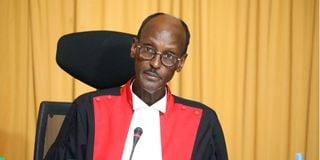
Supreme Court Justice Mohamed Ibrahim has passed away in Nairobi at the age of 69, just two days after returning to the country from India.

According to a source, the judge, who was part of the inaugural Supreme Court team, fell ill around three weeks ago and was flown to India for treatment.
After being hospitalised for a while, he was brought back to Kenya on Monday and admitted to the Intensive Care Unit (ICU) of a city hospital, where he died on Wednesday.

In her message of condolence, Chief Justice Martha Koome eulogised him as a jurist of exceptional humility and integrity.

“Justice Ibrahim will be remembered as a steadfast guardian of constitutionalism, electoral justice, and human dignity. The Judiciary, the Supreme Court and the JSC (Judicial Service Commission) mourn the loss of a distinguished jurist whose legacy bridges courageous advocacy and principled judging, and whose life exemplified fidelity to his oath of office, service to country, and compassion for the voiceless,” she said.

Faith Odhiambo, President of the Law Society of Kenya, also mourned judge Ibrahim, saying that he had served with "unparalleled grace and distinguished intellect".

"His rare calmness spoke of a man who fully understood the role of judicial authority as an opportunity to serve, and the nuances of justice as a tool for maintaining social order. His passing on is a big loss to the Supreme Court, the Judiciary, and to the administration of Justice in Kenya," Ms Odhiambo said.

She went on: "Since his appointment to Kenya's inaugural Supreme Court bench, Justice Ibrahim stood out as an independent, astute voice of reason. His sound contributions to Kenya's Jurisprudence portrayed great wealth of knowledge, depth of character and dedication to advancing the law. He will be dearly missed by all who experienced him."

Justice Ibrahim, who joined the Supreme Court in June 2011, was due to retire in December next year.

A pioneer in his community

Admitted to the Bar in 1982, he was the first member of the Kenyan Somali community to be become as an advocate of the High Court of Kenya.

He started his career at the Waruhiu & Muite Advocates law firm, becoming a partner in 1985.

After practising with several other notable firms, he set up his own practice and became deeply involved in public interest litigation and civic advocacy during some of Kenya's most challenging political periods.

Through his work with organisations such as Kituo cha Sheria and the Lawyers Committee for Human Rights, as well as his role as a founding trustee of the Mwangaza Trust, he demonstrated his lifelong dedication to ensuring access to justice, promoting inclusion, and defending fundamental rights.

He joined the judiciary in 2003 and rose through the ranks to serve as a High Court judge in Eldoret, Mombasa and Nairobi, before joining the Supreme Court in 2011.

Presidential petition 

In 2017, Justice Ibrahim fell ill during the hearing of the presidential election petition filed by Raila Odinga, who was challenging the victory of President Uhuru Kenyatta.

The Supreme Court eventually nullified President Kenyatta’s win, although Odinga boycotted the rerun.

At the start of the hearing, Chief Justice David Maraga informed the lawyers and advocates that Justice Ibrahim was receiving medical attention.

However, due to time constraints, the other members of the bench had to proceed with the hearing in his absence.

According to Article 163(2) of the Constitution, the court is properly constituted for the purposes of its hearings if it comprises more than five judges.

The other judges present were Deputy Chief Justice Philomena Mwilu, Jackton Ojwang, Njoki Ndung'u and Isaac Lenaola.

Rulings backlog

During a vetting process for judges and magistrates in 2012, Justice Ibrahim was permitted to remain in his position on the condition that he clear a backlog of over 200 cases.

He was forced to give an undertaking to the former Chief Justice, Willy Mutunga, that he would complete the judgments he had left unfinished.

The speed at which he completed the judgments and rulings also sparked another debate.

Some of the cases had been pending for more than five years, including those in Eldoret, where he had already left. 

PAYE Tax Calculator

Note: The results are not exact but very close to the actual.