Taha Mohamedali: From fundi jobs to a thriving accidental pet business

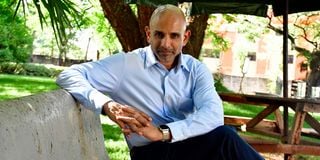
Petstore Kenya CEO Taha Mohamedali poses for a photo after the interview on January 15, 2026. 


Photo credit: Francis Nderitu | Nation Media Group

This pet business was an accident. In 2017, Taha Mohamedali and a friend got dogs. Getting dog food in Nairobi was a nightmare—shops with no stock, broken card machines, no delivery.

"Why don't we just import our own?" Taha suggested. But they couldn't buy small quantities, so they brought in an entire container. Yes, mental. They sold some to friends and were left with mountains of dog food.
That's how they started selling online. They hired a store guy and a driver. PetStore Kenya was born.

At the time, Taha was doing fundi jobs—installing glass, covered in silicone and dust—while trying to keep his father's over 100-year-old glass business afloat.

This was the same man who had quit his job as a software engineer at Microsoft in the US to come home and help his ailing father. The family business, Essajee Amijee EA Ltd, had hit serious financial headwinds. It was demoralising work.

The pet business ticked along modestly until Covid hit and a ship got stuck in the Suez Canal. Taha had read Nassim Taleb's The Black Swan and done risk analysis: the one thing that could kill them was a shipping problem.

So in 2019, he took a frightening loan and ordered eight times their usual stock. When the Suez Canal blocked in 2020, "everyone else had no stock—and we did."

The business exploded. Now they also rescue and feed strays because, as Taha puts it, "God is watching."

Behind everything else is a highly intense, obsessive man. Get him going on longevity science or canine psychology, human psychology, and you'll see just how deep the rabbit hole goes. Like a dog with a bone, you could say.

“Who are you?” is always a fascinating question to ask someone—or even to answer. I still struggle with it.

Actually, I don’t. I’ve simplified it, distilled it to a single sentence. And it’s not something I just made up. It’s something I’ve been thinking about for close to 25 years. Who I am is the sum of the things I can do masterfully, with subconscious competence.

If I can drive a car without thinking about it, that’s part of who I am. If I’m a good father—whether that’s a skill I’ve worked on or something I came wired with, because God made me that way—that’s part of who I am.

If I’m rubbish at making a fried egg, that’s also who I am. If I can run long distances poorly but run short distances well, then fine. That tells me something; that part of my who-I-am architecture is sprinter, not endurance runner. That’s how I know who I am.

So what are these things that you can do masterfully and with subconscious competence?

The list is relatively short, it's around 10 things, less than 10, that I do excessively well. One: I'm a master of anti-aging and longevity. I'm a medical consultant for doctors and individuals.

I have a very deep, meticulous, clinical understanding of human physiology and how to optimise it for peak performance—physically and mentally.

Two: Dogs. I love animals in general, but dogs are at the top of the list. I know a lot about how they work, how they behave, how to communicate with them, train them, feed them, care for them, love them.

Three: I'm a techie. I understand and enjoy figuring out complex systems—not complicated systems. If you want clarity on that distinction, look up Nassim Taleb who wrote The Black Swan, Antifragile, and Skin in the Game. Taleb explains complicated versus complex brilliantly.

Interesting.

Beyond those, there are other things here and there, but those rise to the top. I also have a deep understanding of human psychology. I've studied it extensively—the neurochemistry, what drives emotion and behaviour. I can deconstruct behaviour, including my own, and adjust it when needed. I've become good at breaking emotions into structural components so they can actually be addressed. Not just I'm having a bad day, let me see a shrink.

A lot of this comes from my own trauma—going through difficult things and not finding answers from people who claimed to be experts. I listened, paid, and hit dead ends. So I studied the thing that affects me most: my emotional life. My depression. My existential questions. I needed to parameterise it.

No therapist is going to tell me how to make money, how to be a good family member, or how to be productive. Those are my pillars: understand money, understand relationships, understand health, be useful.

Did you study this medically, professionally, or academically?

Professionally? No. In school? Not quite. I was pre-med and completed my pre-med studies at Brown University. But I didn't go to medical school—no financial aid for international students at the time.

So I switched to computer engineering and worked as a software engineer at Microsoft for seven years. Compared to college, life suddenly became very easy. I had time and money.

Going from broke college student to having both felt like heaven. College had been brutal—no partying, just labs, circuit boards, code, a few friends, very little sleep. Microsoft felt like a joke for about five years. I used that time to learn everything that interested me.

I competed in fitness, became a powerlifter, got deep into yoga, became a yoga ambassador. I danced, did circus and aerial arts, even danced at weddings. I took classes endlessly.

Petstore Kenya CEO Taha Mohamedali poses for a photo after the interview on January 15, 2026. 


Photo credit: Francis Nderitu | Nation Media Group

During that period, I went deep into human performance science—kinesiology, biomechanics, holistic lifestyle coaching.

Through the CHEK Institute, I was trained in the four doctors: Dr Diet, Dr Movement, Dr Sleep, and Dr Happiness. I already had Dr Movement and Dr Diet. Dr Sleep was an emerging science, and I was young—sleep took care of itself. Dr Happiness was the elusive one. No template. No formula. No dashboard to measure your HQ—your happiness quotient.

Where did you love for dogs come from?

I’ve always had dogs. Since I was about seven, there were dogs in the house. I grew up here in Nairobi, in Westlands, and I spent a lot of time with them. They made me very happy.

Then I went to college and didn’t have dogs around anymore. I lost that daily connection with our family dogs. Years later—around 2009—when I was doing my holistic lifestyle coaching training, I spent time with a modern-day shaman.

He told us something that stayed with me. He said the only real love a human being will ever experience—the kind most religions describe as unconditional love—is the love of a dog. That idea lodged itself in me. Now, I can vouch for that.

You mean to say nobody loves you as much as a dog?

Never. It will never happen.

Even your parents?

Never. Human love is always conditional. Become a thief and start stealing from your parents, and see if they love you the same. Become a millionaire, and see if expectations don’t shift. There are always conditions attached. With a dog, there aren’t.

Is it important to be loved unconditionally? Should you be?

Yes.

By who?

By anybody. That’s a choice. A valid one. And it’s a good question—but the real question is why we ask it in the first place. Is it even possible for a human to love unconditionally?

The honest answer is: probably not. Humans don’t really have the capacity for it, because we’re overridden by two things—fear and greed.

Those two emotions cancel out unconditionality. Dogs don’t have that. They don’t have greed. And fear, when it exists, is immediate—not strategic. A dog might be scared at the moment, but it doesn’t turn it into manipulation.

It doesn’t calculate. A dog doesn’t know who you are, what you’ve done, what you might do tomorrow. You show up and it’s just: Hey. You’re here. Great.

How old are you? How many dogs have you owned?

I’m 43. Growing up—in my childhood and teenage years—we probably had between 20 and 30 dogs over about seven or eight years. They had puppies, dogs passed on, it was a cycle. In my adult life, maybe another 30.

When I was living with my family, we had about six at a time. When I moved out, it dropped to one or two. Now it’s mostly one. And that dog is my life. He sleeps in my bed. My wife and child don’t—he does.

My entire life is organised around him. What time I wake up. What time I sleep. Where I go on holiday. If I’m booking a place, it better accommodate dogs. If a restaurant doesn’t allow dogs, I’m not going.

Wait—why doesn’t your wife sleep in your bed and your dog does?

Because my dog snores less. (Raucous laughter) No, seriously—we have a five-year-old daughter. So my wife sleeps with our child, and I sleep with mine. Our schedules are synchronised differently.

They go to bed at nine because she has to wake up and go to school. My dog and I run on the same clock. If I’m up late, he’s up with me. If I wake up early, he’s up with me. If I go to bed early, he’s there. He’s in sync with me. He is my schedule.

He’s half Staffordshire Bull Terrier, half Labrador—so a bit smaller than a Lab. Medium-sized. About 23 kilos. Incredible temperament.

You got your child a bit late, yes?

Yes—intentionally, but largely because of circumstance. There was a lot of family upheaval. My father fell ill and passed in 2013, and the aftermath took time to deal with. Then came the banking collapses—Chase Bank Kenya and Imperial Bank Kenya in 2015—which wiped me out.

You as a person, or your family?

Both. More me than them. It’s been a decade of rebuilding from scratch. I didn’t have the financial stability to bring a child into the world when I couldn’t even manage myself properly, so we waited. I lost years trying to keep my father alive.

After he passed, there were things that took time to resolve. Then 2015 hit and knocked me out again. I was broke for a long time, started businesses, then Covid happened. And then we had a baby—during Covid.

If I fold this back into who I am now, I run my life with an extreme level of governance. I’ve been hit too many times by unexpected events. So everything is filtered through risk first. Every decision starts with the same question: What’s the risk?

Buying a watch—what’s the risk? Going out for a drink—where, and what’s the risk? My brain now runs a constant, subconscious risk assessment. If it doesn’t pass, I don’t go.

What's your governance principle on marriage?

Easy. Until inconvenience do us part. I'm serious. Most people enter marriage with these grand vows—until death do us part—which means: you can hate each other, mistreat each other, live completely misaligned, and still feel obligated to stay.

That's absurd.

Marriage should be easy. If it isn't, you didn't enter it with an aligned value system. Period. I didn't invent that—I learned it from Tony Robbins. He talks about value systems: money, security, family, health, growth, adventure. Everyone ranks these differently. If one person has a high value for adventure and the other prizes stability and security, that marriage will struggle. It's not moral failure—it's misalignment.

Top three things you want to achieve this year.

First, I’m gearing toward a business exit. That’s the big one. Second, I want to spend more time with my family. I’ve neglected them over the last three years. Third, I want my health back.

What you see now is a shell of what I used to be. I was strong—muscular. I trained hard, played sports. All that dropped off as I focused on risk mitigation and financial survival.

The exit matters because it buys me time. Time to be present with my child. I lost my father young and didn’t get much everyday time with him. I don’t want to repeat that with my daughter. So while I’m still young—despite what you say—I want to be part of my child’s daily life. I have that chance. I want to take it.

What are you struggling with at 43?

It’s less a struggle and more a question: what do I do with the next half of my life? It’s a challenge of thought. I also struggle with inequality. With humanity. I feel guilt sometimes about being successful—successful by my own definition, not compared to billionaires or anyone like that.

If my life is comfortable and I see other people suffering, I struggle to reconcile that.

Part of it is spiritual. I believe in God. And then I get stuck in that loop: if God cares about everyone, why is this person suffering while I’m okay? I can’t resolve that. No one has ever given me a satisfying answer.

So I wrestle with balance. How much do I do for myself, and how much do I do for the world? Where do I draw the line? Where do I stop and take care of myself? Sometimes I don’t. Sometimes I sacrifice my comfort too much. That’s the struggle.

You've mentioned traumas. What were they, and what impact did they have?

I'll keep it high level. When my father passed, there was what I believe was fraud around his estate. I eventually stopped trying to prove it and moved on, but it shattered my idea of family—what it's supposed to mean. I'd quit my job at Microsoft to come back and take care of him. Not for money. Just to be there.

Then the banks collapsed in 2015. That knocked me out. I come from a 100-year-plus old family business in glass, but I wasn't a business guy—I was a software engineer. Suddenly, I was jobless, doing manual work: installing glass, mirrors, windows. Being demoralised. Being spoken to badly. Realising how poorly construction workers are treated.

Then Covid. We had a baby with an extremely complicated birth—months in ICU. Every day not knowing if your child will survive changes how you experience life.

After that, a long, messy breakup with a business partner who was also a close friend. Two years—lawyers, court cases, pain on both sides. No villains. Just systems and rules that didn't evolve as the business did. Around the same time: duties went up, theft in the business, pressure everywhere. Not one catastrophic event.

What I learned—again—was that I didn't have the tools. So I went back to studying happiness. Looking for frameworks. Looking for modalities. It always comes back to the same question: how do you change how the brain responds? Neuroplasticity.

PAYE Tax Calculator

Note: The results are not exact but very close to the actual.