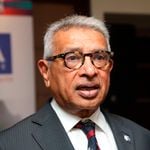
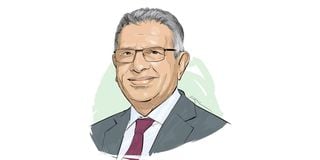
Ashok Shah says risk behaves a lot like chemistry, where variables interact, reactions follow patterns, and results reward patience. It is a lesson he first learned at Kingston University and one he applied over a 50-year run in an insurance career that he is preparing to bring to a close.
As he prepares to step down from his role as the Group CEO of APA Apollo Group, the veteran executive credits an unlikely foundation—an applied chemistry degree—for shaping the analytical mindset that defined his career. Applied chemistry, which he doubled with electronics, taught him to see risk as something to measure, test and understand rather than fear.
“Chemistry is about creating new substances. It forces you to think about how structures are built and how compounds come together. When I moved into electronics, I did a lot of physics too, and physics is very logical—almost like mathematics. You learn systems, sequences, cause and effect.”
“This foundation taught me how to look at different parts of a business in insurance and to be able to understand how systems connect and analyse how small changes can affect outcomes. That is how I developed chemistry with risk business,” says Mr Shah.
“In chemistry, you combine different substances to create something new. In electronics, you learn systems, sequences, cause and effect. In business, you bring people together to make things happen.”
Mr Shah will be stepping down from the CEO role at the end of June to pave the way for Risper Ohaga, who is completing her tenure as chief financial officer and executive director at the East African Breweries PLC. His successor joins an organisation that has been championing for women, raising the share of women in its workforce to about 52 percent.
APA started the recruitment process early last year before settling on Ms Ohaga, who has been a non-executive director at the insurer over the past four years. For Mr Shah, he feels it is time to bring in new blood and allow him get out of the frontline and offer support in the background.
“The group is strong, but it needs to become stronger and grow larger. I began to feel that if I held on too long, I might slow down some of the changes we need to make. That is one reason I decided it was time to step back and allow the group to bring in new blood and new energy,” he said.
“My contribution and legacy will be better served if I guide from the side while younger leaders drive the next phase. Insurance still has enormous potential, and with fresh leadership supported by people like us who bring decades of experience, the business can grow even faster.”
At the group level, Mr Shah has overseen a complex network of seven CEOs. He says each CEO brings unique strengths, and every business under the group has its own distinct character. As group CEO, Mr Shah’s role has been to balance this diversity, offering guidance where leaders need support and stepping back where they excel.
Managing such a variety of personalities and business cultures requires constant attention, as decisions by one CEO can have ripple effects across the group. For Shah, it has been a careful balancing act, ensuring the organisation remains resilient while continuing to grow.
Mr Shah reflected on one early mistake in his leadership when he believed in trying to solve problems on his own rather than confiding in his team. He noted that he has since improved in this regard, allowing him to trust his team more and be willing to step down.
“One mistake I made early on was trying to solve problems on my own instead of confiding in my team. When something was going wrong, I would think I had to handle it myself. But over time, I came to learn that you can’t do it alone. You need the support of your team, and you should involve them early,” he said.
As he retreats from being the face of the company, Mr Shah plans to step up his contribution in building emerging areas like microinsurance, climate change insurance, sustainability and social corporate responsibility through Apollo Foundation.
He also plans to spend more time with family and live his passion for travelling around the world—rather than spending hours thinking about how to balance risk and return.
“It will be a big change—letting go of that authority and power. I won’t be there to tell people what they should or shouldn’t be doing,” he says.
“On a personal level, it is a good change. I will have more time for my family. I have always enjoyed travelling, so I am looking forward to visiting places I haven’t yet seen. I will be able to spend more time on personal commitments that I haven’t always had the space for.”
He remembers the humble beginnings in 1977 when the business started as Apollo with Sh2 million capital and the bold boxes ticked along the way to build a financial services institution that now operates in Kenya, Uganda, and Tanzania.
The business was started by Mr Shah’s family after they lost their farm and their coffee was stolen.
Shashi Shah, who founded the business, stepped down from the CEO role in 1994, allowing Ashok, who had been helping with marketing and other areas, to be appointed as the new CEO in 1996.
By the late 1990s, when the group was ready to scale, Mr Shah and his team identified two paths to becoming a substantial player: aggressive organic growth or strategic mergers.
Their first major move was merging with Pan Africa General Insurance, creating APA—short for Apollo Pan Africa. This became the foundation of the group’s expansion.
In 2000, APA became the first company willing to offer health insurance to HIV-positive clients in what was a bold move in an industry that had largely avoided the risk. It held this record for six years before other insurers came on board.
In 2007, the group launched a campaign to “rewrite the rules,” which disrupted some of the traditional insurance practices. This approach fuelled what Mr Shah describes as a “meteoric rise” before buying out Pan Africa in 2010.
Leapfrog Investment came on board amid the growth and later sold its stake to Swiss Re in 2014—the same year APA shocked the industry by comfortably settling a Sh1.97 billion claim to Jomo Kenyatta International Airport in what was a record six months. Later in 2024, South Africa’s largest privately owned insurance group, Hollard International, also became a shareholder to support growth and value creation.
Throughout this journey, Mr Shah emphasises that the group never asked shareholders to inject additional capital. The company’s growth, liquidity and profitability have been achieved organically, with minority buyouts structured to provide fair value.
“We have continued to make profits and grow shareholder value without ever needing extra capital,” he notes.
Reflecting on his long career, Mr Shah says one of the most testing moments came when the company inadvertently brought in the wrong mix of people. A small group of about four closely connected individuals began undermining the organisation.
“Instead of focusing on their daily jobs and helping the company grow, these individuals started plotting ways to take over the company. We realised these people were trying to destabilise people and manoeuvre to take over the company. We acted quickly and removed the group,” he said.
As Mr Shah steps down, he passes the reins to the next generation while continuing to support the company from the sidelines, focusing on innovation, sustainability and social impact.