‘You can’t help the poor when you’re poor,’ but I chose to try

Food4Education Founder & CEO Wawira Njiru during an interview on October 23, 2025.

Photo credit: Francis Nderitu | Nation Media Group

Some empires are built with five-year plans and venture capital. Wawira Njiru began with 25 hungry children and a kitchen in Ruiru. Fresh out of university in Australia with a nutrition degree and no clear plan, Wawira wanted to do something, anything, for the children back home in Ruiru. School feeding was not the dream. It was simply what urgently needed to be done at that time.

That was 2012. Today, Food4Education feeds 600,000 children daily across 1,500 schools in 13 counties. The organisation processes 100 tonnes of ingredients every day and has delivered over 100 million meals. It employs 5,000 people. Some of those original 25 children now work for her.
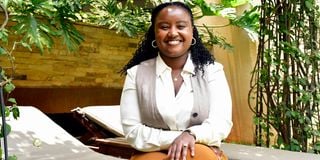
She has shared tables with Princess Beatrice, Malala Yousafzai, and George and Amal Clooney, and been interviewed on stage by Chris Martin of Coldplay. The accolades have piled up: the Skoll Award, the Elevated Prize, Young Global Leader at the World Economic Forum, and UN Kenya Person of the Year.

“It can be surreal,” she says. “I’m learning not to think of it as fatalistic, like it will all end. But it hasn’t ended.”

What she’s learned through this 13-year journey is that leadership is relentless. Growth is “brutal and beautiful.” And the hardest part isn't feeding hundreds of thousands, it's trusting yourself when you only know what you know right now.

Which room have you ever found yourself in that really surprised you?

Last year, I was invited to lunch in New York. It was a ladies’ lunch. The first person who said hi to me when I walked in was Princess Beatrice from the UK. I was like, okay. Then Malala Yousafzai (Pakistani female education activist, and youngest Nobel Prize laureate) walked in. She’s like, “Hey, how are you?” I was like, How did I end up in this circle? Then Ellen Sirleaf, Liberia’s first female president, came in, then the Deputy Secretary General of the UN, and the First Lady of Namibia. So there we were talking about women’s issues over this ladies’ lunch and I’m thinking, I guess I'm a lady too.[Laughs]

Then another one was this year, we hosted an event around the UN General Assembly (Unga). The lead singer of Coldplay, Chris Martin, was there. I’ve known him since 2019, an amazing guy. Anyway, this may sound name-droppy, but in 2020, we were supposed to host an event at his home, but then Covid happened, so we couldn’t. We ended up hosting it this year instead, around Unga, with some of our most supportive partners.

When I saw the list of who was coming, someone said, “George and Amal (Hollywood couple) are coming. They’re confirmed.” Like, Clooney! Literally, they came. It was at one of our donors’ homes. 

Chris Martin came. We had such a beautiful dinner, and he interviewed me. We had a fireside chat. It was his first interview ever. And it was like talking to a friend, because he is a friend. But it was just really surreal that we were able to bring that number of people into a room and that they were all so supportive and interested.

On your website, it says 80 percent of your staff are women, is that intentional?

When I started, I struggled to hire men. I was 20 years old or something, and men just didn’t want to work for a young girl. Plus, initially, all jobs were in the kitchen, and no man wanted to cook for a young 'girl'. [Chuckles] I had a driver once, and I said to him, “Since you’re not driving all through the day, the food arrives at a certain time, and we’re not serving as many schools in the morning, come in when everyone else is coming and help around the kitchen as the food is going out.” He said, “I can’t. I just can’t.”

He told me he’d rather go back to the village than start cutting up vegetables in the kitchen. So he went. I think he is still there. So, no, it wasn’t intentional. In the office, I’d say we're probably 60 percent women, 40 percent men. But in the field, it skews even more toward women.

Mostly because of the type of job. Though now men want those jobs too. We have loader positions where they take the food onto the trucks and distribute it to the schools. That’s mostly men.

Are you surprised at the scale of this thing now?

Food4Education Founder & CEO Wawira Njiru during an interview on October 23, 2025.

Photo credit: Francis Nderitu | Nation Media Group

I’m surprised by how relentless it is. What is? Everything. Leadership is so relentless. It doesn’t give you a weekend, a day, a minute to catch your breath. That's one of the most surprising things.

I can see how it all came together because I was involved in every piece. But previously, when it was smaller, I’d have space in my mind to think about so many other things. Right now, it's constantly in the back of your mind because so many things can happen.

How has your concept of leadership changed over time?

Oh, my God. I was very idealistic; very black and white. But when you’re in a position where you have to make so many considerations, I always say, two things can be true at the same time.

You have to embrace that. Even in conflict, whether within the organisation or with outside partners, their perspective and your perspective could both be valid. It doesn't have to be; this person is wrong, and this person is right.

I've also embraced more of, like, how do I get to the best conclusion? How do I get to the most feasible conclusion with what I know now versus what I'm going to know in five years? I can only deal with things based on the knowledge and information available to me. I can seek out new information, but you can't punish yourself for not knowing something.

So, you come back from Australia with a degree, why didn't you look for a job, why did you want to help in your former school in Ruiru?

I did! But I was drawn to whatever I was doing in school. My parents were like, “We can’t have this!” You know, they were still paying the loan they took out to send me to Australia, and I wanted to continue with the school feeding I’d started.

My dad kept saying, “This is a hobby. This is not a real thing. You have no money. You can’t say you’re helping the poor when you’re poor. It doesn’t work like that. You have to look for money.” [Laughs]

He was like, “I have no money for you to give away. You can’t use my money to help people. You have to go make your own money and then give it. You have zero right now.” I remember telling him, “Dad, you don’t have any money, I don’t have any money. But there are a lot of people in the world who have money. When they hear what we’re doing, they’re going to give us money.” And in his mind, he was like, “You’re so crazy. Go look for a job.”

He tried to set up an interview for me in Kericho—Unilever, at the tea factory. I drove to Kericho and intentionally tanked the interview because I knew I didn’t want to be in Kericho.

My dad was like, “This job is amazing. They give you a house with a gardener. Can you imagine? You will have a gardener!” [Laughs] I was like, “Dad, I don't want a gardener. I'm 24!” Why would he think that having a gardener was part of my life goal? [Laughs]

Maybe he wanted a gardener.

[Laughs] Exactly. So I did a couple of things, you know, trying to figure it out. I even started a Master's degree here at JKUAT [Jomo Kenyatta University of Agriculture and Technology] and then quit in the middle of it. Because everything was leading me toward this. Everything.

Food4Education Founder & CEO Wawira Njiru at her Nairobi office on July 26, 2024.

Photo credit: Evans Habil | Nation Media Group

I’d try something, and I’d just feel like, this is not right. This is not what I want to do. But then there’s this other thing—I have no money, I have no resources. I’m only feeding 50 children. How can I actually grow it?

People use this word a lot, but do you think it's a calling?

I think they throw that word around a lot. I never use it myself, but I feel that it was a very strong obligation, which could be a calling. I felt obligated to figure out how these children eat. And I can’t explain it. I was explaining it to someone last week, and I said it's been beautiful and brutal.

What are some of your personal struggles that you don't talk about publicly?

I went somewhere once and someone asked me, “Who’s your dad?” And I was like, what does it matter? I’m an adult. I’m over 18. Who asks an adult who’s your dad? But people try, especially here, to place you in certain rooms, in certain conversations. Like, who do you belong to? So making it when you don't have that, essentially making a new path, is tough.

I also thought about this the other day. I don’t have children. And if I had children, or had them earlier, it would have been harder for me to do what I’ve done. I’ve had to fully focus on it.

Morning to evening to weekends. It's my life right now. I can take a step back now. I have a good team and everything, but I needed to be obsessive about it to get to where it is. That's challenging because I've had to say, this is my mission for the next couple of years.

There are also personal challenges around being unsure of myself. When making decisions, sometimes I am like, am I making the right decision? I only know what I know, like I said. And I have to trust that I've looked at all the information that's been provided to me and lean on my team.

What are you most personally conflicted about now?

Personally, I don’t think I’m conflicted about much, but it’s thinking about that balance, you know? When you want to have children, how do you manage having children and running a company?

Many women do that, but fewer and fewer women do, because you have to make trade-offs. You have to understand those trade-offs. And running a multi-country operation is not easy. So I’m thinking about that.

Do you consider all these children you feed your own children so much so that you might not have the urge to have children from your womb?

I definitely want to have my own children. I don’t think of these 600,000 children as my own. They have their own parents, and their parents are amazing or not amazing in the ways that they are.

I see myself as partnering with their parents to make their lives better. I'm not taking the role of the parent. I imagine if you’re rescuing children, it’s a different situation. But for me, my job is participating, not replacing.

I definitely want to have my own children. I think more and more in my life it’s become more of a possibility than it was before, just because of the way my time used to be versus now. I can see how it could shape-shift toward accommodating that, versus before, when it was not easy to see that happen.

Because you’ve been in these crazy rooms and met all these powerful people, has that shifted your perspective on power?

Yes. People are very ordinary in a comforting way. Not in a way to put anyone down, but in a way to make you feel like you exist amongst so many.

Food4Education Founder & CEO Wawira Njiru during an interview on October 23, 2025.

Photo credit: Francis Nderitu | Nation Media Group

Your ordinariness is as ordinary as the other person's. And that's comforting because it means you don't have to have superhuman abilities to do things. You just have to be a human being.

What fears do you harbour now?

I was at TED Talks this year in Vancouver, my first time. When I gave my TED talk, someone came to me and said, “Don't remain small. Don’t just stay in one place, one country.” And he gave an example. He said, “Don't be M-Pesa. They're amazing in Kenya, but they haven’t done anything else across the continent.”

I was like, I mean, I’m a fan of M-Pesa, but what I fear is not living up to the potential. Not pushing the boundaries of what is possible.

I’m not playing small, but I still think there's more room to push, especially across the continent. And I fear fatigue from doing that. What if it’s impossible? What if it’s draining? But I don't want to remain—I fear having a small mind.

PAYE Tax Calculator

Note: The results are not exact but very close to the actual.