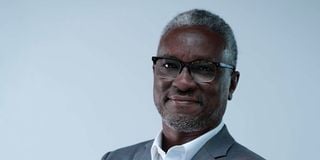
In order to build a thriving company, Ndonye Njoroge has also had to build a life between continents. As the founder of Marathon XP, a design and consulting firm which he started in 2013, he has worked with everyone from scrappy Nairobi startups to Kenya’s largest banks and telcos.
Success has come in various forms, yes, but also with it this feeling that perhaps needs to grow more solid roots after decades spent between the US, Kenya, and now South Africa.
“When you live abroad, you miss that chance to participate fully in family life and friendships. I’d like to come back to that—not politics, just belonging to a community in a deeper way.”
At 55, raising two teenagers while nurturing a company, he is still, in many other ways, putting down roots—choosing to anchor himself not only in the work he does, but in the people he builds with.
How did you end up doing what you’re doing now?
I started out as a consultant after business school in the US, first with a small firm, then at IBM Consulting. Later, I worked at AOL, running a video advertising product.
When my children were very young, my wife and I decided to move back to Africa—either Kenya or South Africa. We chose Kenya, as IBM recruited me to head their East Africa office. That was after nearly 20 years abroad.
I always wanted to run my own business. Back in 2005, I even tried launching an online video company, though it only lasted a year. After two years at IBM in Nairobi, I felt ready to strike out on my own.
The idea was to offer consulting of the same quality I had seen abroad, but for East African companies that often don’t get that attention.
Essentially, a homegrown version of a “Big Four” firm. That’s what I’ve been building since. The vision is still there, even though we’ve adapted along the way. McKinsey, after all, started with just a few people—why not us? It’s been harder than I imagined. I thought two years would be enough to take off, but the journey has been tougher and slower than expected.
What do you think is your true talent?
I think of myself as a builder—someone who takes time to think, plan, and patiently put things together. I’m fascinated not just by outcomes, but by how things get done.
Over time, I’ve realised that the biggest complication in any process is people. They’re complex, and they make everything else more complex. That said, I believe I relate well to people. This has been crucial in building teams.
When did you realise that it is your core talent?
I’ve never thought of myself as an extrovert, but I’ve often found myself in leadership roles. Growing up, I played a lot of sports—basketball in high school, football at university—and often ended up as team captain.
Even in professional settings, I would naturally be asked to take on leadership responsibilities. I didn’t see it as a talent; it just happened.
In 2005, I decided to start a company. I had been working in tech—digital consulting, programming—and saw the rise of online video. Back then, people were emailing funny clips, which felt revolutionary given how slow the internet was.
I became fascinated with the idea of creating online video content for the diaspora: news, entertainment, updates from home.
The vision was to build a distributed global network, starting with Kenya and then expanding country by country. What surprised me was my ability to rally people around the idea.
I spoke to my brother, his friends, my friends—we pooled money, bought equipment, and built a small team. Unlike the leadership roles that came as part of corporate life, this was different.
Outside the structure of a company, I had to persuade people to believe in an idea that had captured my imagination. That experience gave me the confidence to try again later—to believe I could build something from scratch and make it real.
How are things so far?
Honestly, it’s been good. But there’s always that tension of wondering how much more we could do. We’re doing all right, though not as well as last year—and 2023 was exceptional, so it’s been hard to sustain that level of growth. There’s some disappointment and anxiety in that. Still, when I step back, I see how far we’ve come. We now have about 34 to 35 consultants on projects.
For a long time, it was just the two of us in an office with no furniture. Compared to those days, I feel grateful. The business now feels far more stable, and I worry much less about its survival.
What’s the hardest thing about being an expatriate? It feels like living in two worlds. One of the lessons I took from my time in the US was that things never feel settled when you imagine you’ll eventually leave.
When I first arrived there, I thought I’d do my undergrad and graduate school, then return to Kenya and build something amazing.
But in the ’90s, coming back didn’t seem like the best idea. So, I stayed on, doing well, but always with this thought that I’d leave. And when you live like that, you don’t really set roots or build anything lasting.
Even now, with my business mostly in Kenya while I spend time in South Africa, I feel unsettled—always bouncing back and forth. It’s disorienting, and the years slip by faster than you realise. When I say I was away for 20 years, it still shocks me. I have to count the years—1991 to 2011—and every time, it really is two decades gone.
Under what circumstances then do you perhaps find yourself doubtful of yourself?
I’m not always comfortable in new spaces or environments—it takes me a while to settle in. Recently, I joined some executive groups and courses, like Sunny Bindra’s Fast Forward.
At first, it felt awkward being in the same room as CEOs of major East African companies, while I was coming in as someone who had simply started my own business.
The self-doubt didn’t last long, but it was strange to feel that way as a man in my 50s among other men. I didn’t like that it was still a real thing for me.
When have you found yourself in significant forks in the road?
I feel like many of my big decisions have been career-based. During my MBA, for instance, companies like GE and the likes were recruiting, but I found them too traditional.
Instead, I chose a younger consulting firm during the dot-com era—a major fork in the road. Looking back, friends who joined those large corporations often spent 20 years in one or two companies, while my path went in a very different direction.
Another big choice was moving to New York as a young consultant. It wasn’t really for career reasons, but for life and enjoyment. I had a great time, and while moving to a smaller town to settle down would have created a very different life, I don’t regret the decision.
Then there was the family piece. By 2006–2007, when I got married, I realised I couldn’t keep biding my time, waiting for “what’s next.” My wife made it clear—this was home, no more drifting.
Soon after, we had children in Washington DC, and we faced a massive decision: do we stay in the US and raise little Americans, or return to Kenya and raise Kenyan children? What’s remarkable is how that decision felt, even though just a few years earlier I had decided that DC was home.
I had bought a house, and settled in. That shift taught me something: I can change my mind, even on big things. And because of that, I make decisions today with more ease than I used to.
So, what do you want for yourself now as a man?
I think what I want most is to see children into adulthood in a graceful way—to watch them become the adults they’re meant to be, in whatever form that takes. I know that will give me great satisfaction.
After all the moving I’ve done, I’d also like to create something more permanent in Kenya. Not a literal castle, but a place of my own—a base. And with that, to be more present with family and friends, to play that role as an older man rooted in community.
When you live abroad, you miss that chance to participate fully in family life and friendships. I’d like to come back to that—not politics, just belonging to a community in a deeper way.
Is there something you remember tenderly from your childhood?
When I was growing up, my dad was a civil servant posted to embassies throughout the ’70s, so we moved around a lot. In 1974, we were in Addis Ababa, not long after the coup. There was still fighting, and at night we could hear gunfire.
On the way to school, while in the embassy car, we encountered a number of bodies on the roadside. I was only five or six. It’s a dark memory, but it stands out. Of course, there were many happy ones too—but that one has always stayed with me. Other than that, I had an excellent childhood.
How do you want to spend the rest of your 50s? Have your 50s been kind to you?
Apart from the divorce—which, thankfully, was cordial and not too difficult—things have been pretty good. Moving to South Africa was great for the child.
The business also reached a level of stability in my 50s. Of course, I’d like to keep growing it: finding more like-minded people, building strong products with and for our customers.
I still feel there’s a lot I want to do in my 50s. I don’t really think about retirement, but if I think of slowing down, it’s something further out.