Nobody quite knows the rivers from which the talents of men flow. Because as young as Mackinlay Mutsembi can recall, he could always play a musical instrument. He can play the saxophone, trumpet, tuba, trombone, harmonica, horn, and cornet—most of the brass instruments, actually. He can draw, cook, and write. He never had formal training with these instruments; one day he picked up a saxophone and it just felt like an extension of his body.
Early this year, he attempted to set the Guinness World Record for the longest continuous trumpet performance, playing for 24 hours straight at Nairobi’s Geco Cafe. He played over 300 songs spanning genres like jazz, Afro-jazz, R&B, pop, soul, jazz fusion, original compositions, and Kenyan classics. “I did it because nobody had ever done it with a trumpet before.” He said, “The way the trumpet is made. It fights against being played.”
Mackinlay is the founder and director of the Nairobi Horns Project, Afrolect Jazz, and Afrolect Academy—platforms that champion horn-driven sound and nurture young talent. Even though he's thriving as a musician now, this was never something he had always pursued. "Music was purely a business decision,” he reveals, a statement that seems to contradict everything about his natural gifts.
[Note: The current record holder for the longest marathon trumpet performance is Joshua Olusanya from Nigeria, who played continuously for 25 hours].
Why do you think some people, like you, are very good at what they do and how much of it is talent?
The real differentiator is never talent but consistency because anything is possible. Anybody can prepare and run a marathon. But very few people can run 20 marathons. It’s doing something over and over until it tips.
Have you tipped as an artiste?
I’m always working on improving something. That’s why I don't release songs quickly. Two or three years can pass before I put anything out, because by then I feel that my sound has already changed, it no longer represents me. Over time, I’ve had to learn that it’s best to release immediately. Otherwise, the music just piles up.
That’s my biggest struggle. The creative process gets stuck when a song is ready, but I keep thinking: maybe it could be better, maybe it doesn’t reflect me enough. Some works are just part of the journey.
People may not understand why you’d record and not release songs, but it happens. For me, it’s like product design—you go through prototypes before the final version.
Artistically, there’s nothing wrong with the prototypes; art is perception. It’s the tension between consistency and perfection, between art and common sense.
The business side wants speed and efficiency. The artiste in me wants every detail right—even if it’s just about making the blue pop. Balancing those two is tough. I’ve had to learn the art later in life because my roots are in business.
Where did your music come from? Has it always been in your bones?
I’ve played a musical instrument since I was 12. Before coming fully into music, I did other things. I studied linguistics, thought of be coming a journalist, and wrote a lot for newspapers. I then worked in non-profit organisations sector, later with small enterprises, did a bit of tech, and eventually an earned MBA in strategy. I’ve always been very business-driven.
The turning point was realising I could actually make money playing instruments. So, for me, it was a structured, deliberate decision—a business decision. At the time (in 2012), I was working as a programmes director for a non-profit.
I ended up on a tour—though at the time I didn’t really know what that meant. It was called Out of Africa: A Safari Through Magical Kenya. Quite a big deal. You could say the performers were stars, at least for the pop market. The show went to the Netherlands for four months, and they were looking for a trumpeter. They couldn’t find the proficiency they wanted until someone told them, “There’s this guy—he’s not a musician.” That’s how I got in.
You had been playing before?
Yes. I come from Mombasa. I started playing young—not by choice, it was my mother’s decision to keep us out of trouble. I grew up in Kisauni, a tough neighbourhood; drugs, crime, poverty, violence. She was a staunch Christian with the Salvation Army. With two boys in her hands, she knew idle hands meant trouble.
My father was different—creative, not much of a churchgoer. He could have been a writer; he was also a gifted chef. Years later I visited a place he once ran and people told me they hadn’t changed his menu in over 10 years. That’s when I realised how talented he’d been. I think I inherited that spark from him.
So, my brother and I joined the church brass band. Saturdays were for rehearsal, Thursdays too. The moment I picked up an instrument, something shifted. It was like a switch went on—suddenly my ears were open. I’d always drawn, painted, cooked, written—but music became the most consistent thing in my life.
Music also gave me access I’d never known. Growing up disadvantaged, I was literally on “the other side of town.”
Even the idea of eating in a restaurant felt foreign. I still remember the first time I discovered a buffet, that you could have chicken and fish on the same plate—and it wasn’t Christmas! For us, that was luxury.
In Mombasa, we became the provincial brass band, playing at parades and even at the State House for the Provincial Commissioner.
Honestly, we looked forward to national holidays, mostly for the food—they’d feed us like kings. But more than the meals, music gave me an opportunity. It changed my life. From the very first weeks, people could already see: this guy has something. But we all play, my sister is in an all girls brass band.
Why a trumpet? Why not a drum or a guitar? What about a trumpet speaks to you?
The trumpet was always there, in the background. But it wasn’t my first instrument—it was the last. The end of the circle.
In campus, I was deep into saxophone. I’d transcribe Kenny G, note for note. That’s how we build vocabulary in music—you copy, memorise, then make it your own. Notes become phrases, phrases become melodies and the truth is, the songs we love most often have the fewest notes.
At some point I played sax exclusively for five years. But when I got my first job and wanted an instrument of my own, the trumpet was the cheapest option—an old one for $100 (currently Sh12,940), while a sax cost four times more. Instruments come in levels—beginner, intermediate, professional, custom.
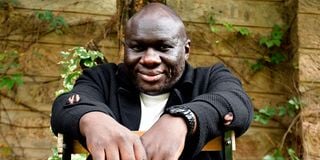
Mackinlay Mutsembi also known as Mackinlay Music poses for a picture after the interview on August 28, 2025.
Photo credit: Francis Nderitu | Nation Media Group
I now own a few professional horns, even a custom worth over $6,000 (Sh775,440). It doesn’t sound better, just costs more. So, the trumpet became my path. Fifteen years of fighting with it. And it’s true: the trumpet fights back. Even after all this time, some instruments I haven’t touched in decades still feel easier to play than the trumpet. That’s just the nature of it—it resists you.
Why did you decide to have a crack at the Guinness World Record?
Part of it was because no one had ever done it on trumpet. The piano record is about five days, guitar close to seven. But the trumpet is different. If you play solidly for even an hour, you’re finished.
It’s an endurance instrument. Many world-class trumpeters have had career-ending lip injuries. That was my biggest fear—if my lips split, I’d be out for months. But I was sure I could do it. And honestly, my aim wasn’t even to set a record—it was simply to play, to see if it could be done.
My preparation wasn’t musical, it was physical. I worked out, built stamina in the gym. Not for trumpet technique, just for endurance.
What insecurities do you have as a musician?
I feel like people have put me on a pedestal now - there’s always some expectation. At this level, you think through things a bit more before you leap.
But as a trumpet player, I still feel insecure. The biggest one is that I didn’t go to school for music. I always wonder if my technique would be better if I had.
There are things I’ve struggled with on my own for years. Sometimes I don’t like how I sound, so I change a few things, then months later I want to sound different. It’s a constant cycle. At the back of my mind, that thought never leaves—that I never trained formally, and I jumped into this career late, even though I jumped at the very top.
I’m 40 now and sometimes I ask myself “Is this the thing I should be doing?” People ask me “what else do you do?” I do entertainment.
The business of entertainment. Now I’m branching into music education. I'm building an academy.
How difficult is it to live off your art?
It is very difficult. I realise that I’m an outlier, but I’ve seen how tough it is. The art industry doesn’t have structures that allow for sustainable earnings. Artistes want to create—that part they know.
But earning from it? That’s a different world. Commercialisation has nothing to do with how good you are as an artiste, and yet that’s the one thing most artistes don’t know how to do. And here in Kenya the structures simply aren’t there.
I was fortunate, I came from a professional background that gave me some leverage, and I’ve been able to move fast. But for many, it’s a struggle. What I keep saying is that we’re now in the golden age of art.
Think of it: there was once a golden age of medicine—suddenly people were finding cures for everything. Then came the golden age of engineering—railways being laid into Africa, roads being built. Now? We’re in that moment for the arts.
What's been your most challenging period as an artiste?
Moving to music from my NGO job 10 years ago. Everyone thought I was crazy. Who quits a six-figure job, moves to a new city just to become a musician? It didn’t make sense to anyone. And my entry wasn’t gradual.
Most people start from the bottom—you play in small places, you hustle your way up. I didn’t. I started at the top. I was already in the office, in New York, around superstars. People assumed I was this big deal, hanging with superstars. And then it ended—and that’s when I hit the reality of music in Kenya. Which I didn’t know before.
I came back to Mombasa, tried to start a band. That was the toughest few months of my life. All these ideas in my head, people thought I was crazy. If you’re not mentally strong, that’s the point you break.
But I had seen it at a very high level, I had seen the vision. Nobody else around me had. And that gap—that was the real challenge. Day to day, you’re moving without a clear plan. You think you have a plan, but the reality is you just have to adjust every single day.
When you're given great talent, I always believe that something also is taken away. What do you think has been taken away?
Sleep. I just don’t sleep. I have never been able to do more than three hours of sleep.